Monthly & Seasonal Forecasts now on ClimateData.ca: Learn what’s new, Explore the map.

Groundhog Day vs. the Seasonal Forecast: What ClimateData.ca Says About Spring 2026

Date February 12, 2026
Author Frances Delaney and Ryan Smith, Canadian Centre for Climate Services
Topics Get Climate Smart, Seasonal to decadal forecasts
Share this post

Groundhog Day vs. the Seasonal Forecast: What ClimateData.ca Says About Spring 2026 

Each February, Canadians look to their favourite sleepy rodents for a hint about when spring might arrive. According to the Groundhog Day tradition, if a groundhog sees their shadow, there will be six more weeks of winter; if they don’t, it will be an early spring.  

In 2026, several well-known groundhogs across the country had different predictions for spring. For example, Ontario’s Wiarton Willie and Quebec’s Fred la marmotte are predicting an early spring, while Vancouver Island’s Van Island Violet and Alberta’s Balzac Billy are predicting a later spring. 

But can we trust these groundhog shadows? 

Let’s see what the seasonal forecasters say about what is likely to happen this spring.

Example blue block.

What the Seasonal Outlook Shows

The seasonal forecasts available on ClimateData.ca are produced by Environment and Climate Change Canada and are updated monthly. Seasonal forecasts show how climate conditions over the next three months are likely to compare with the past, indicating the probability of above-, near-, or below-normal temperature and precipitation. 

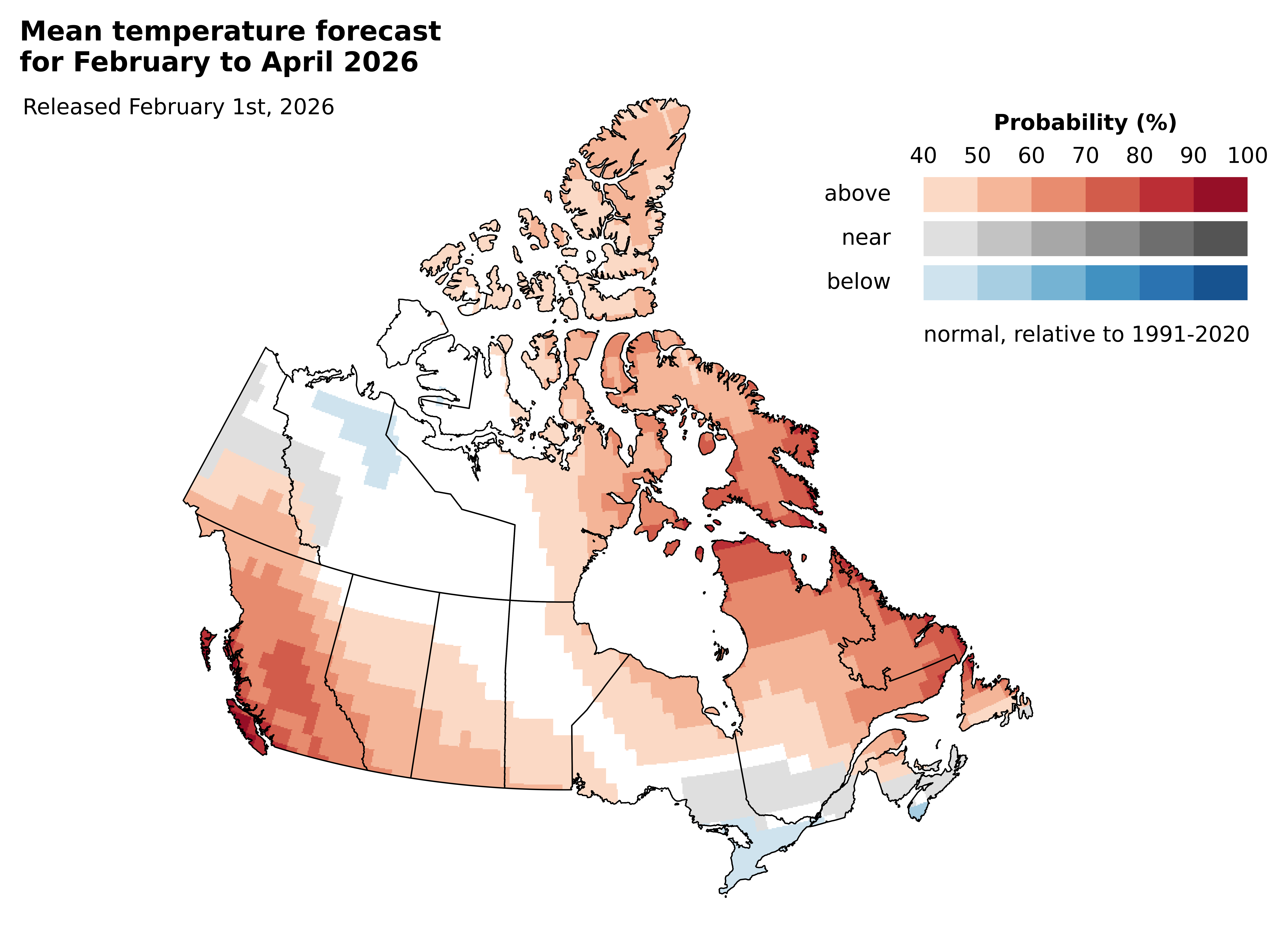
For February to April 2026, temperature forecasts suggest: 

  • Warmer-than-normal conditions are more likely than not in British Columbia, southern Yukon, southern Alberta, Saskatchewan, and Manitoba, parts of Northern and Western Ontario, large areas of Quebec, most of Nunavut, and much of Atlantic Canada. 
  • Near-normal temperatures are more likely in parts of central and Eastern Ontario, southwestern Quebec, central Yukon, and most of Nova Scotia.  
  • Below-normal temperatures are more likely in southern Ontario, southwestern Nova Scotia, and northern Yukon and Northwest Territories.  

These forecasts help us gauge whether conditions are leaning more toward a late spring or an extended winter, rather than giving a black-and-white prediction. They estimate how average conditions over a season are likely to compare with ‘normal’ (i.e., the 1991-2020 mean conditions for that same season).  

Check out the map, and zoom in to your location here: Explore Maps – ClimateData.ca.  

So which groundhogs align with the seasonal forecasts? 

Early Spring: 

Do the seasonal forecasts align with the groundhog?Link to groundhog news articleWhy the seasonal forecasts do or don’t alignSkill level*
❌ NoNova Scotia’s Shubenacadie Sam did not see her shadow, predicting an early springThe seasonal forecast for southern Nova Scotia where Shubenacadie Sam lives shows only a 32% chance of above normal temperatures, making an early spring unlikely.Medium Skill ⭐⭐
✅ YesQuebec’s Fred la marmotte predicts an early springMuch of northern and eastern Quebec is likely to experience above normal temperatures. Fred la marmotte is located in Percé, Quebec, where there is a 63% chance of February to April seasonal temperatures being above normal.Medium Skill ⭐⭐
❌ NoOntario’s Wiarton Willie predicts an early springAlthough above normal temperatures are more likely than not in parts of Northern Ontario, Wiarton, ON has only a 20% chance of February to April being warmer than normal.Medium Skill ⭐⭐
✅ YesOkanagan Okie predicts an early springMost of British Columbia is expected to experience above normal temperatures, and in the Okanagan Valley, there is a 70% chance that the average temperature over February to April will be above normal.Medium Skill ⭐⭐

*Click here to learn what skill meansConsidering Uncertainty in Seasonal Forecasts – ClimateData.ca. 

Late Spring: 

Do the seasonal forecasts align with the groundhog?Link to groundhog news articleWhy the seasonal forecasts do or don’t alignSkill level*
❌ NoVan Island Violet is predicting six more weeks of winter. In coastal British Columbia and on Vancouver Island, above-normal temperatures are likely to very likely. In Nanaimo, BC, there is a 74% chance that February to April will be warmer than normal, and only a 3% chance that it will be cooler! 

High Skill

⭐⭐⭐

❌ NoAlberta’s Balzac Billy, otherwise known as the “Prairie Prognosticator”, predicted six more weeks of winter Much of southern Alberta is most likely to experience above normal temperatures, and in Calgary, where Balzac Billy resides, there is a 58% chance that February to April seasonal temperatures will be above normal. 

Medium Skill 

⭐⭐ 


❌ NoManitoba Merv predicts six more weeks of winter. North of Winnipeg, where Manitoba Merv lives, there is a 45% chance that February to April seasonal temperatures will be above normal, and only a 19% chance that they will be below normal, making six more weeks of winter unlikely. 

Medium Skill

⭐⭐

*Click here to learn what skill meansConsidering Uncertainty in Seasonal Forecasts – ClimateData.ca. 

Exploring Seasonal Forecasts on ClimateData.ca 

On ClimateData.ca, you can access the latest seasonal outlooks alongside historical climate data and long-term projections. The platform allows you to: 

  • Check the forecasts for your location, using the zoomable map interface you are already familiar with from other ClimateData.ca products.  
  • Compare seasonal forecasts with historical data and future climate projections, to support decision-making based on information across multiple time horizons-from the 1950s to the end of the century.  
  • Access clear explanations and supporting guidance, including Learning Zone content, blogs, FAQs, and additional resources. 
  • Download monthly and seasonal forecasts in consistent formats, making it easier to bring these forecasts into existing workflows, analyses, and reports. 

These tools support planning in sectors such as agriculture, infrastructure, emergency management, and public health. Read more here: New and Noteworthy: Monthly and Seasonal Forecasts now on ClimateData.ca – ClimateData.ca. 


From Folklore to Forecasts – No shadow of a doubt that seasonal forecasts tell a clearer story 

Groundhog Day will always be a fun way to talk about the season ahead – and has long been a way for cities and towns across the country to gather, create community, and have something to look forward to. For practical decision-making, however, seasonal forecasts allow you to “step out of the shadows” and get into the data, providing you with a more complete and scientific picture of likely spring conditions. So enjoy the folklore, and then check the outlook before you put the shovel away.