Canada’s Changing Climate Report 2026: The latest science supported by data

Date September 4, 2026
Author ClimateData.ca
Topics New and Noteworthy
Share this post

Introducing CCCR 2026 

Canada’s Changing Climate Report (CCCR) 2026 is an updated synthesis and assessment of the latest knowledge and data about past, near-term, and future climate change in Canada. CCCR 2026 draws on the latest science published since the release of CCCR 2019.  

It includes an updated assessment of observed climate trends alongside projections of future change, using enhanced observational datasets and the latest generation of climate models. The report assesses changes across key components of the climate system, including changes in temperature, precipitation, extremes, freshwater systems, oceans, cryosphere and the carbon cycle, providing a strong evidence base for understanding both past and future climate conditions. 

“ Canada has warmed over the past 75 years due to emissions of greenhouse gases from human activities. Over this period Canada has warmed by 2.0°C and Canada’s North has warmed by 2.6°C.  Warming temperatures have driven wide-ranging, interconnected, and sustained changes across Canada.” – Headline Statement 1 & 4, Canada’s Changing Climate Report 2026, Report Summary 

As Canada’s authoritative assessment of climate change, the CCCR 2026 report establishes the scientific foundation for understanding climate risks. ClimateData.ca complements this by providing access to data and tools needed to support adaptation and decision-making, helping to bridge the gap between science and practice.  
 

What’s new in CCCR 2026? 

CCCR 2026 builds on the 2019 report with expanded topic coverage, new scientific evidence, and a structure designed to better serve a range of audiences, from high-level users to technical practitioners. The report’s overall findings are distilled into a set of headline statements that tell a concise story about past and future climate change in Canada.  These headline statements are supported by carefully assessed key messages that provide more detail about observed and projected climate trends in Canada and about how confident scientists are in these changes. New to this edition of CCCR are overviews of past and future changes in climate in Canada in chapters 2 and 3 of the report, which draw on the detailed assessments throughout the report. 

The report reflects advances in climate science, incorporating enhanced observational datasets, stronger evidence linking observed changes to human influence, and new approaches for narrowing the range of long-term projected warming under different emissions scenarios.  

New topics have been added, including climate extremes, marine heatwaves, changes in processes and phenomena in the atmosphere and ocean that influence regional changes in Canadian climate, the carbon cycle, and guidance on how to apply climate information in local and regional adaptation contexts. The CCCR also includes Indigenous science. First Nations, Inuit, and Métis place-based case stories are included throughout the report based on Indigenous observations and perspectives on climate change, providing complementary knowledge alongside Western scientific evidence (e.g., Box 1). 

Box 1: Case Stories of Indigenous Science One of the case stories highlighting Indigenous science, A Lifetime of Climate Change in the Arctic, shares the observations of Inuit Elder Paul Emingak and his connection to the land. Over the course of Paul’s life, his observations and experiences with the rhythms of the seasons begin to shift from predictable to unpredictable. He speaks about the delay and change in amount of snowfall in the fall, the unpredictability of freeze-up for snowmobile travel, the loss of caribou, and the impact these changes have on traditional ways of life. 

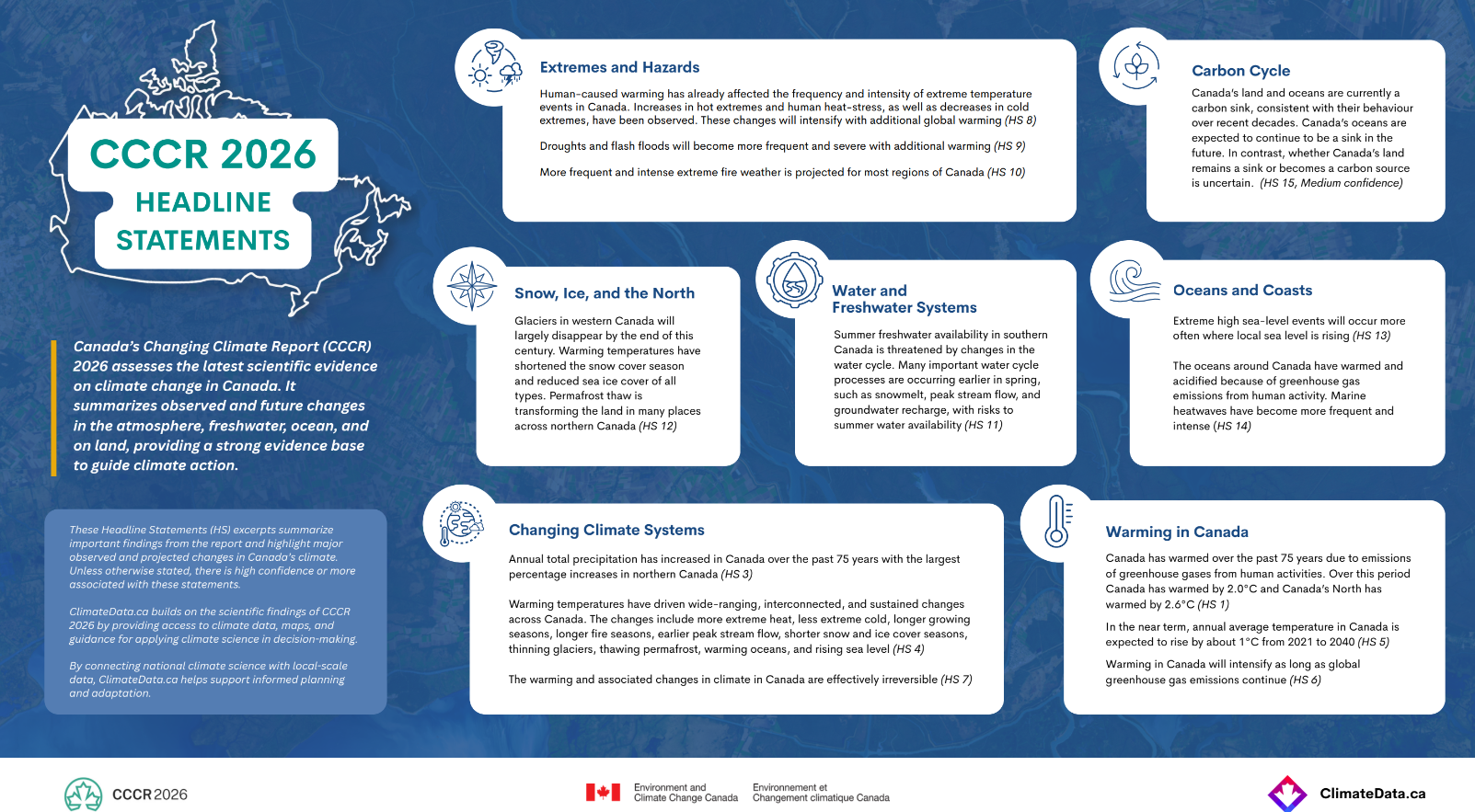
CCCR 2026 Headline Statements 

At the core of CCCR 2026 are Headline Statements that synthesize the most important observed and projected climate trends in Canada. Grounded in high scientific confidence, these statements are supported by detailed evidence throughout the report. 

Download this graphic as a PDF.

Read the full set of Headline Statements 

CCCR 2026 and ClimateData.ca 

CCCR 2026 provides the scientific foundation for understanding Canada’s current and future climate and climate driven hazards. It is designed to help users understand how the climate has changed and is projected to change, and how those changes might drive impacts and risks. ClimateData.ca compliments this foundation by providing locally relevant data and tools that support analysis at the regional and community scale, enabling climate risk and vulnerability assessments and informing decision-making. 

ClimateData.ca provides climate datasets, tools, and guidance for readers of CCCR 2026 who want to explore the data further. Users can view historical and projected climate data on interactive maps, learn about key climate concepts in the Learning Zone, and analyze or download customized subsets of data. Together, these tools build on the information presented in CCCR 2026 and help readers apply the report’s findings to their own context. 

For a full interactive walkthrough of ClimateData.ca, feel free to consult and share our Self-Guided Tour 


Continue Your Resilience Journey 

Understanding climate data is a critical step toward action, CCCR 2026 carefully assesses how Canada’s climate is projected to change and ClimateData.ca enables users to explore these changes through data at the regional and local scale. Together, they support informed decisions that build resilience to a changing climate. To get started, read the report, explore data relevant to your region, and follow along with additional ClimateData.ca content on CCCR 2026.