Introducing Canada’s Climate Service Providers

Date September 11, 2026
Author Martin Payette, Ouranos
Topics Get Climate Smart
Share this post

Introduction

Climate change forces us to rethink how we plan for the future. In the past, activities such as road work, seasonal operations, and crop production could be planned based on historical climate patterns. Today, those patterns are shifting, and the assumption that past climate conditions are a proxy for the future no longer holds. Adapting to a changing climate means adjusting to new and constantly evolving conditions.

Future climate projections describe how climate conditions may change under different emissions scenarios. They help governments, communities and professionals look beyond historical climate patterns when assessing risks and planning practical adaptation measures. However, selecting and interpreting the right information for a particular decision can be complex. Climate service providers help bridge this gap by connecting users with relevant data, tools, expertise and guidance.

This article explores how climate service providers support informed decision-making and help communities navigate the path to greater climate resilience.

Defining climate services

Climate services provide scientifically credible data, information and guidance to support climate-informed decision-making.[1-3] They serve a wide range of users, including elected officials, policy analysts, sector practitioners, engineers, farmers, urban planners, researchers, government agencies and members of the public.[4,5]

A few examples of climate services include[6]:

  • Access to historical and future climate data
  • Training and guidance on interpreting and using data and climate change information
  • Support for building adaptation approaches and strategies and understanding and managing risks
  • Knowledge transfer of complex climate-related subjects for different audiences
  • Collaboration with experts in various fields

Climate services are distinct from weather forecasting services. Weather forecasts describe expected conditions over the coming hours, days or weeks, whereas climate services generally examine longer-term patterns and changes over periods of several decades. Some organizations provide both types of services, as well as seasonal and decadal predictions, to support decisions across the timescales relevant to their users.[7]

Who provides climate services in Canada?

In Canada, climate services are provided by a network of national and regional organizations. Regional climate service providers offer information, tools and guidance tailored to the needs of their regions, while working collaboratively with national coordination and support from the Canadian Centre for Climate Services (CCCS).  Established in 2018, the CCCS helps people across the country prepare for climate change and now plays an important role in enabling the National Adaptation Strategy (NAS).[10] Among the network of regional organizations, Ouranos is the longest standing with 25 years of experience, while the newest, ORCCA, was created in 2023.

Table 1: The five regional climate service providers supported by CCCS[11]

Name (date of establishment)Function
Ouranos(2001)
  • Produce locally relevant historical and future climate data.
  • Coordinate climate adaptation research, planning and collaboration to support decision-making in Québec.
  • Strengthen user capacity through training and knowledge transfer.
Pacific Climate Impacts Consortium (PCIC)(2005)
  • Produce locally relevant historical and future climate data.
  • Develop downscaled hydrology projections for regions across British Columbia.
  • Support the use of climate data in long-term planning through engagement, guidance and training.
ClimateWest*(2021)
  • Support municipalities, Indigenous communities, organizations and businesses in Alberta, Saskatchewan and Manitoba to understand and prepare for climate change hazards and opportunities.
  • Provide assistance in locating accurate climate data, understanding its implications and integrating the data into decision-making.
  • Facilitate collaboration and provide opportunities to share knowledge, make connections and work together to build climate resilience in the Prairie provinces.
  • Increase knowledge and capacity to adapt to a changing climate by sharing funding opportunities and providing training videos, webinars, workshops and an annual forum.
CLIMAtlantic(2021)
  • Support people and organizations in Atlantic Canada in accessing and using climate data and information.
  • Support risk assessment and management, as well as adaptation approaches.
  • Develop tools, training, resources and programs to strengthen region-specific adaptation capacity.
  • Facilitate collaboration and knowledge exchange through communities of practice and engagement activities.
  • Strengthen user capacity through training and knowledge transfer, including the Climate Adaptation and Resilience Training program and Community Resilience Program.
Ontario Resource Centre for Climate Adaptation (ORCCA)(2023)
  • Support users across Ontario in accessing and applying climate information.
  • Provide adaptation planning and implementation support.
  • Develop tools, training and resources to strengthen adaptation capacity.
  • Facilitate collaboration and knowledge exchange.

*ClimateWest was originally founded by three partners – the International Institute for Sustainable Development, the Prairie Adaptation Research Collaborative, and the Prairie Climate Centre – who played a significant role in establishing the organisation. The Prairie Climate Centre continues to provide climate services in the region including support for climate change risk assessments and adaptation planning.

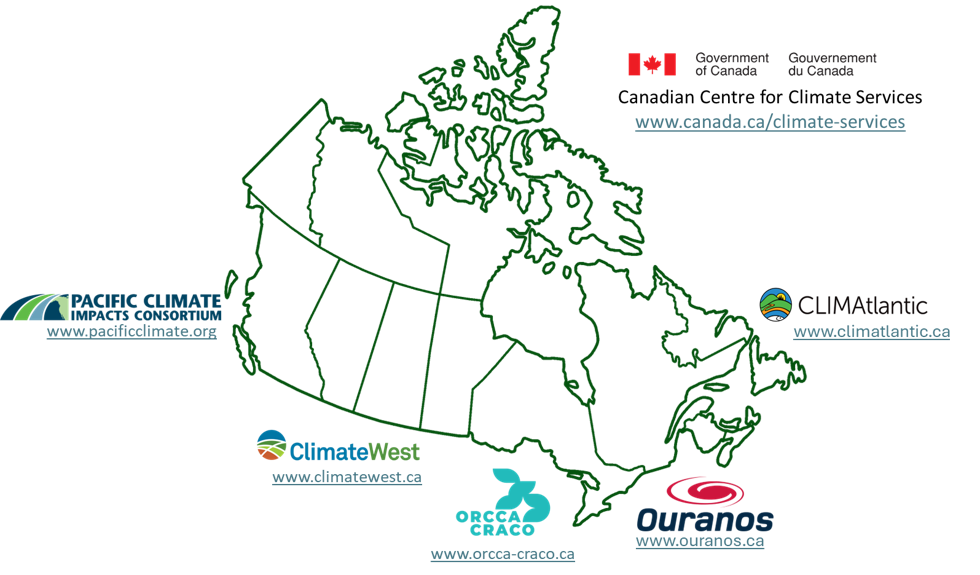
All of these regional providers function independently, with mandates focused on the specific needs of each of their regions. PCIC and Ouranos specialize in climate research and modeling for their respective regions while also offering expertise in adaptation coordination to support the use of climate information for more effective planning and decision making. CLIMAtlantic, ClimateWest and ORCCA each support adaptation as well for their areas of operation, while facilitating access to regionally relevant climate information through the ClimateData.ca portal.

Figure title: Climate service providers supported by the CCCS in Canada

Together, these organizations help the CCCS fulfill its mandate to help Canadians increase their resilience to climate change. Part of this mandate includes contributing to the development of the ClimateData.ca portal. The partnership also promotes adaptation and ensures consistent messaging across the country through various trainings and conferences and supports Ouranos’ PAVICS virtual laboratory, which serves more advanced users of climate data. By pooling resources and expertise from multiple organizations, these climate service providers—and ultimately their users—benefit from a broader, more comprehensive network of climate science and adaptation knowledge.

What about northern Canada?

The unique governance structures, lack of regional climate service providers and capacity constraints in northern regions require tailored solutions that leverage rather than duplicate capacity available in other jurisdictions and climate services organizations.Since 2023, the CCCS has been evolving its role in delivering regional climate services in the North to keep pace with growing demand and operating context. The focus has been on increasing partnerships and responsiveness to the needs and priorities of northerners, as well as aligning with the Government of Canada’s Adaptation Action Plan. The CCCS is working to increase the number of northern climate data products available on ClimateData.ca, and improve the regional relevance of the services it provides to northerners in collaboration with Crown-Indigenous Relations and Northern Affairs Canada (CIRNAC), territorial governments, Indigenous organizations, and regional climate service providers that provide data and adaptation supports to parts of the North. For an example of this work, see the following case study: Eeyou Istchee Coastal Climate Change Adaptation and Environmental Emergency Preparedness Workshop

The five regional organizations also provide the services listed in Table 1 to the following northern areas of Canada:

  • Nunavik and James Bay (Ouranos)
  • Labrador (CLIMAtlantic)
  • Yukon (PCIC)
  • Northern Prairies (ClimateWest)
  • Northern Ontario (ORCCA)

Climate services are shaped by capacity, mandate and user needs

Organizations that provide climate services are not all the same. The products and services offered can range from climate data products to adaptation-focused services. They also differ in the level of knowledge transfer, communications and engagement that they do. It all depends on their mandate and the needs of their audiences.

Some climate service providers focus more on providing climate data.[3] They may develop climate projections tailored to the needs of a specific region or activity sector. Their scientific expertise is made available to users and they may also be involved with the larger scientific community to contribute to overall knowledge on climate change.

Other organizations that offer mainly adaptation services are more focused on how climate projections can be used to inform decision-making and increase resilience. They support, guide and train users in how to use tailored data products. This support is provided at different levels, such as during the co-development and implementation of adaptation plans, climate risk assessments, and in monitoring and evaluation phases.[8,9] Support can also include developing effective climate communication tools or  helping organizations find funding opportunities for adaptation projects.

Most importantly, climate services adapt to the geographical, demographic, and cultural realities of their users. Climate data and adaptation guidance are shaped by location-specific factors such as regional climate hazards, community capacity and resources, governance structures, and culturally-rooted ways of understanding and responding to climate risk. Grounding climate services in the lived experiences and priorities of their users ensures that they are not only scientifically robust, but also relevant, accessible, and practical.

Learn more about how climate information can be applied in decision-making

Hazard Information in CCCR 2026 and ClimateData.ca: Bridging the Gap Between Science and Practice

Conclusion

Thanks to a collaborative network of regional providers working to support ClimateData.ca, Canadians can access knowledge and expertise from a large pool of experts to help make more informed decisions.

Climate services aren’t just about data; they’re about supporting and empowering people. By fostering collaboration, building capacity, and grounding decisions in science on one side and lived experience on the other, climate service providers help communities move from awareness to action. Their continued evolution and cooperation will be essential as Canada works toward a more resilient, climate‑ready future.

Want to know more about climate service providers?

Read Chapter 10 in Canada’s Changing Climate Report (CCCR) 2026.

The chapter gives an overview of the role of climate service providers in climate change adaptation in Canada. It also describes approaches to interpret and use climate data, while examining effective ways to share and communicate climate-related information.

References

[1]World Meteorological Organization. Climate Services for Supporting Climate Change Adaptation, Supplement to the Technical Guidelines for The National Adaptation Plan Process [Internet]. 2016. Available from: https://unfccc.int/sites/default/files/resource/WMO_Climate_Services_for_Supporting_CCA.pdf

[2]Hewitt C, Mason SJ, Walland D. The Global Framework for Climate Services. 2012;2:831–2.

[3]World Meteorological Organization. Climate Knowledge for Action: A Global Framework for Climate Services – Empowering the Most Vulnerable [Internet]. 2011 [cited 2026 Jan 5]. Report No.: 1065. Available from: https://www.uncclearn.org/resources/library/climate-knowledge-for-action-a-global-framework-for-climate-services-empowering-the-most-vulnerable/

[4]BC Climate Action Secretariat. Climate Change Connections in the B.C. Curriculum: Kindergarten – Grade 3 [Internet]. 2025 [cited 2026 Jan 6]. Available from: https://www.bctf.ca/classroom-resources/details/climate-change-connections-in-the-b.c.-curriculum–kindergarten—grade-3

[5]Vaughan C, Dessai S. Climate services for society: origins, institutional arrangements, and design elements for an evaluation framework. WIREs Climate Change. 2014 Sep;5(5):587–603.

[6]Canada E and CC. Introduction to climate services [Internet]. 2018 [cited 2025 Dec 16]. Available from: https://www.canada.ca/en/environment-climate-change/services/climate-change/canadian-centre-climate-services/basics/introduction.html

[7]Seasonal to Decadal (S2D) Forecasts – ClimateData.ca [Internet]. [cited 2026 Jan 5]. Available from: https://climatedata.ca/seasonal-to-decadal/

[8]Findlater K, Webber S, Kandlikar M, Donner S. Climate services promise better decisions but mainly focus on better data. Nat Clim Chang. 2021 Sep;11(9):731–7.

[9]Hewitt CD, Lowe JA. Toward a European Climate Prediction System. Bulletin of the American Meteorological Society. 2018 Oct 1;99(10):1997–2001.

[10]Canada E and CC. Canadian Centre for Climate Services [Internet]. 2018 [cited 2025 Nov 6]. Available from: https://www.canada.ca/en/environment-climate-change/services/climate-change/canadian-centre-climate-services.html

[11]Regional Partners – ClimateData.ca [Internet]. [cited 2026 Jan 6]. Available from: https://climatedata.ca/about/regional-partners/