2026 likely to be among the four hottest years on record
Environment and Climate Change Canada’s (ECCC) forecast for global temperature indicates the unprecedented warmth of the past three years will continue in 2026
The global temperature forecast from ECCC indicates that 2026 will likely be among the four hottest years on record, comparable to 2023 and 2025, and approaching 2024, the hottest year ever recorded.
ECCC’s Canadian Centre for Climate Modelling and Analysis (CCCma) is forecasting a global mean surface temperature in 2026 of 1.44 ± 0.09 °C above pre-industrial levels (1850-1900). This would put 2026 in the same range as 2023 and 2025, which according to the World Meteorological Organization (WMO) are the second and third hottest years on record to date. The WMO observed value for 2025 (1.44 ± 0.13 °C) closely aligns with ECCC’s prediction for 2025 (to within 0.01 °C).
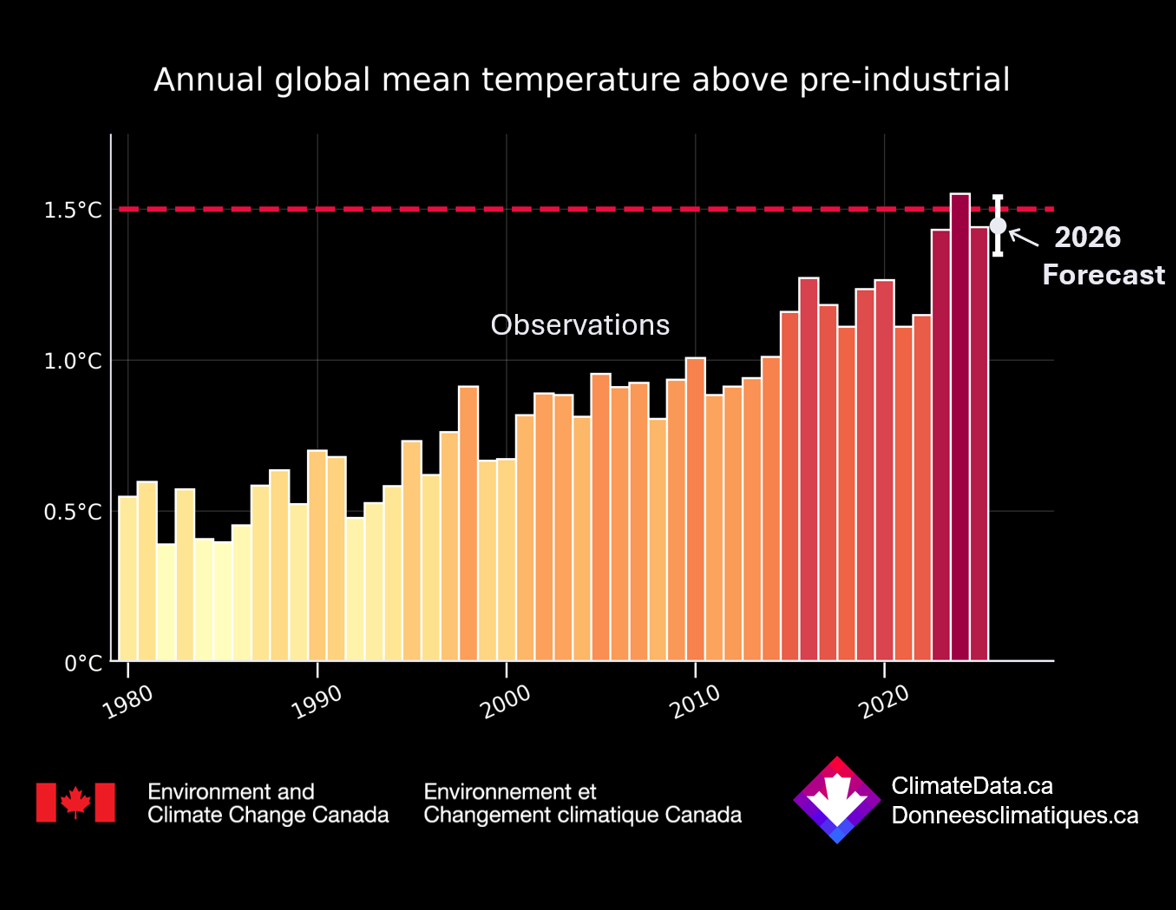
Figure 1: The observed annual global mean temperatures for each year from 1980 to 2025 are shown relative to the pre-industrial global mean temperature (1850-1900, before most human-caused warming occurred) using an updated version of the IPCC AR6 report global mean temperature dataset through 2023 and the WMO’s observed estimates for 2024 and 2025. The central estimate of the temperature forecast for 2026 is shown as a white dot and the 95% confidence interval is shown as white brackets. The actual value is expected to fall within this range 19 times out of 20.
The unprecedented global temperatures over the last few years can be partly attributed to the strong El Niño event in 2023-2024, compounded by ongoing human-induced global warming. Neutral El Niño-Southern Oscillation conditions returned in May 2024, followed by a weak La Niña in December 2024 that cooled the tropical Pacific and moderated global temperatures into 2025. Forecasts suggest a return from weak La Niña conditions to neutral conditions in 2026, possibly followed by an El Niño event later in the year that could lead to record temperatures in 2027.
“La Niña exerts a widespread cooling influence akin to ‘global air conditioning’, whereas El Niño acts like a ‘global furnace’. These effects are the main cause of the ups and downs that punctuate the steady rise in global temperatures. It’s likely that the global temperature record set in 2024 following the last El Niño will be broken the next time an El Niño occurs.”
– ECCC scientist Dr. Bill Merryfield
There is a >99% chance (virtually certain) that 2026 will be hotter than every year on record prior to 2023 though only a 1% chance that it will break 2024’s record high temperature of 1.55 °C. 2026 is also set to be the 13th consecutive year in which temperatures reach at least 1.0 °C above pre-industrial levels, with a 12% chance of exceeding the 1.5 °C Paris Agreement target.
Note that exceeding 1.5 °C above the pre-industrial global mean temperature in a single year does not constitute failure to meet the Paris Agreement’s goal, which is defined by the long-term average temperature over multiple decades. However, ECCC’s decadal forecasts indicate that the period from 2026 to 2030 will likely be the hottest five-year period on record. According to Celeste Saulo, Secretary-General of the WMO, “…it will be virtually impossible to limit global warming to 1.5 °C in the next few years without temporarily overshooting the Paris Agreement target.”
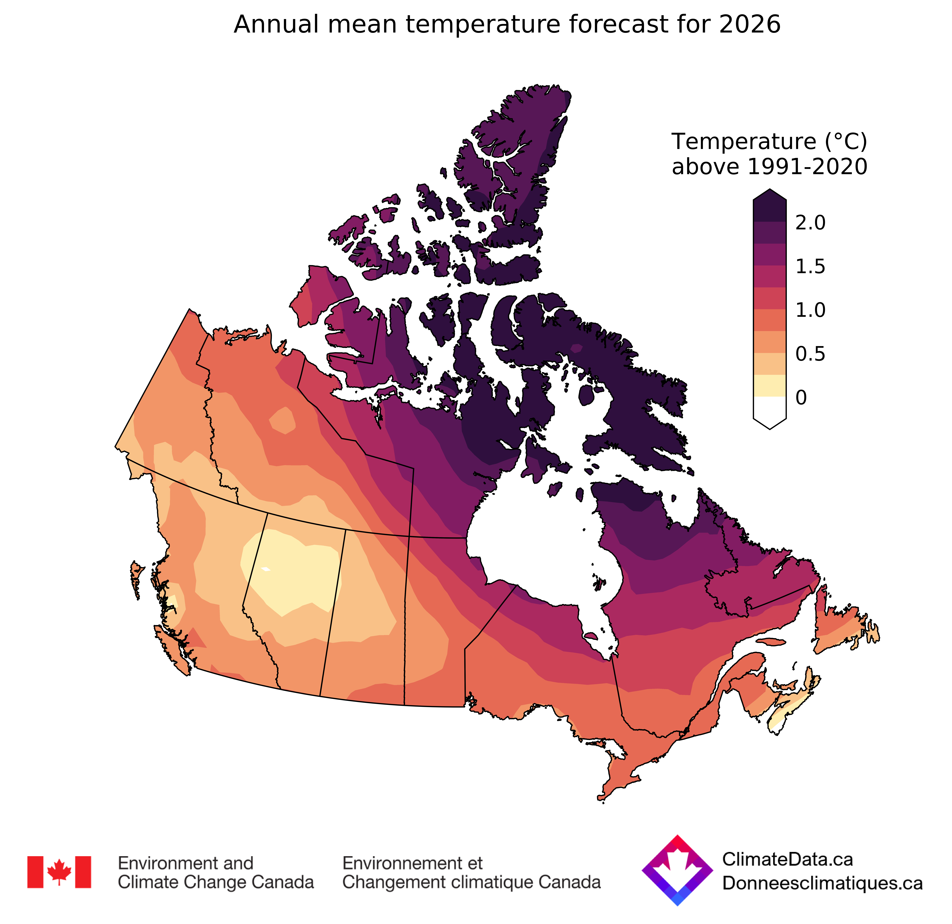
Figure 2: The annual mean temperature forecast for 2026 relative to a 1991 to 2020 baseline across Canada. Darker colours indicate larger temperature differences between the baseline period and the 2026 forecast. The forecast is provided at a spatial resolution of approximately 100 km × 100 km (on a 1 degree × 1 degree grid).
On average, Canada is warming at more than twice the global rate, with Northern regions warming about three times as quickly. These rising temperatures have been accompanied by increasingly extreme heat waves attributed to climate change. Annual mean temperatures relative to a 1991 to 2020 baseline are forecast to exceed 1.0 °C in many parts of the country, and 2.0 °C across much of Canada’s North.
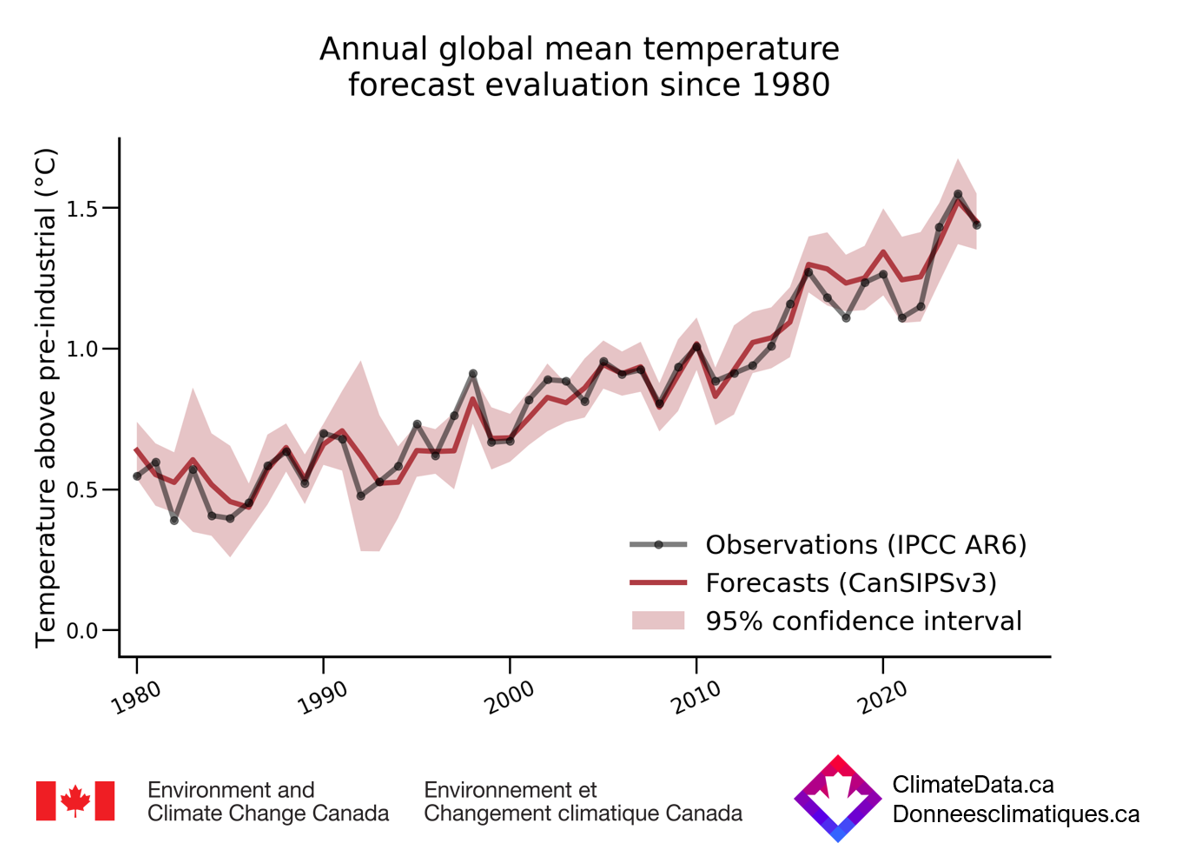 Figure 3: Evaluation of past forecasts of annual global mean temperature produced by CanSIPSv3 for 1980 to 2025. The central estimates of the forecasts are shown in red, with the shaded area indicating the 95% confidence interval. Observed annual global mean temperatures from 1980 to 2025 relative to the pre-industrial mean temperature for 1850-1900 are shown in black, using an updated version of the dataset used in the IPCC AR6 report through 2023 and the WMO estimates for 2024 and 2025.
ECCC’s annual global mean temperature forecast is produced by the CCCma using the Canadian Seasonal to Interannual Prediction System version 3 (CanSIPSv3). These forecasts perform well when compared to observations over recent decades.
Monthly and seasonal forecasts produced using CanSIPSv3 are issued monthly and will become available on ClimateData.ca starting January 26th, 2026.
This project was undertaken with the support of:


