ClimateData.ca has undergone a major redesign to make it easier than ever to find, understand, and use high-quality climate data. Meet the Updated ClimateData.ca.

Climate Change and Salmon in British Columbia

Date November 25, 2025
Author Edward Beard, Pacific Climate Impacts Consortium and David Dick, W̱SÁNEĆ Marine Guardians
Topics Climate Data in Action, Get Climate Smart, West Coast
Share this post

Introduction


Salmon are a vital component of British Columbia (BC)’s ecosystems, cultures, economies, and recreational activities. However, climate change is affecting salmon habitat across the province, compounding the impact of other human-caused stressors on salmon populations.

Written by the Pacific Climate Impacts Consortium (PCIC), utilizing insights from the QENTOL, YEN / W̱SÁNEĆ Marine Guardians Program (Box 1), this blog post describes the importance of salmon in BC, explores the impacts of climate change on Pacific salmon populations, and outlines the climate data and information available to support adaptation and conservation efforts.

Box 1: QENTOL, YEN / W̱SÁNEĆ Marine Guardians Program

The W̱SÁNEĆ Marine Guardians monitor KELŁOLEMEĆEN (killer whales, or orcas) in the Salish Sea. The program combines traditional knowledge of KELŁOLEMEĆEN with modern technology to track orca movements throughout W̱SÁNEĆ Territory. By doing this, the W̱SÁNEĆ Marine Guardians are “compiling a comprehensive dataset of Indigenous science that accurately reflects the marine environment and its effects on Southern Resident Killer Whales” (SRKWs). Using this information, they recommend actions for KELŁOLEMEĆEN conservation, including proposed changes to current regulations to protect the endangered SRKWs.

Because the diet of SRKWs is predominantly chinook (king) salmon, a substantial part of the program involves monitoring salmon habitat and abundance. This work takes place in S,ELE₭TEȽ (Goldstream River), on southern Vancouver Island, where W̱SÁNEĆ people have a long history of harvesting salmon. In this blog post, the W̱SÁNEĆ Marine Guardians have allowed us to reference their insights into this history and their observations. We are grateful for this permission, appreciate their contribution to salmon and KELŁOLEMEĆEN conservation efforts, and recognize the historical relationships Coast Salish people have with the land and water, that continue to this day.

The Importance of Salmon in BC

Salmon have evolved in the Pacific Northwest over millions of years. In BC, there are five species – chinook, sockeye, coho, chum, and pink—and more than 9,000 populations (species and stream combinations) [1]. Although migration pathways and timings vary between different populations, generally all Pacific salmon start their lives in freshwater lakes, rivers, or streams, migrate to the ocean to mature, return to streambeds to lay eggs, and die after reproduction [1]. As a result, Pacific salmon provide essential nutrients to BC’s freshwater, forest, and marine ecosystems, underpinning the region’s unique biodiversity.

Salmon are also deeply intertwined with the history and culture of the region. Many ancestral village sites and First Nations communities in BC are founded on traditional salmon fishing grounds [2]. For example, SÁNEĆ people have harvested salmon in S,ELE₭TEȽ (Goldstream River) for thousands of years and elders explain that smokehouses were built at S,ELE₭TEȽ, where SÁNEĆ would gather salmon, berries, and medicine and come together [3]. Today, salmon remain vital to SÁNEĆ culture and are an important food source. In addition, salmon contribute to BC’s economy through recreational and commercial fisheries and tourism, including wildlife viewing of salmon and interdependent species such as orcas, bears, and eagles [2].

How is climate change impacting Pacific salmon?

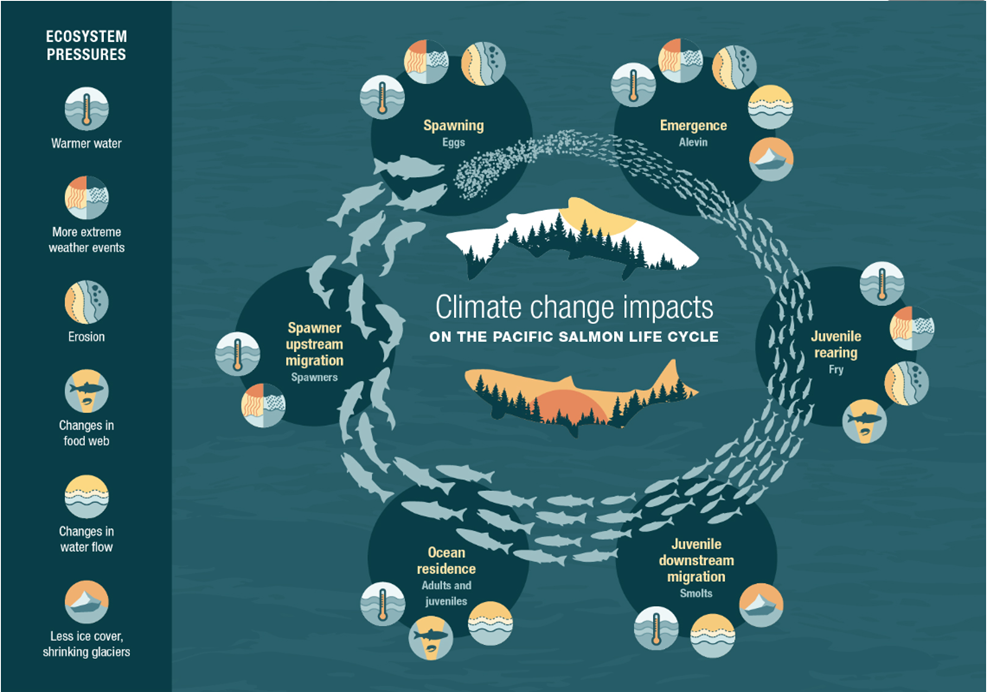
Overall, Pacific salmon are declining in BC and Yukon [4][5]. Industrial development, urbanization, aquaculture, and fisheries are some of the human activities that are negatively impacting Pacific salmon [4]. In addition, anthropogenic climate change is impacting the ecosystems that Pacific salmon depend on at every stage of their life cycle (Figure 1) [5].

Figure 1: Climate change impacts on the Pacific salmon life cycle [1]

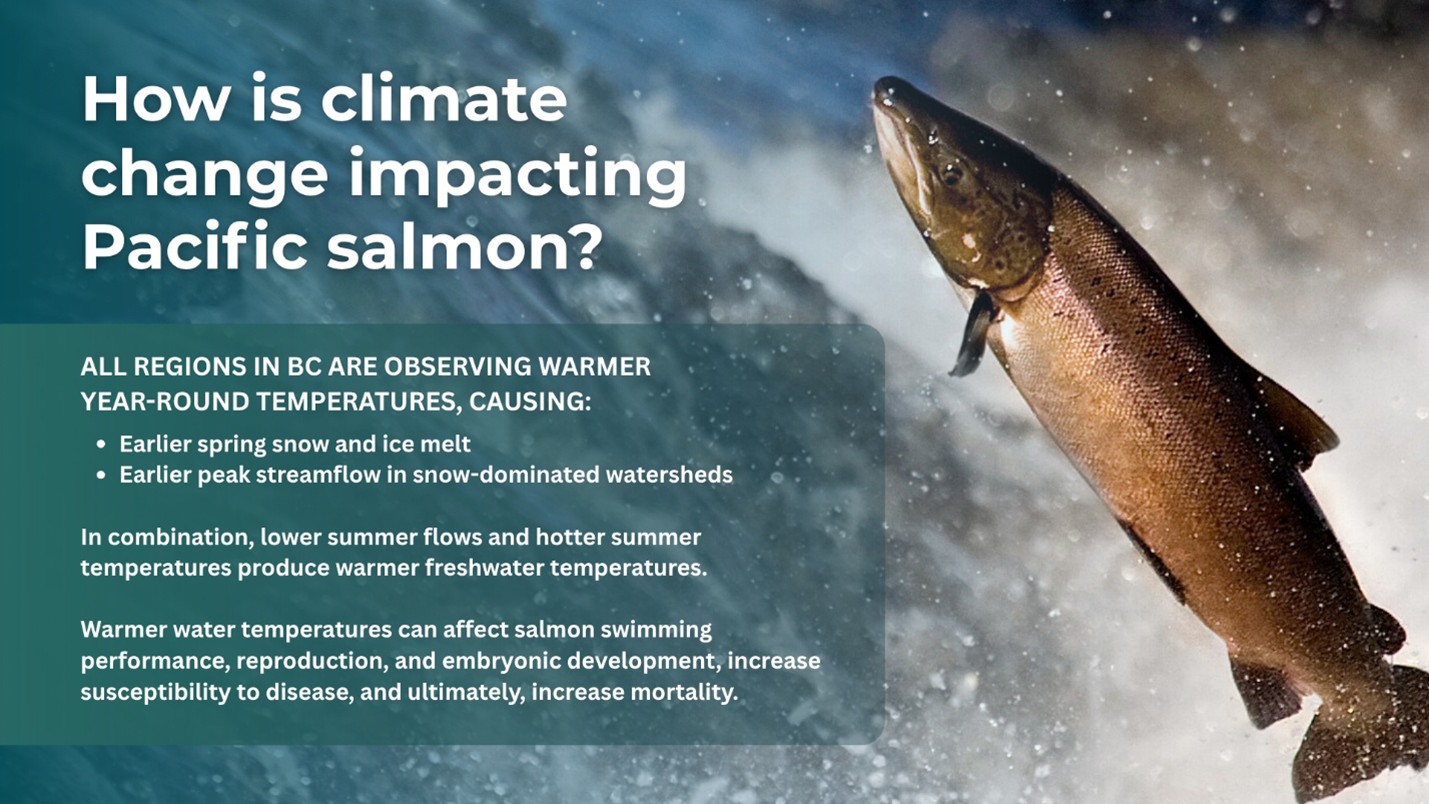
Due to climate change, all regions in BC are observing warmer year-round temperatures. Warmer temperatures are causing earlier spring snow- and ice-melt and earlier peak streamflow in snow-dominated watersheds leading to reduced summer streamflow in some regions [6]. All regions in BC are also observing hotter summer temperatures. Combined with lower summer streamflow, hotter summer temperatures are resulting in warmer freshwater temperatures [7]. Warmer water temperatures can be devastating for Pacific salmon, affecting swimming performance, reproduction, and embryonic development, increasing susceptibility to disease, and ultimately, increasing mortality [3][4][5].

In addition, climate change is impacting North Pacific marine ecosystems, causing increasing temperatures, deoxygenation, acidification, and changes to circulation and vertical mixing [5][8]. These marine impacts are increasing salmon energy demands while interrupting the food webs on which salmon rely, adding to the pressures on their survival [5].

Future climate projections

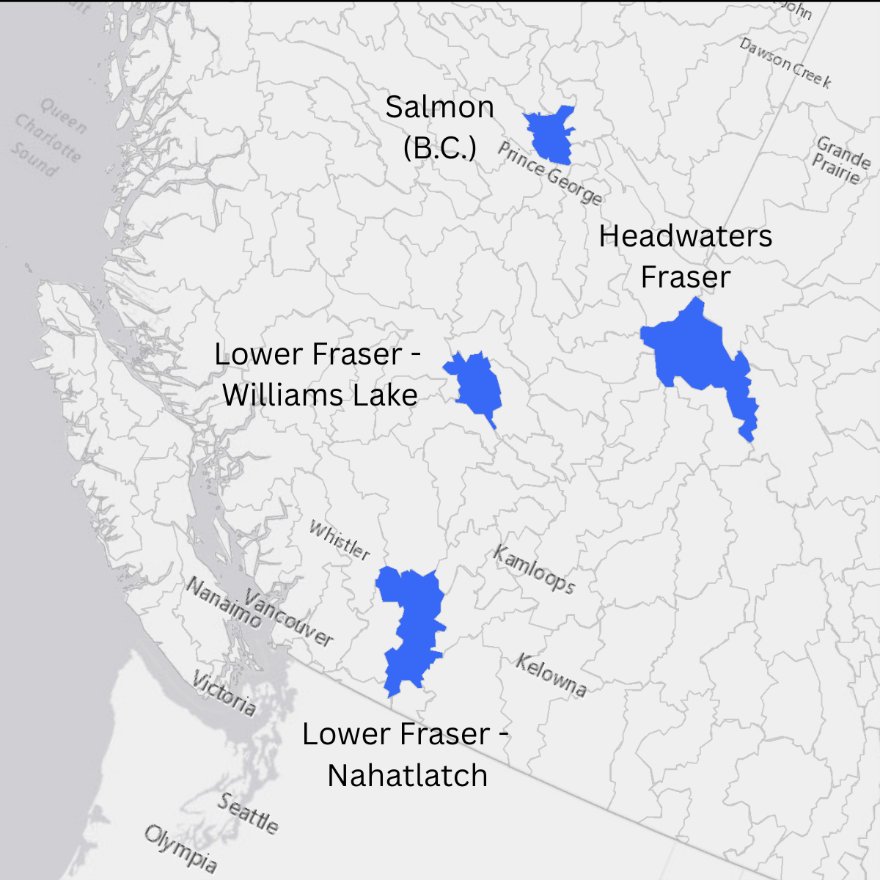
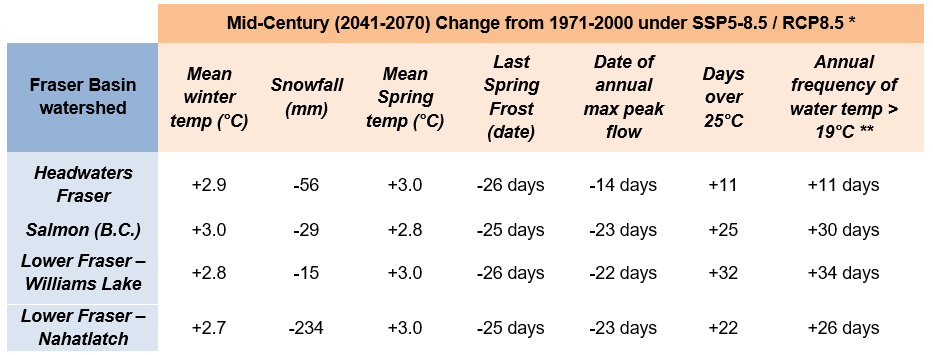
Table 1 outlines projections from ClimateData.ca and the Salmon Climate Impacts Portal (SCIP) for the 2050s (relative to the 1971-2000 period) for four different watersheds in the Fraser River Basin – the largest salmon-bearing basin in BC (Figure 2). The projections are based on a high greenhouse gas emissions scenario (SSP5-8.5 for ClimateData.ca projections and RCP8.5 for SCIP projections*). Between now and 2050, the trajectory of climate projections for different emissions scenarios (e.g., low, medium, and high) are approximately the same.

Figure 2: The four watersheds in the Fraser River Basin for which projections are displayed in Table 1.

Table 1: Projections for the 2050s relative to the 1971-2000 period for four different watersheds throughout the Fraser River Basin. The data for mean winter and spring temperatures, snowfall, the last spring frost, and days over 25°C come from ClimateData.ca and represent the median of 26 climate models. The data for the date of annual peak flow and frequency of water temperature exceeding 19°C** come from PCIC’s SCIP and represent the mean of 6 models. ClimateData.ca projections are based on SSP5-8.5 and SCIP projections are based on RCP8.5*.

SCIP projections are based on RCP8.5 because downscaled CMIP6 projections have not yet been incorporated into this tool. For illustrative purposes in this blog, CMIP6 projections from ClimateData.ca based on SSP5-8.5 and CMIP5 projections from SCIP based on RCP8.5 are comparable because both scenarios apply the same level of radiative forcing and there is substantial overlap in the range of the different projections. However, for more detailed analyses it’s best practice to compare projections from the same phase of modelling that use the same emissions scenarios.

** On the SCIP 19°C was selected as a representative average temperature for impacts on salmon at various different life stages. 19°C also tends to be the upper range of salmon’s optimum temperature for aerobic scope, so anything above 19°C can start to detrimentally impact salmon energy levels.

Looking at the ClimateData.ca projections in Table 1, we can see that in all four watersheds winter and spring temperatures are projected to increase by approximately 3°C, snowfall will decrease, the date of the last spring frost will be 3-4 weeks earlier, and there will be more days exceeding 25°C [4]. Looking at the projections from PCIC’s SCIP we can assess the impact of these climatic changes on freshwater conditions.

Firstly, streamflow is projected to peak two weeks earlier in the Headwaters Fraser watershed and around three weeks earlier in the Salmon, Williams Lake, and Nahatlatch watersheds by the 2050s. This is likely due to warmer winter and spring temperatures causing less snowfall, a shorter frost season, and earlier spring snow- and ice-melt. Secondly, a substantial increase in the annual frequency of water temperatures exceeding 19°C is projected by the 2050s, especially in the middle and lower watersheds. This is likely due to the combined impact of earlier peak flow and hotter summer temperatures. The projected increase in freshwater temperature is concerning given the impacts this can have on salmon.

Extreme rainfall can also impact salmon. For example, W̱SÁNEĆ Marine Guardians observed that flooding caused by the November 2021 atmospheric river in BC impacted salmon spawning habitat in S,ELE₭TEȽ [3]. High-resolution (~800m) projections from PCIC’s Climate Projections for the Capital Region report show that by the 2050s (under SSP5-8.5), 1-in-20-year extreme rainfall events in the Capital Regional District will be more intense, with an average of 15 mm of additional rainfall compared to 1981-2010. This projection suggests that the impact of extreme rainfall events on salmon spawning habitat could be even greater in future.

W̱SÁNEĆ Marine Guardians are also concerned about sea level rise accelerating erosion of the saltmarsh habitat in S,ELE₭TEȽ, which is critical habitat for juvenile salmon survival [3]Relative Sea-Level Change projections from ClimateData.ca project 16 cm of relative sea-level rise in the Saanich Inlet by 2050 and 59 cm by 2100 (under SSP5-8.5). These projections, and the projections in Table 1 above, indicate that future climatic changes will place additional stress on Pacific salmon populations, with potential implications for their ecological, cultural, and commercial contributions to life in BC. Local organizations and communities, including the W̱SÁNEĆ Marine Guardians, are monitoring these changes and undertaking work to protect salmon habitat.

Adaptation and conservation

Many organizations and communities in BC are working to protect Pacific salmon from the impacts of climate change. The projections information available via ClimateData.ca and PCIC’s Data Portals and Analysis tools (particularly the hydrologic model output and SCIP) can be used to support these efforts. For example, from 2019 to 2023 PCIC applied climate projections alongside hydrologic modelling to project the effect of climate change on the temperature of the Nechako River and inform how Rio Tinto’s Summer Temperature Management Program (STMP) might be altered in the future to best protect salmon from the impacts of a warming climate (Box 2).

Box 2: Rio Tinto’s Summer Temperature Management Program (STMP) and PCIC projections for the Nechako River

The Nechako River is a tributary of the Fraser River and is valuable habitat for a variety of fish species, including salmon. It is fed from the Nechako Reservoir, held behind the Kenney Dam. To help manage water temperature in the river during the salmon migration period, Rio Tinto – the operator of the reservoir – releases water via the Skins Lake Spillway. This ensures salmon migrating up the river during the summer are not exposed to excessively warm water. Looking ahead, climate change is expected to influence freshwater availability, the timing of peak flows, and water temperatures. To prepare for these changes, Rio Tinto sought information on projected future conditions to inform potential adjustments to reservoir operations.

Using streamflow and water temperature modelling under different emissions scenarios, PCIC provided projections for a variety of indices, including the volume and temperature of reservoir inflow, the timing of water availability, and the probability of outflow temperatures exceeding 20 °C during the STMP period, which corresponds to the sockeye migration period [9]. These projections have informed Rio Tinto’s reservoir release strategies, so that in the future reservoir operations can continue safely while mitigating the impacts of climate change on critical salmon habitat [10].

There is also concern amongst scientists, conservationists, and communities about the increasing pressures on Pacific salmon from wildfires and changes in North Pacific marine ecosystems [1][11]. Both ClimateData.ca’s Fire Weather Projections App and Marine Sector resources are available to support users in understanding how climate change will impact fire weather and the marine environment, and the information can be used to inform conservation efforts. Additional requests for climate data or support can also be submitted to the Climate Services Support Desk.

Finally, it’s important to recognize that First Nations communities and programs such as the QENTOL, YEN / W̱SÁNEĆ Marine Guardians play an important role in salmon conservation. Collaborations that incorporate both Indigenous knowledge and future climate projections can lead to more impactful interventions to protect Pacific salmon and their cultural and ecological significance in BC.

References

[1] Fisheries and Oceans Canada (2021). Canada’s Oceans Now: Pacific Ecosystems, 2021. https://www.dfo-mpo.gc.ca/oceans/publications/soto-rceo/2021/report-rapport-eng.html

[2] Pacific Salmon Foundation and Fraser Basin Council (2011). Backgrounder: Salmon in BC. https://psf.ca/wp-content/uploads/2021/10/Download-PDF216-1.pdf

[3] QENTOL, YEN (2025). Annual Report, 2024-25. https://www.qentolyen.com/annual-reports

[4] Connors, K., Jones, E., Peacock, S., and Belton, K. (2024). State of Salmon 2024 Report. Pacific Salmon Foundation. https://stateofsalmon.psf.ca/

[5] Grant, S.C.H., MacDonald, B.L., Winston, M.L. (2019). State of the Canadian Pacific salmon: Responses to changing climate and habitats. Fisheries and Oceans Canada. https://www.dfo-mpo.gc.ca/species-especes/publications/salmon-saumon/state-etat-2019/abstract-resume-eng.html

[6] Bush, E. and Lemmen, D.S., (editors). (2019). Canada’s Changing Climate Report; Government of Canada. https://changingclimate.ca/CCCR2019/.

[7] White, J. C., Khamis, K., Dugdale, S., Jackson, F. L., Malcolm, I. A., Krause, S., Hannah, D. M. (2023) Drought impacts on river water temperature: A process-based understanding from temperate climates. Hydrological Processes. 37, 10. https://onlinelibrary.wiley.com/doi/10.1002/hyp.14958

[8] Boldt, J.L., Joyce, E., Tucker, S., Gauthier, S., and Dosser, H. (editors). (2024). State of the physical, biological and selected fishery resources of Pacific Canadian marine ecosystems in 2023. Fisheries and Oceans Canada. https://waves-vagues.dfo-mpo.gc.ca/library-bibliotheque/41260879.pdf

[9] Larabi, S., Schnorbus, M. A., & Zwiers, F. W. (2022). A coupled streamflow and water temperature (VIC-RBM-CE-QUAL-W2) model for the Nechako Reservoir. Journal of Hydrology: Regional Studies, 44, 101237. https://hdl.handle.net/1828/21758

[10] Larabi, S., Schnorbus, M. A., & Zwiers, F. W. (2023). Diagnosing the ability of reservoir operations to meet hydropower production and fisheries needs under climate change in a western cordillera drainage basin. Climatic Change, 176(12), 161. https://hdl.handle.net/1828/21790

[11] Pacific Salmon Foundation (2024). Playbook to Guide Landscape Recovery Strategies & Priorities for Salmon Habitat Following Major Wildfires. https://psf.ca/wildfire-playbook/