Putting it all together
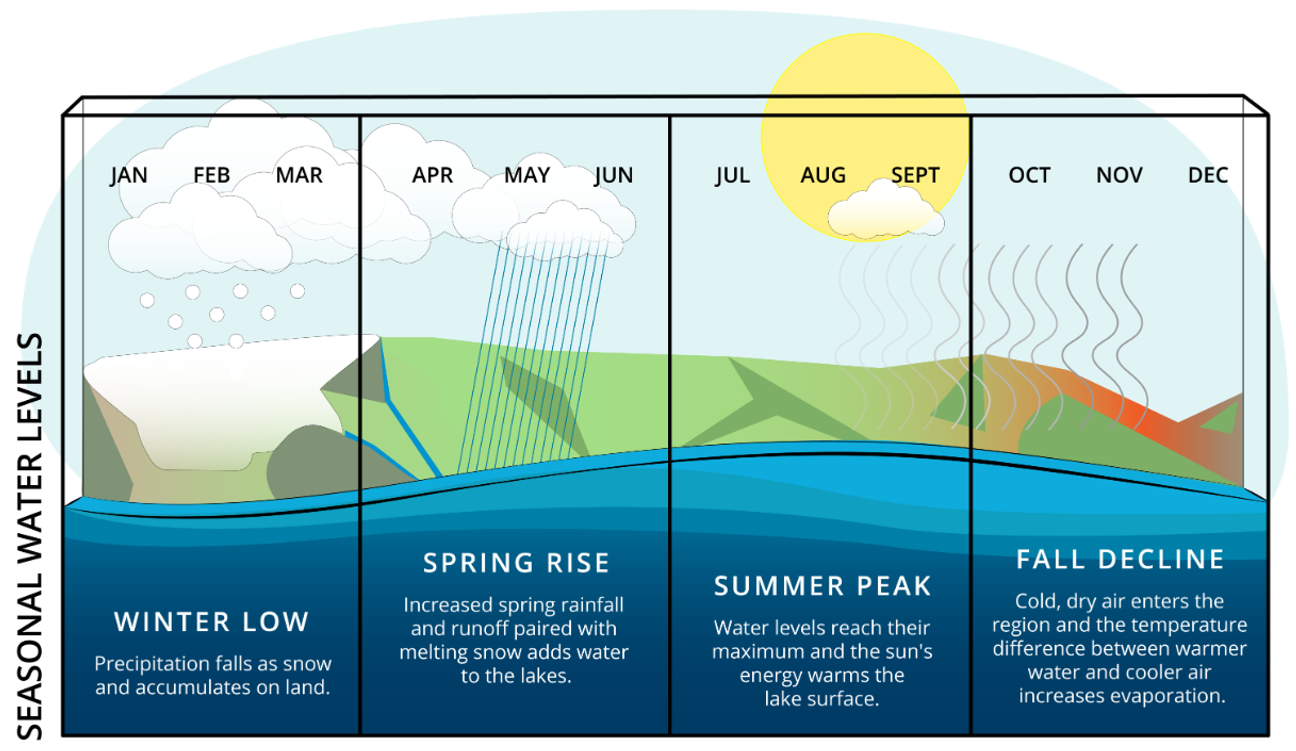
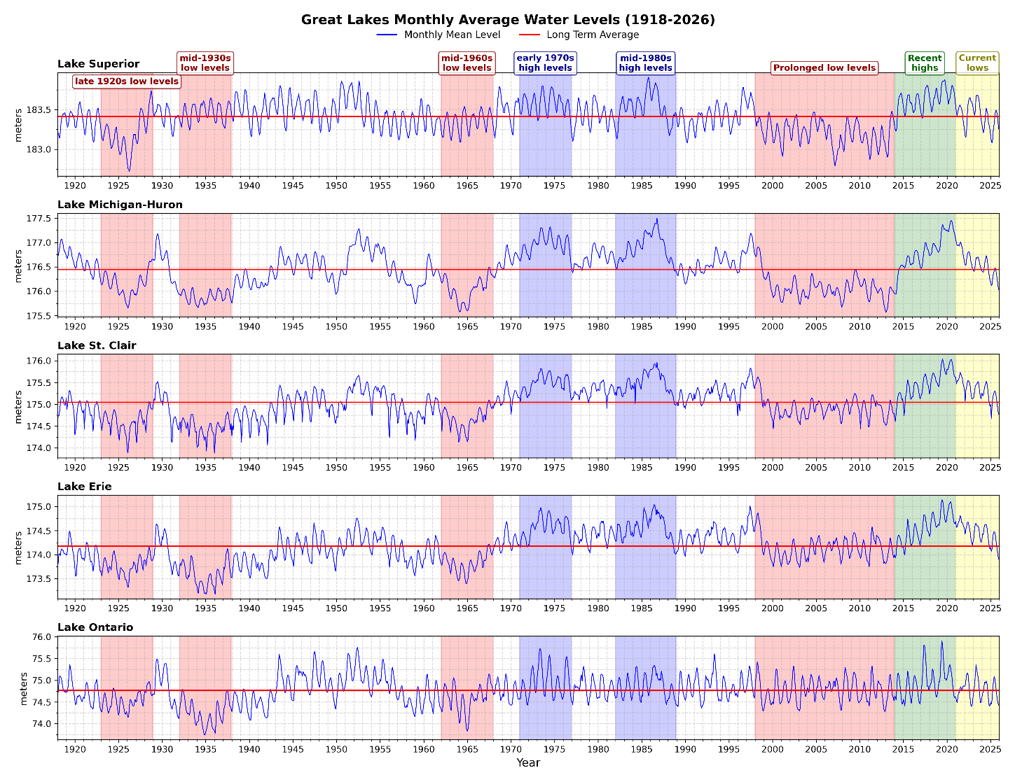
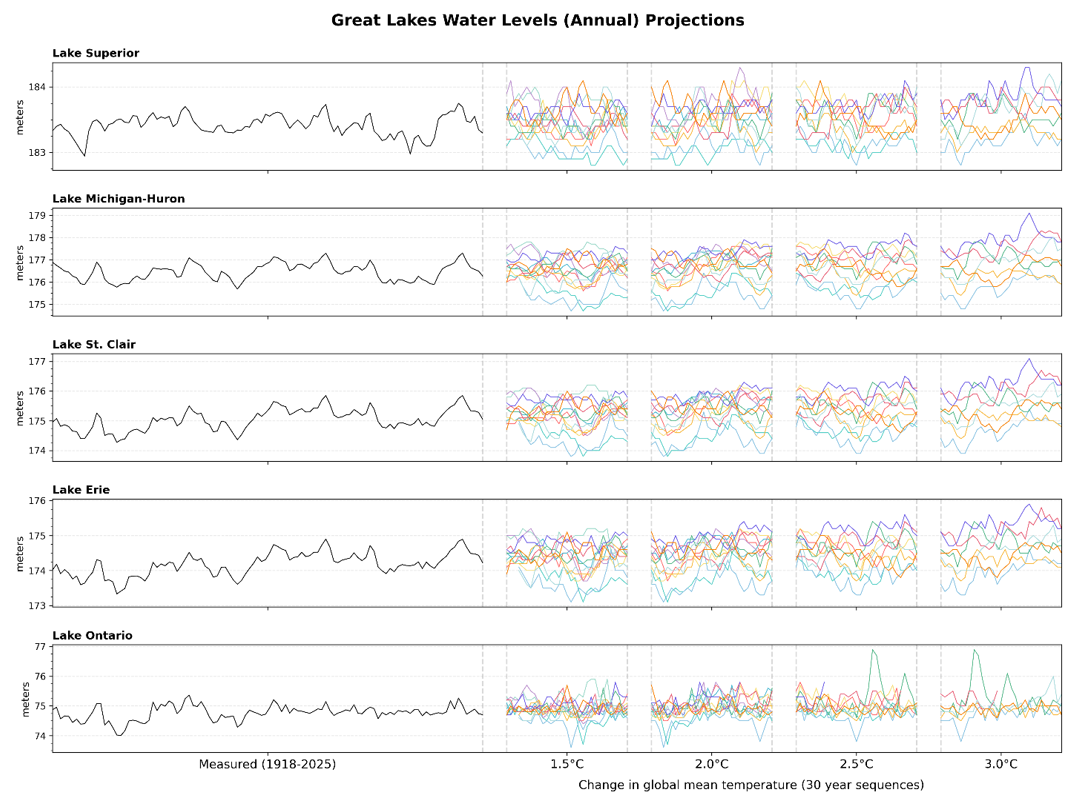
Taken together, the historical record and climate-based projections show that Great Lakes water levels are dynamic, and future conditions are likely to include greater variability and more pronounced extremes. Rather than a consistent long-term rise or fall, research points toward greater variability in water levels, with a higher frequency of extreme highs and lows expected in the future [13], [14]. Higher emissions scenarios amplify this variability, “leading to a wider range of possible water levels and more extreme conditions” [13]. Seasonal patterns may also shift as snowmelt timing, precipitation, and evaporation rates change due to a warming climate, building on observed changes in the timing and amplitude of seasonal water level cycles over the past century [15], [16], [17].
At the same time, it is important to interpret future projections carefully. Great Lakes water level projections share the same broad sources of uncertainty as other climate projections, but they also carry added uncertainty because global climate models operate at spatial resolutions that do not necessarily simulate the local and regional processes that affect Great Lakes water levels. Until recently, most climate models used simplified, one-dimensional (1D) lake models that represent lakes as vertical columns of water, which can introduce biases because these 1D representations do not capture the circulation and mixing processes that occur in the Great Lakes [5], [9], [10]. Early modelling approaches also used one-way coupling between the climate and hydrological models, missing important lake–atmosphere feedback; more recent studies [5], [9] using three-dimensional lake models with two-way coupling have reduced some of these biases.
Although there is uncertainty in long-term future projections of water levels in the Great Lakes, projections should still be considered alongside the historical record of water levels to support planning and adaptation. For example, projections suggest that future water levels will be more variable [13], [14].
Conclusion
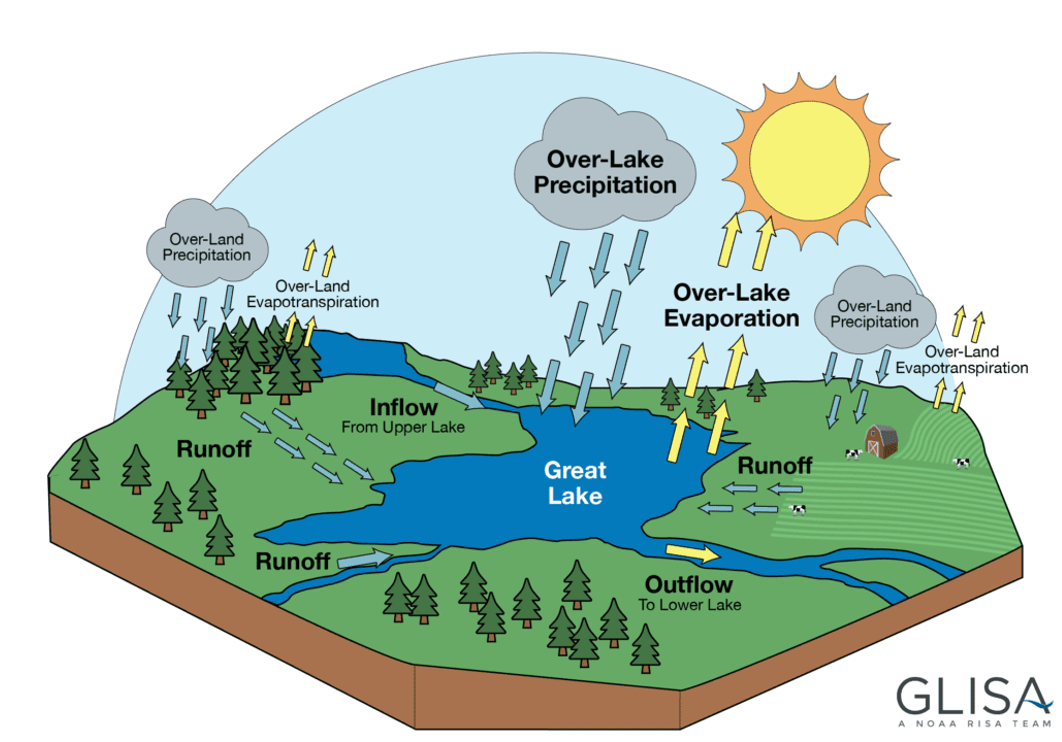
Great Lakes water levels matter because they impact human activities, infrastructure, and ecology in the basin – from shipping and hydropower to shoreline infrastructure, recreation, and wetlands. This article describes the factors influencing lake levels, including the balance between precipitation, runoff, and evaporation. At the same time, water levels vary naturally over seasons and decades and are also influenced by basin characteristics and regulation at key outlets – meaning future changes cannot be understood through temperature or precipitation trends alone.
Despite advances in modelling, there is no scientific consensus on how Great Lakes water levels will change throughout the 21st century. Studies [5], [11], [12], [13], [14]. project different long-term trends, reflecting both the complexity of the Great Lakes system and key methodological differences between studies. These studies are consistent however in their projections of a wider range of plausible future lake-level conditions [13], [14]. For planning, considering strategies that perform well across both high- and low-water extremes is prudent based on science. ClimateData.ca supports this work by providing access to local climate data and guidance to help users explore projected changes in some of the key drivers of variability in lake levels, namely, temperature and precipitation.