New Climate Data for Adaptation Planning: Return Level Projections for Temperature and Precipitation

Date June 22, 2026
Author ClimateData.ca
Topics Climate Data, New and Noteworthy
Share this post

New Climate Data for Adaptation Planning: Return Level Projections for Temperature and Precipitation

ClimateData.ca has released new projections for return levels of 1-in-5-, 1-in-10-, 1-in-20-, 1-in-30- and 1-in-50-year events for three variables (maximum temperature, minimum temperature, and maximum daily precipitation). Going a step further than the annual “Hottest Day” and “Maximum 1-Day Precipitation” data, this addition supports climate change adaptation planning, particularly for users assessing risks associated with extremes.

The return levels of the following variables are available on ClimateData.ca:

These projections are available through ClimateData.ca’s interactive map and download pages, making it easier to incorporate these climate projections into decision-making.

What is a Return Level and how does it differ from a Return Period?

The term return period is often used to describe, in a statistical sense, the expected average time between extreme events, in other words, the frequency. The term return level, on the other hand, is used to describe the magnitude of extremes with a particular return period (1-in-5-year, 1-in-20-year etc.).

ConceptWhat It DescribesExample
Return PeriodFrequency“1-in-20-year return period” = expected ~ once every 20 years, 5% chance per year
Return LevelMagnitudee.g., 39°C for a 1-in-20-year maximum temperature return level

What data will be on ClimateData.ca?


The data provided on ClimateData.ca will initially consist of return level projections, i.e., the magnitude of events. So, when you click on the 1-in-20-year Annual Maximum Temperature (Return Level) variable, the values will indicate how hot this rare temperature event is projected to be, on average, over that time period.  

For example, if a user navigates to 1-in-20-year Annual Maximum Temperature (Return Level) and notes a value of 38°C, it means a daily high of 38°C is projected to occur, on average, once per 20-year period* for the selected time frame and emissions scenario.

In the future, we will provide data on how the frequency of specific events (i.e. their return period) is expected to change.


*Caution: Misinterpreting Return Levels


While return periods are useful, it is easy to misunderstand what they represent. In particular, a 1-in-20-year event does not mean a guaranteed occurrence once every 20 years on a regular cycle. Instead, it means that there is a 5% (1-in-20) chance of occurrence each year, on average. So, the 38°C high mentioned in the previous paragraph may occur back-to-back, even within a single year, or not at all over several decades.
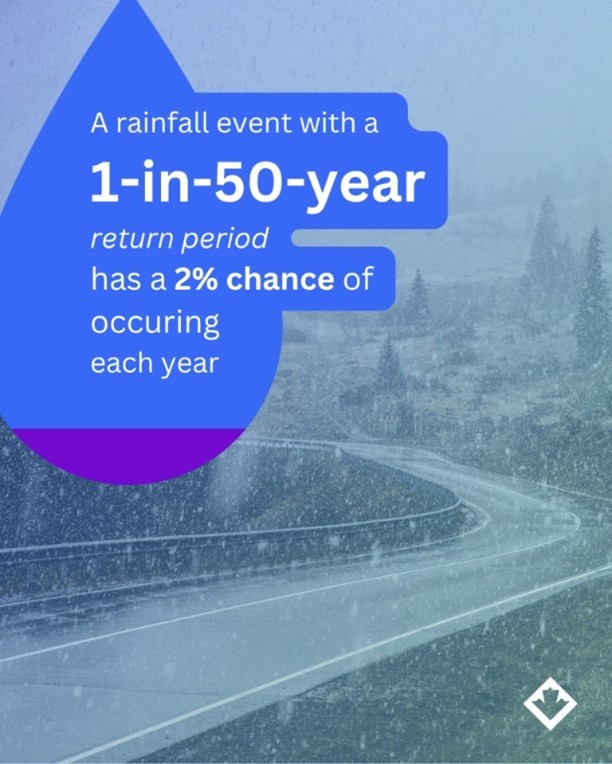
Similarly, climate change is affecting the frequency of extremes as well as the intensity meaning that what is considered a 1-in-20-year occurrence today may happen more frequently in the future. As the climate continues to change, this chance would technically be lower at the start of the period and higher towards the end, but when and if such events actually occur is also largely determined by factors such as year-to-year climate variability as well as specific meteorological conditions, so the concept of average chance of occurrence per year over the period is still useful.


Why Is This Data Important?

Projections for return levels can equip users such as planners, engineers, and policymakers with actionable information to assess infrastructure vulnerabilities, design resilient systems, and plan for future extremes. Whether it’s sizing stormwater systems, preparing heatwave response plans, or ensuring community preparedness for extreme cold, this data provides a foundation for informed decision-making.

Learn More

As part of this release, an accompanying Learning Zone article outlines considerations for working with return levels information. Variable descriptions on ClimateData.ca dive deeper into the science behind return levels and how these projections are developed. Visit the Variable, Maps or Download Pages to access the dataset, explore the new resource, and start planning for the future.

Stay tuned for more updates as we continue to expand our suite of tools and datasets, empowering Canadians to respond to the challenges of a changing climate.