How to find and interpret the return level data on ClimateData.ca
ClimateData.ca provides return level projections for 1-in-5-, 1-in-10-, 1-in-20-year, 1-in-30-year and 1-in-50-year events and various emissions scenarios over different periods, allowing users to explore potential extremes in future climates. The return levels of the following variables are available on ClimateData.ca:
- Annual Maximum Temperature: This represents the highest daily maximum temperature of the year.
- Annual Minimum Temperature: This represents the lowest daily minimum temperature of the year.
- Annual Maximum 1-day Precipitation: This represents the highest 1-day precipitation total of the year.
To explore return level projections on ClimateData.ca, navigate to the map, select the desired return level, variable, emissions scenario and time period. The resulting map will be the median (50th percentile) return level from the climate model ensemble.
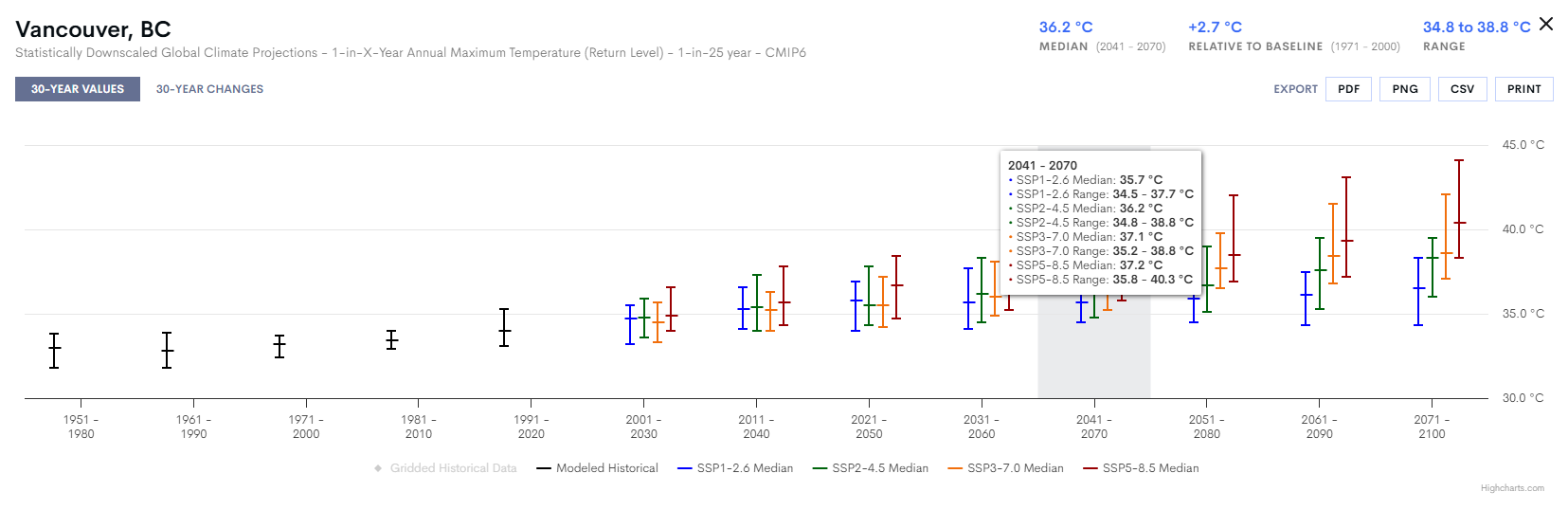
To see how return levels are projected to evolve over the century, either search for a location using the search bar, or zoom in and select a grid cell. A summary box will appear with the median and range of projections for that time period, as well as the projected difference relative to the 1971-2000 period. Clicking “See details” will bring up a plot as seen in Figure 4.
The time series plots include four emissions scenarios and hovering over the plot will bring up a tooltip with data for each scenario. For example, in Figure 4 the median value of the climate model ensemble indicates that under the SSP2-4.5 emissions scenario there is, on average, a 1-in-25 chance per year that the maximum daily temperature will reach or exceed 36.2°C in the 2041-2070 timeframe.