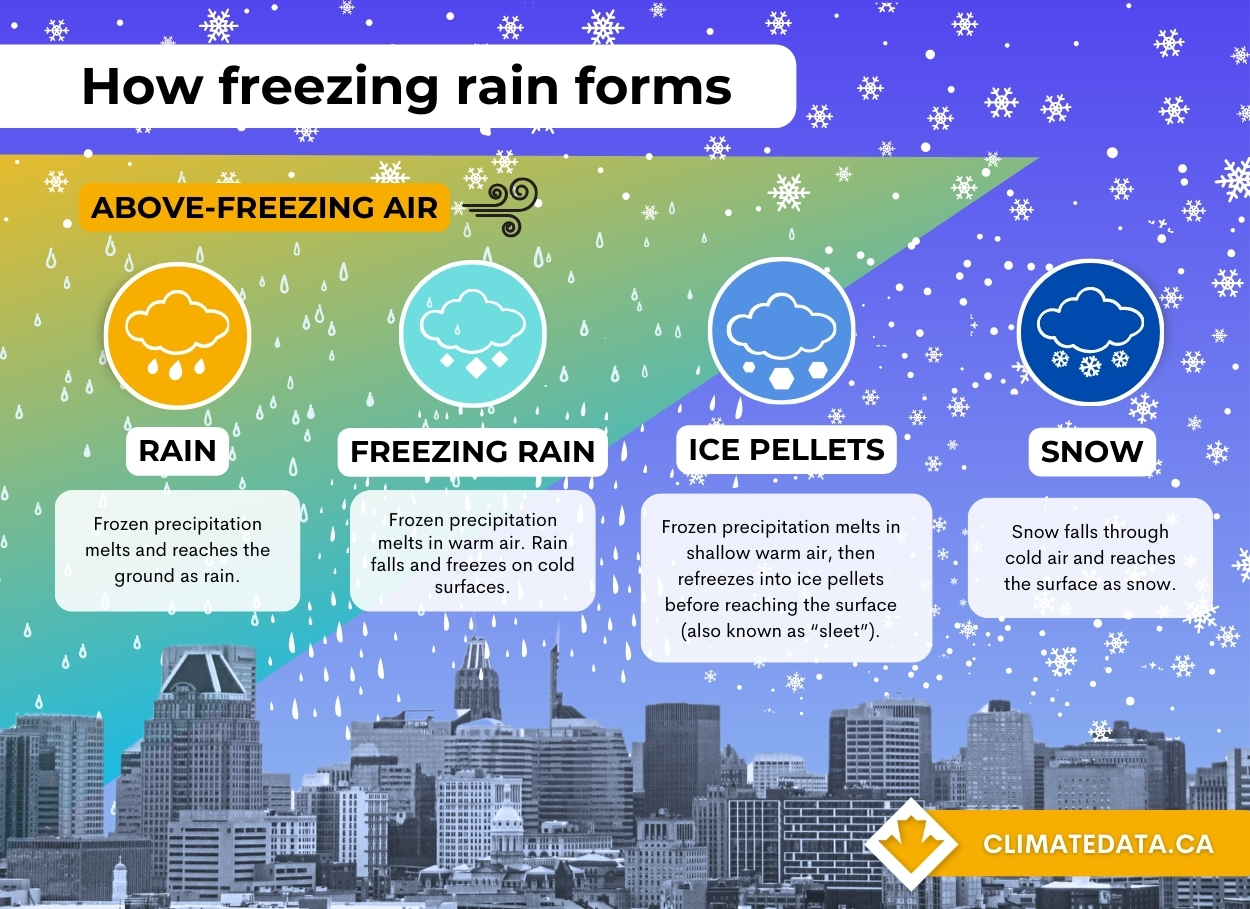
Where does freezing rain tend to fall in Canada?
Freezing rain is most often observed in eastern Canada, particularly in regions like southern Québec, southeastern Ontario, and the Atlantic Provinces. During the winter season, these areas are more susceptible to the conditions that lead to freezing rain due to their geographical location and prevailing weather patterns.
The St. Lawrence River Valley is a notable hotspot for freezing rain events in Canada. Here, cold air sinks into the valley, cooling liquid raindrops as they fall from relatively warm air aloft. It is not uncommon for places like Ottawa and Montréal to experience numerous freezing rain warnings per year. In most cases, freezing rain events last a few minutes to a few hours. However, longer and more serious freezing rain events are possible, as witnessed during the infamous 1998 Quebec ice storm. During this event, more than 100 mm of mixed precipitation fell over five consecutive days, downing trees and powerlines, coating roads, and resulting in at least 40 deaths.
What research is being done on the impacts of climate change on freezing rain in Canada?
The relationship between freezing rain and climate change is an active area of research. A study by McCray, Paquin, Thériault, and Bresson (2022) used the Canadian Regional Climate Model (CRCM5) to project changes in freezing rain patterns across North America. Here are three key takeaways from their study:
- The frequency of freezing rain is expected to rise in parts of western and central Canada (Alberta, Saskatchewan, Manitoba) and decline across much of the United States.
- The specific method used to model freezing rain events affects the magnitude, but not the direction, of projected changes.
- The choice of global climate model used to drive the regional climate model greatly influences the predictions, indicating significant uncertainty in both the extent and direction of changes in freezing rain events.[2]
A different approach to modelling future freezing rain was undertaken as a part of the Climate-resilient Buildings and Core Public Infrastructure initiative (CRBCPI). The final CRBCPI report contains modelled climate parameters intended for use in infrastructure design (so-called ‘design values’), specifically buildings and bridges. One of these design values is ice accretion. Ice accretion can occur as a result of several different processes; however, freezing rain is the dominant cause of ice accretion in most locations in Canada, making it a suitable proxy – or stand in – for this hazard. CRBCPI’s ice accretion data project a similar poleward shift in future freezing precipitation conditions due to rising surface temperatures as noted by McCray et al. (2022). Confidence in projections of future ice accretion values is low due to the complexity of processes involved in the formation of ice accretion, and the limited spatial and temporal resolution of climate models.[3]