ClimateData.ca has undergone a major redesign to make it easier than ever to find, understand, and use high-quality climate data. Meet the Updated ClimateData.ca.

Climate Data in Action: Wine Climate Zones

Date September 1, 2025
Author Frances Delaney, Canadian Centre for Climate Services
Topics Climate Data in Action
Share this post

Introduction


Canada’s wine industry has grown steadily over the past few decades, gaining recognition for its cool-climate varietals and distinctive ice wine. Its major wine-producing regions—spanning British Columbia, Ontario, Quebec, and Nova Scotia—depend on a complex interplay of climate, soil, and geography. As climate conditions shift, wine producers are beginning to consider how changes in temperature, precipitation, and extreme weather might affect grape production, wine quality, and the long-term viability of traditional growing areas[1].

This article uses datasets and tools available on ClimateData.ca to demonstrate how one might begin to explore the potential impacts of climate change on wine production in British Columbia’s Okanagan Valley, specifically, in Poplar Grove. Rather than offering definitive predictions, the analysis shows how publicly available climate information—such as future projections of growing season temperature and frost risk—can support and inspire conversations about adaptation and resilience in the wine sector. By using climate data at the local scale, producers, researchers, and policymakers can better assess future conditions and plan for change.


How does climate change impact wine?


1. Growing season temperature

In general, climates with cooler growing season temperatures tend to produce wines that are lighter in body, higher in acidity, and more delicate in flavour. Warmer climates, in contrast, often result in fuller-bodied wines with softer acidity and richer, darker fruit characteristics (see table below for more details).[2] As temperatures rise, some traditional cool wine-growing areas may become more suitable for intermediate or warm grape varieties, shifting the cooler climate viticulture northward. Some areas of the Okanagan Valley in BC have already seen a shift from “cool” climate viticulture to “intermediate” climate viticulture over the past 40 years.[3]

Table derived from: Jones, 2015

* Jones, 2015

** Palate Club, 2025

***Mean average temperature during the growing season (April 1 to October 31)


2. Extreme weather


Rising temperatures and shifting climate patterns may mean changes in the frequency and severity of several types of extreme weather events across the country—including heat waves, cold snaps, heavy rain, droughts, and hail.

Hot temperatures accelerate grape ripening, resulting in higher sugar levels and changes to the balance of acidity and tannins in the final wine. When daily temperatures rise above 30°C, grapevines start experiencing a major decline in photosynthesis and in anthocyanin production, which can reduce or dilute grape colour. By 33°C, the grapevines can experience a significant reduction in productivity, and by 40°C, there is a complete halt in photosynthetic activity.[4] Beyond direct effects on grapevines, hotter temperatures also increase the risk of wildfires, another concern for wine production (see Box 1).

Box 1: A sneaky threat: Smoke taint Wildfires can damage or destroy vineyards. However, even distant wildfires can impact the flavour of wine grapes, due to a phenomenon call “smoke taint”. This refers to the smoky, ashy taste of wines made from grapes that were exposed to wildfire smoke in the ripening phase. Smoke taint can lead to massive financial losses – for example, Australia lost $AUD 400 million from the 2020 wildfires. Learn how researchers at the University of BC Okanagan are aiming to identify chemicals to detect smoke taint in wine here.

Temperature extremes at the other end of the spectrum also pose risks. Cold snaps can damage vines (see Box 2 for an example), while too much rain during harvest can split berries and produce fungal diseases. Finally, droughts may harm the leaves and the grapes, while hail or thunderstorms can bruise or damage grapes and lower the overall yield and quality of the grapes.[2]

Box 2: The ‘24 Freeze: Frost Impacts on Vineyards in the Okanagan. In January of 2024, a deep freeze hit the Okanagan Valley, where temperatures dropped below −20°C in the Okanagan for several days. This led to devastating losses, where 90% of grape production was lost. The B.C. government allowed wineries to import grapes and juice to make their 2024 vintages to “protect jobs and maintain the cultural and economic vitality” of the industry.Read more here: B.C. lets wineries import grapes after ‘devastating’ winter loss | CBC News ere.


Using ClimateData.ca to Explore Future Climate Conditions

Given how closely grape production is tied to weather and climate conditions, access to localized climate data becomes an important tool for long-term planning in the wine industry. Over the coming decades, particularly under a higher-emissions scenario, Canada’s climate is expected to undergo substantial changes, increasing the risks facing grape production and viticulture.

To illustrate how climate data can support long-term planning in the wine industry, we used the Okanagan Valley, British Columbia as a case study. Specifically, the 10 km by 6 km grid cell of Poplar Grove, as there are about 18 wineries in this small area. While this analysis focuses on a single region, the approach can be applied elsewhere in Canada. By using publicly available tools on ClimateData.ca, we demonstrate how one might begin to explore potential climate impacts on grape growing and wine production under different future scenarios.

We examined a selection of climate indicators relevant to viticulture, including average growing season temperatures, extreme heat days (above 30°C), and spring frost risk, using both intermediate (SSP2-4.5) and high (SSP5-8.5) emissions scenarios from 1950 to 2100.


1. Average Growing Season Temperatures


We used ClimateData.ca’s Download Page to compute the mean temperature for the growing season in Poplar Grove. We downloaded monthly mean temperatures for all months between April and October for the grid cell of Poplar Grove. From here, we calculated the growing season averages from 1950 to 2100 for a low and high emissions scenario (SSP2-4.5, and SSP5-8.5, respectively).

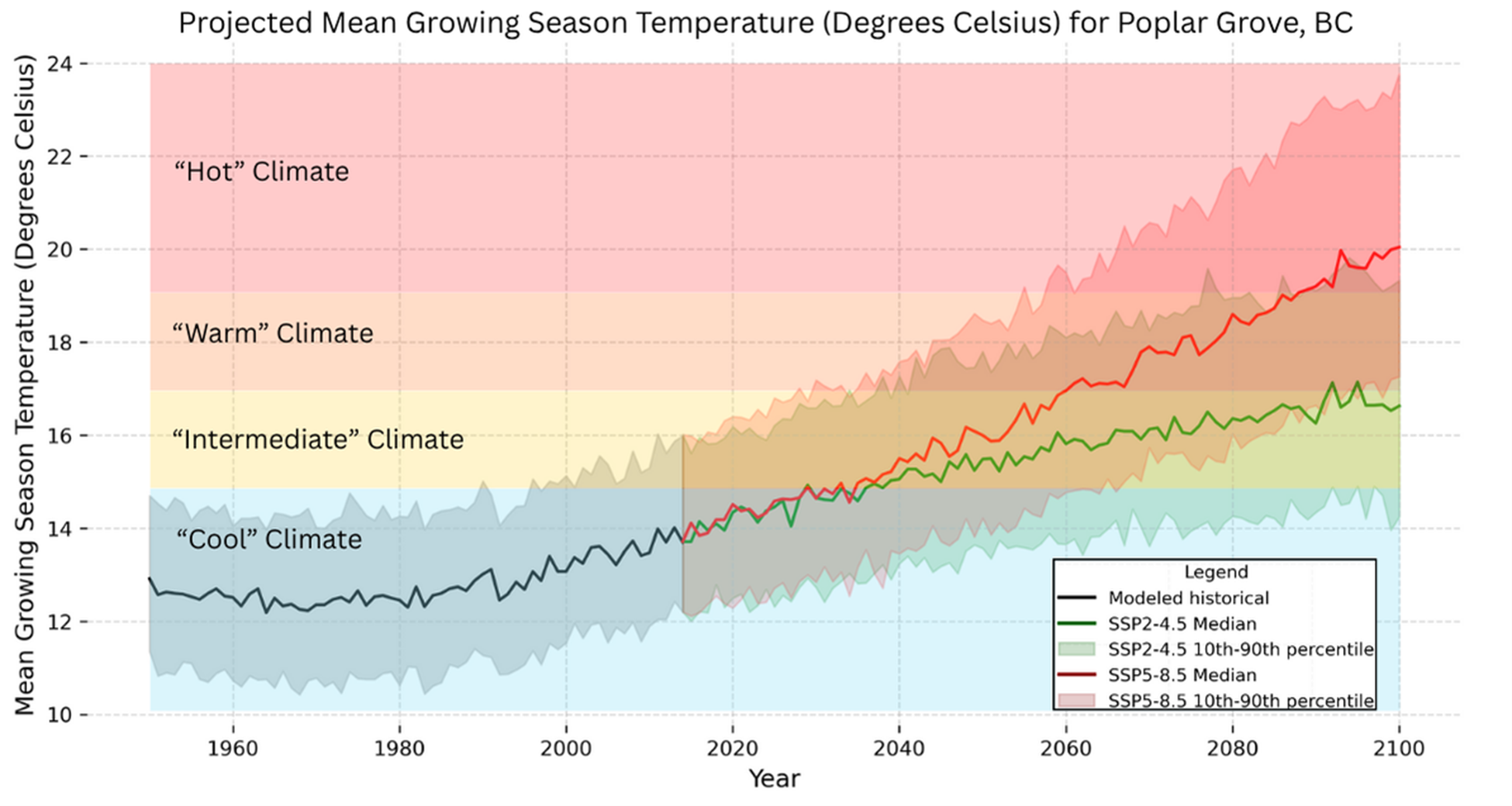
Figure 1: The average temperature in the growing season (April 1 to October 31) in Poplar Grove, BC, from 1950 to 2100.

The graph shows that growing season temperatures in Poplar Grove are expected to rise in the coming decades under both emissions scenarios. The black line shows past climate conditions based on model simulations, and the coloured lines represent the range of possible futures, with the middle lines showing the median, or “most likely,” pathway and the shaded areas showing the range of variability we could expect.

Looking at the variability for the past period, the warmer end of the modeled range suggests that Poplar Grove may already have experienced years shifting from a “cool” to an “intermediate” climate since about 2000. Early on, such years would have been rare, if they happened at all, but they become more plausible as a larger portion of the shaded range moves into the “intermediate” zone. This aligns with the findings of Hewer and Gough (2021), who reported that the Okanagan Valley has already made this shift based on observed data.

It’s important to note that modeled historical data do not reproduce daily or yearly weather exactly as it occurred—this data provides a simulated version of past climate that captures the overall patterns and variability of the observed weather. Because of this, the “most likely” (median) pathway in the modelled results will not match observed historical data exactly. Instead, it is the variability shown in the model that encompasses the outcomes seen in real-world records, which explains why the upper end of the modelled range aligns with the observed shift from “cool” to “intermediate” zone. (Read more about modeled historical data here: Modelled Historical Data — ClimateData.ca.)

Building on this, the projections show that the shift toward warmer climate categories in Poplar Grove is not temporary—it is here to stay. The median, or “most likely,” pathway under both emissions scenarios reaches the “intermediate” climate category by about 2030, meaning that what was once only seen at the warmer edge of variability becomes the typical climate for the region.

From there, the range of possibilities widens. The median under a lower emissions scenario continues to rise gradually, reaching about 16.5°C by the end of the century. Poplar Grove remains in the “intermediate” category under this scenario. Under a high emissions scenario, the median increases much more sharply, crossing into the “warm” category by the 2060s and approaching 20°C by century’s end—placing the region in the “hot” category and making it suitable for grape varieties adapted to the warmest climates.

These figures reflect the 10 km by 6 km grid cell for Poplar Grove. Within that grid, “microclimates” shaped by elevation, slope, water bodies, and other local features may result in more than one climate category within a grid cell.  In this case, using change values (also known and labelled on ClimateData.ca as “delta” values) in conjunction with site-specific historical data can provide more locally-specific projections of future climate.


2. Extreme Heat


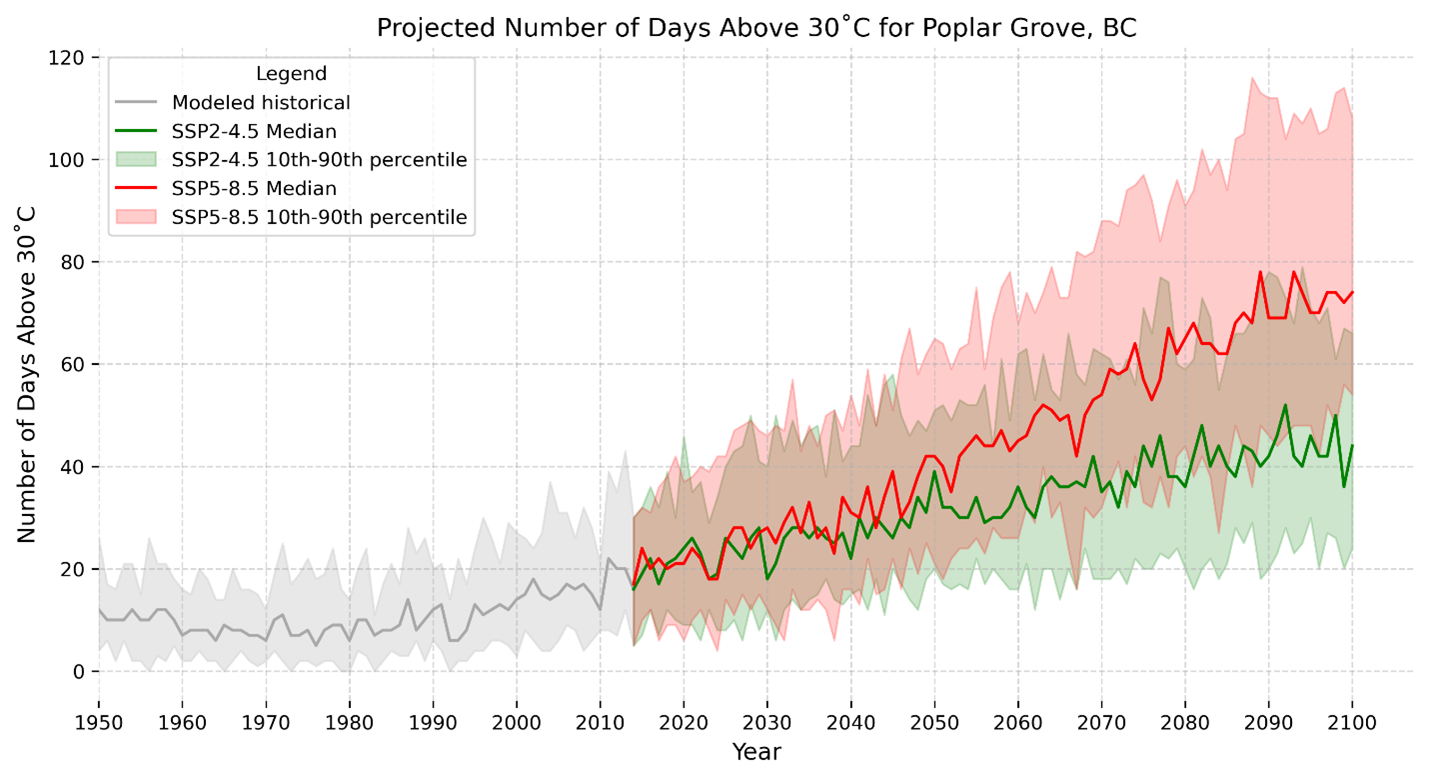
To assess heat stress, we looked at how many days above 30°C Poplar Grove could experience by 2100.  
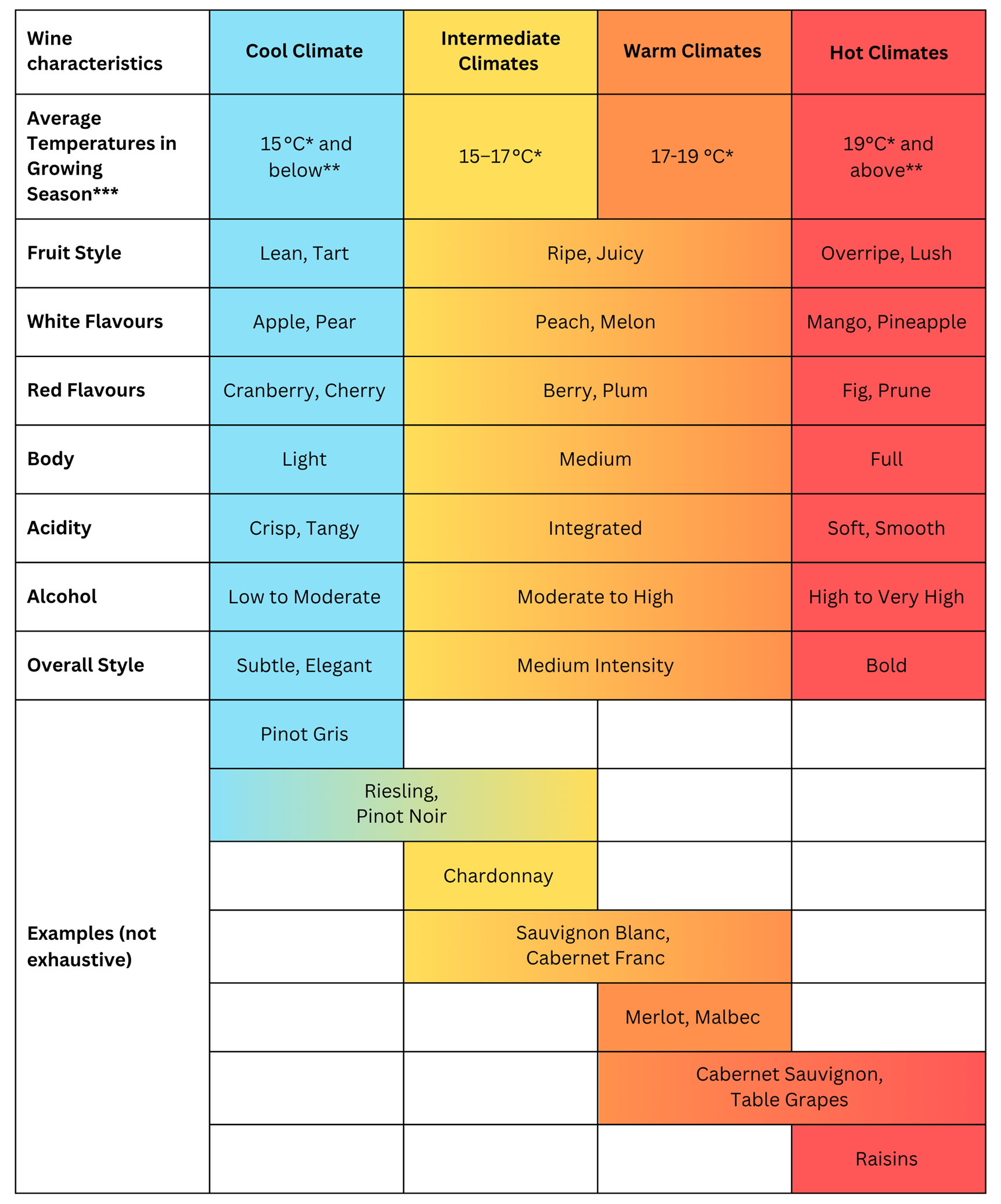
Figure 2: The number of days above 30°C in Poplar Grove in a medium and high emissions scenario (SSP2-4.5 and SSP5-8.5, respectively).

The graph shows that the number of days above 30°C in Poplar Grove is projected to increase under both emissions scenarios. Historically, the region experienced about 17 such days per year (or about 2.5 weeks). By the end of the century, under a lower emissions scenario, this could rise to approximately 45 days (or roughly 6.5 weeks) and up to 75 days (over 10.5 weeks) under a high emissions scenario—an increase of roughly 58 days (about 8 additional weeks of extreme heat each year). This substantial increase suggests that heat-related risks, such as reduced photosynthesis and heat stress in grapevines, could become much more common.


3. Spring Frost


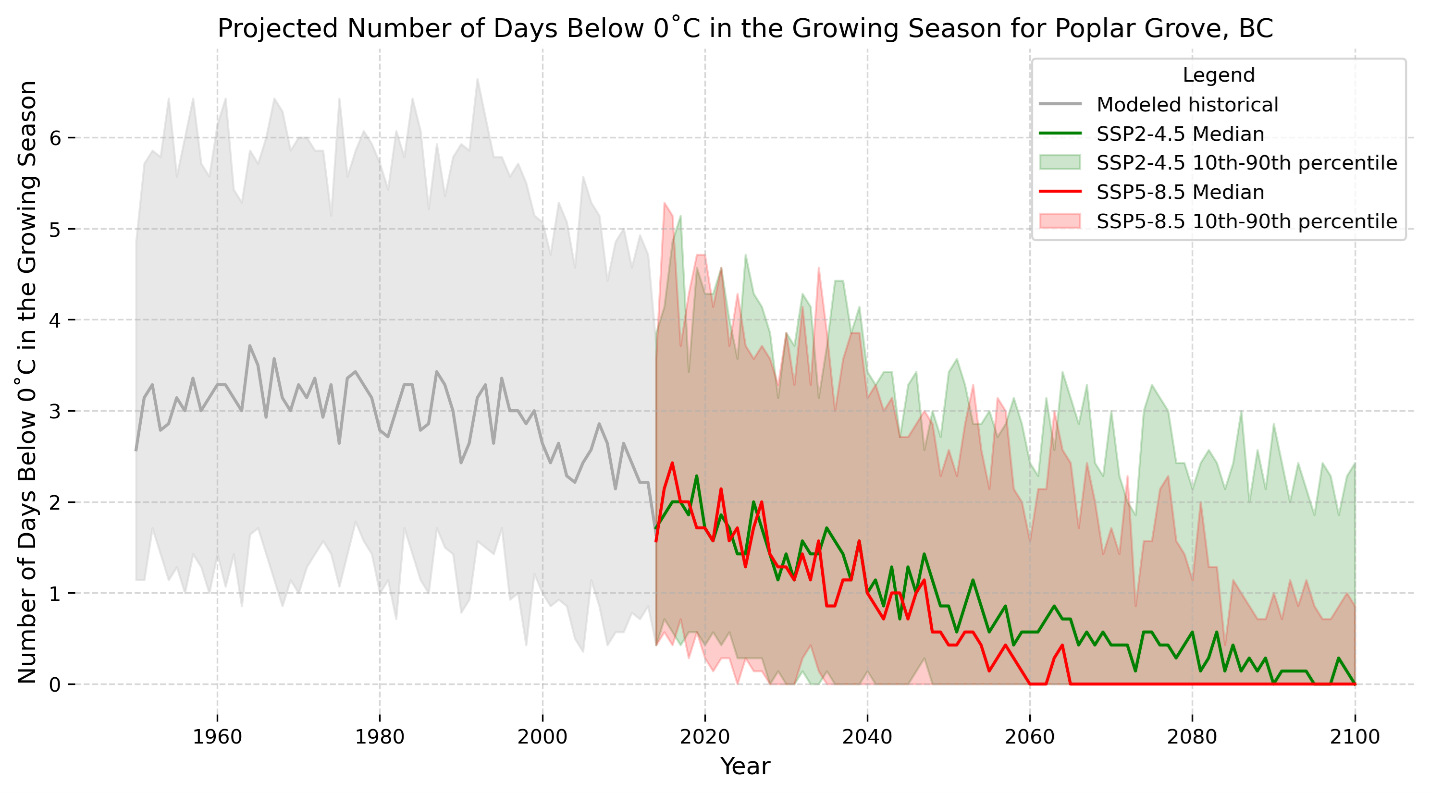
We also examined the risk of spring frost by looking at the projected number of days when the minimum temperature drops below 0°C within the growing season. This matters because grapevines exposed to sub-zero temperatures can suffer damage to their vegetative growth, and hard freezes (below -2.2 °C) can significantly reduce yields.[2] 

Figure 3: Projected number of days with a minimum temperature below 0°C during the growing season (April 1 to October 31) in Poplar Grove under a medium and high emissions scenario (SSP2-4.5 and SSP5-8.5, respectively).

Overall, a warmer climate will mean fewer days below freezing during the growing season (from April 1 to October 31) in Poplar Grove, on average. Figure 3 shows that the number of freezing days will decrease in the future, with no days below 0°C by about 2065 in a high emissions scenario, and less than one day per growing season in a low emissions scenario by 2100.


Adaptation Actions


Canadian winemakers are already adopting a range of climate adaptation strategies for their specific regional challenges.[5] Some of these actions include, but are not limited to:

  • Planting and trialing grape varieties that are more suitable to warmer conditions and more tolerant of drought.
  • Creating canopies to provide more shade.
  • Planting at higher altitudes or planting in cooler areas.
  • Improving disease management and applying fungicides.
  • Improving irrigation and drainage technologies.
  • Planting cover crops.

To see more examples of adaptation in the wine industry, read this article by Poirier et al., 2021. To read about an example of adaptation of the wine industry in Canada – read the AgriRisk project of Nova Scotia and learn how they developed mapping tools to help winemakers: AgricRisk: Risk Management in the Grape and Wine Industry in Nova Scotia.


Conclusion


As Canada’s climate continues to change, especially under a high emissions scenario, grape growers will need to navigate a range of new and evolving challenges. From shifting growing season temperatures to increased heat extremes and changing frost risks, the future of viticulture in Canada will be shaped by the ability to anticipate and adapt to local climate conditions.

This article demonstrates how publicly available tools on ClimateData.ca can support this process. By exploring data specific to the Poplar Grove, within the Okanagan Valley, we show how one might begin to assess potential climate impacts on grape growing and wine production. These tools allow users to visualize projections at the grid cell (10 km by 6 km), watershed, or municipal level, which can help producers, researchers, and planners make informed decisions about adaptation strategies, from selecting grape varieties to adjusting planting practices.


[1] Agriculture and Agrifood Canada. 2023. Statistical overview of the Canadian fruit industry, 2023.

[2] Jones, G. 2015. Climate, Grapes, and Wine. Retrieved June 5th, 2025 from: GuildSomm International

[3] Hewer, M. and Gough, W. 2021. Climate change impact assessment on grape growth and wine production in the Okanagan Valley (Canada). Climate Risk Management. DOI: https://doi.org/10.1016/j.crm.2021.100343.

[4] Hewer, M., & Brunette, M. 2020. Climate change impact assessment on grape and wine for Ontario, Canada’s appellations of origin. Reg Environ Change 20, 86 (2020). https://doi.org/10.1007/s10113-020-01673-y

[5] Poirier, E., Plummer, R., & Pichering, G. 2021. Climate change adaptation in the Canadian wine industry: Strategies and drivers. Canadian Geographies.  https://doi.org/10.1111/cag.12665

[6] Palate Club. 2025. Wine & Weather: The Best Climate for Grapes. Retrieved on June 27, 2025, from: https://www.palateclub.com/climate-for-grapes/