ClimateData.ca has undergone a major redesign to make it easier than ever to find, understand, and use high-quality climate data. Meet the Updated ClimateData.ca.

I’m Dreaming of a Green Christmas: How Climate Change is Reshaping Christmas Tree Farming in Southern Ontario

Date December 5, 2025
Author Casey Clunas, Frances Delaney, and Ryan Smith, Canadian Centre for Climate Services; Kelsey Leonard and Alison Clarke, University of Waterloo Christmas Tree Lab
Topics Case studies, Climate Data in Action, Seasonal to decadal forecasts
Share this post

Introduction

Across Canada, growing and harvesting Christmas trees is an important seasonal tradition—but changing climate conditions are reshaping where and how these trees can thrive. Christmas tree farms are more than just seasonal decor, they are part of Canada’s ornamental horticulture sector, a component of the agricultural sector, which saw a total of $3.24 billion in annual sales in 2024.[1] Despite their classification as ornamental, these farms play a key role in carbon sequestration by maintaining continuous carbon storage through their standing trees and soils. In addition, Christmas tree farms support biodiversity, rural economies, and Canada’s global exports.
Christmas tree farms operate in every province, with the largest numbers in Ontario (418), British Columbia (276), Quebec (257), and Nova Scotia (213) as of 2021.[1] While growing conditions vary across regions, many growers are having to contend with warmer temperatures, shifting growing seasons, and more variable weather. Because Christmas trees require six to twelve years to reach maturity, these long production cycles increase their exposure to changing climate conditions, pests, diseases, and extreme events.This article explores how climate change is reshaping Christmas tree farming, with a particular focus on southern Ontario—one of the country’s major production regions and an area already experiencing rapid climate warming trends.

Box 1: Did You Know? In Canada in 2021, over 20,000 hectares (200 square kilometers) of land was dedicated to Christmas tree farms.[2] These farms not only produce Christmas trees that are a cherished part of Canadian culture, but they maintain ongoing carbon storage in trees and soils, enhance biodiversity, and support rural economies.

Christmas Tree Farming in Southern Ontario

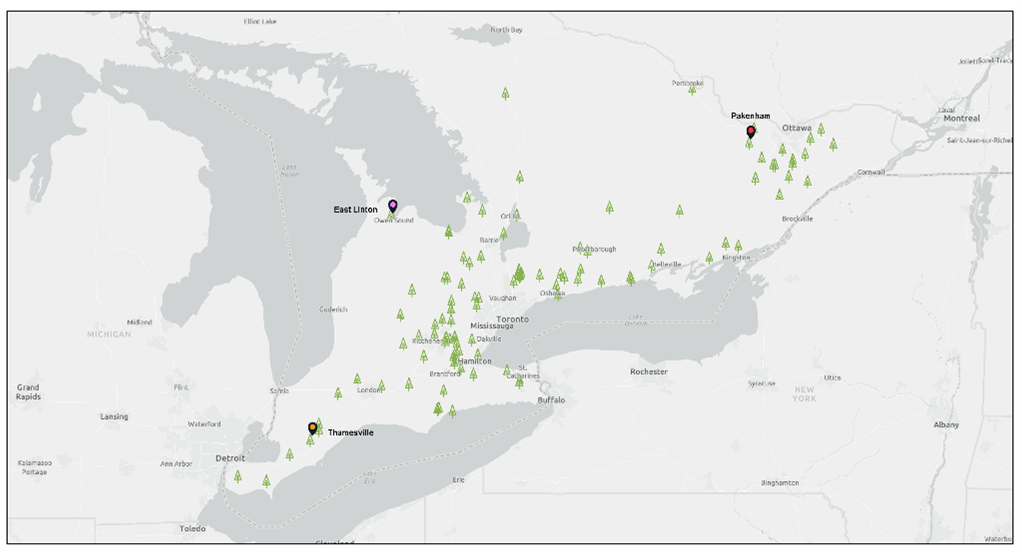
Southern Ontario is one of the most important Christmas tree–producing regions in Canada, with several hundred farms distributed across the area from Windsor through the Greater Toronto and Hamilton Area, and east toward Kingston and Ottawa. As shown in Figure 1, production is concentrated along the Lake Huron–Georgian Bay corridor, throughout the Golden Horseshoe, and across the mixed farming landscapes of eastern Ontario.

Southern Ontario supports a mix of Christmas tree species—including white spruce, balsam fir, Fraser fir, and Scotch pine—each responding differently to heat, moisture, and soil conditions.

The region’s warm summers, long frost-free period, and variable precipitation patterns make site factors such as drainage, soil texture, and exposure especially important for establishment and growth. While many farms operate successfully under these conditions, southern Ontario sits near the warmer edge of the suitability range for several traditional Christmas tree species. This makes shifts in temperature, moisture, and seasonal patterns a central consideration for long-term planning as the climate continues to change.

Figure 1: Map of Christmas Tree Farms in Southern Ontario

How climate change impacts Christmas tree farms

A warming climate is reshaping growing conditions for Christmas trees, affecting suitability, seasonal extremes, and pest dynamics. The sections below summarize the main climate-related challenges for growers.

Shifting climate zones

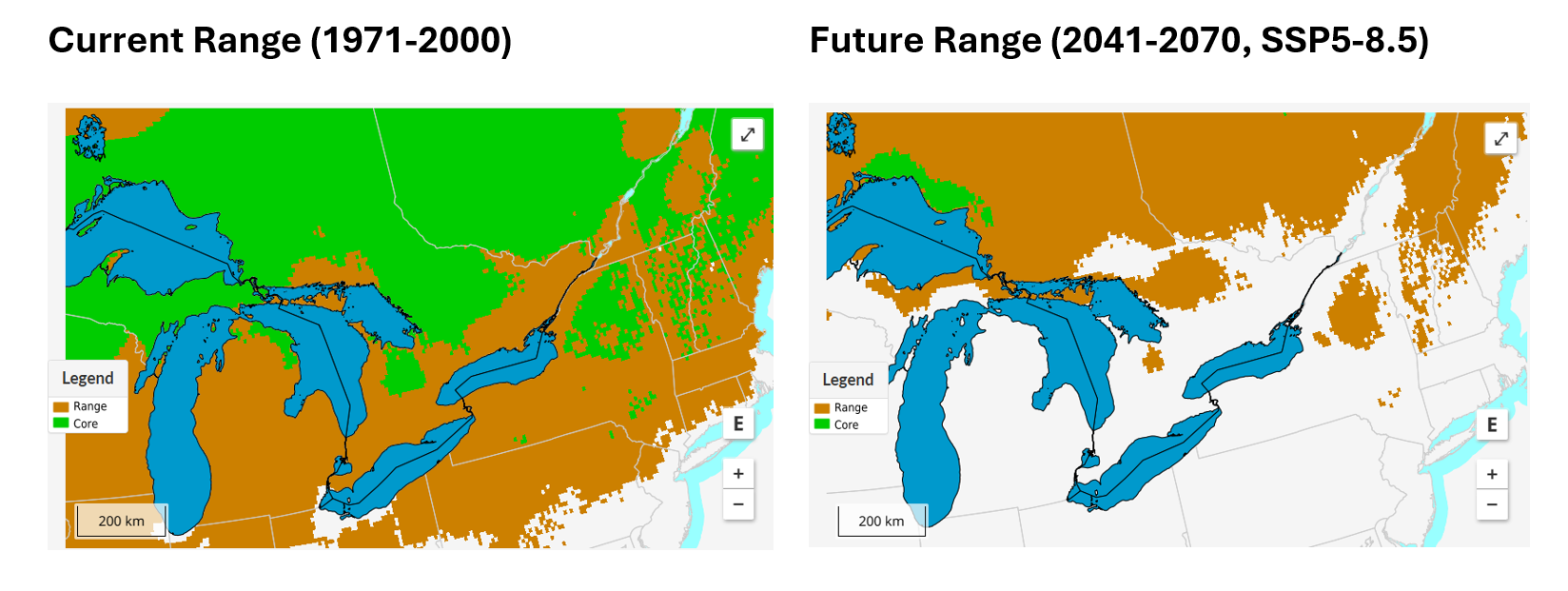
In Figure 1, the green area represents the core climate range for white spruce—the conditions under which the species tends to grow most vigorously across its natural distribution. The brown area indicates the broader climate range, where the species is still capable of surviving or being successfully cultivated, though growth may be slower or more variable.

Figure 2: Current (1971-2000)[3] and future (2041-2070, SSP585)[4] ranges of Picea glauca (Moench) Voss (white spruce).

Across its natural range, white spruce occupies a wide variety of climates—from the cool, short summer season environments of the western subarctic to the longer, warmer summers of the Great Lakes–St. Lawrence region. In southern Ontario, where Christmas tree farming is well established, historical climate conditions sit near the warm edge of this distribution (the left panel in Figure 2). While white spruce is highly adaptable, growth performance is closely tied to temperature, moisture availability, and growing-season length. Guidance for Christmas tree producers reinforces this, noting that white spruce tends to grow best on cool, moist, well-drained sites, while hot, dry, or poorly drained conditions can reduce growth and quality even where the species can survive.[5] Looking ahead to 2041–2070 under a high-emissions scenario (the right panel in Figure 2), the suitability range for white spruce is projected to shift northward. For most of southern Ontario, and much of the northern United States, future climate conditions are expected to fall outside of the species’ optimal range. To provide a clearer, locally relevant basis for understanding future climate projections, Table 1 focuses on climate variables previously used in white spruce growth studies in southern Ontario and Quebec.[6]

Table 1: Climate Conditions for Three Christmas Tree Farm locations in Southern Ontario

CharacteristicHistorical Climate Conditions* (1971–2000)Future Climate Conditions* (2041–2070 – High Emissions Scenario)
Thamesville, ONEast Linton, ONPakenham, ONThamesville, ONEast Linton, ONPakenham, ON
Mean annual temperature (°C)8.96.85.911.9 to 14.410.0 to 12.59.2 to 11.6
Maximum annual temperature (°C)13.311.211.316.3 to 18.914.3 to 17.014.5 to 16.9
Minimum annual temperature (°C)4.52.40.57.6 to 9.75.6 to 8.13.9 to 6.3
Frost-Free Season (growing season) (days)179160145205 to 240191 to 227163 to 196
Degree Days above 10°C1429105111441882 to 25041449 to 20661552 to 2128
Annual Precipitation (mm)9291084926951 to 10371129 to 1207996 to 1059
Summer total precipitation (mm)240235243201 to 250200 to 249228 to 264

*30-year average data from ClimateData.ca for Thamesville, East Linton, and Pakenham, Ontario.

All three locations are projected to become warmer, with longer growing seasons, more degree days, and slightly higher annual precipitation by 2041–2070 under a high-emissions scenario. These shifts generally point toward more favourable conditions for heat-tolerant species (and less favourable conditions for cold-climate species). These projections also indicate that heat stress is likely to be more of an issue, precipitation will be more variable, and there is higher potential for summer droughts even when annual precipitation remains the same or increases. These projections of future climate are used to produce the panel on the right of Figure 2, which indicates climate conditions in Southern Ontario will become less suitable for white spruce.

Extremes and severe weather

Severe weather events—such as heat waves, flooding rains, drought, and high winds—present challenges for growers across agricultural and forestry sectors, including Christmas tree producers. Extreme heat events, for example, pose a serious threat to trees, especially young ones.[7],[8] Meanwhile, changes in precipitation patterns—whether excessive rainfall or prolonged drought—can stress trees and alter soil conditions, affecting overall farm productivity.

Drought and extreme weather events are also impacting Canada’s Christmas tree species. Some species are more drought-tolerant than others, but prolonged dry spells can still be devastating. Canadian growers are seeing drought impacts including mature trees suffering from browning needles, while seedlings develop shallow root systems that are vulnerable to events like flooding. In addition, intense storms and heatwaves can damage or destroy crops, and in some regions, the risk of wildfires adds another layer of uncertainty.

Box 2: 2021 Heat Dome and Christmas Trees: 2021 was a notable year of extreme weather for the province of British Columbia. The summer heat dome and extreme flooding impacted the supply of Christmas trees to the extent that IKEA was unable to sell live trees that year due to supply shortages. With temperatures reaching 45 °C in some areas, one grower expected to lose up to 1000 seedlings from the scorching temperatures

Pests and Diseases

Warmer winters, longer growing seasons, heavy precipitation, and wetter than normal conditions are contributing to rising pest pressures on Christmas tree farms. In many regions across Canada, increases in pest and disease pressures are already being observed. [9] Temperature is a key driver of insect development: while each species requires a certain amount of accumulated heat to complete its life cycle, the rate and timing of development vary with seasonal temperature patterns.

This is where Degree Days (DD)—a measure of accumulated heat above a certain temperature threshold—become a valuable climate variable for growers. By calculating DDs, growers can estimate the timing of key biological events such as egg hatch, larval development, or disease infection, which in turn informs more effective pest control strategies.[10] 

For instance, the Balsam Twig Aphid, a common pest for Christmas trees in Canada, becomes most damaging during its second generation, typically emerging after 150–200 DDs above 10 °C have accumulated.[11],[12]

As the climate warms, the total number of DDs above critical thresholds is expected to increase, potentially allowing multiple pest generations in a season or shifting their emergence earlier in the year.[13] This could not only exacerbate current pest pressures but also introduce new pests to regions where they were previously not viable.

Box 3: University of Waterloo’s Christmas Tree Lab. The unique challenges facing Christmas Tree growers require targeted research and solutions. The Christmas Tree Lab is a dedicated research lab and a key resource for growers, aiding in applied research to help increase the resilience and growth of the industry in Canada.

How can seasonal forecast products help keep the (Christmas) lights on?

Seasonal forecasts—currently available through Environment and Climate Change Canada and coming soon to ClimateData.ca—provide guidance on how upcoming temperature and precipitation conditions are likely to compare with the long-term historical average. While seasonal forecasts do not predict day-to-day weather, they offer useful insights into the probability of different weather patterns emerging in the upcoming months.

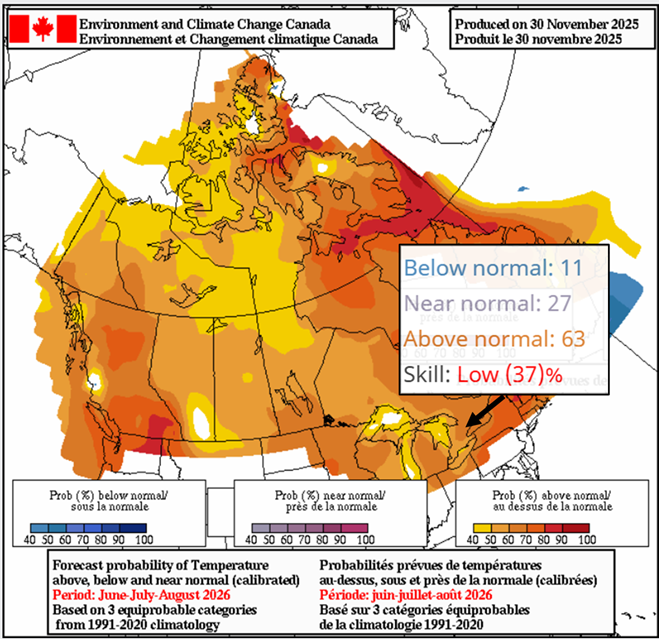
For summer 2026 (June–August), temperature forecasts indicate a higher probability of above-normal conditions across southern Ontario (Figure 3). For growers managing heat-sensitive species such as white spruce, this information can help support early planning for shade, irrigation, and other measures to reduce heat stress. Because seasonal forecasts are updated regularly and forecast “skill” varies by region, growers should check back for updates as the season approaches.

Figure 3: Temperature forecast for June to August 2026. Click here to view the forecast: Seasonal forecasts for Canada.  

For more information on how to interpret seasonal probabilistic forecasts, consult ECCC’s User guide for seasonal forecasts.

A wrap on the holiday season

As climate conditions continue to shift, Christmas tree farmers are working proactively to manage emerging challenges—from heat stress and drought, to pests, diseases, and more frequent extreme weather. Climate data projections and seasonal forecasts all provide practical insights that support both day-to-day decisions and long-term planning. 

Together, these tools help growers anticipate risks, adjust management practices, and build greater resilience into their operations. Ongoing adaptation will be essential to maintain a sustainable supply of Christmas trees, along with the rural economies and ecosystems that depend on them.

As you head to your local Christmas tree farm or market this season, it’s worth reflecting on the work growers are doing to adapt to a changing climate and maintain healthy, locally grown trees. When the holidays are over, consider giving your tree a second life—through mulching, recycling, or other community reuse programs.

Box 4: A new life for old Christmas trees: A common myth is that live Christmas trees are more environmentally impactful than artificial trees. However, live Christmas trees have an abundance of beneficial uses after making your home festive for the holiday season[14]. They can be chipped for mulch, the wood can be recycled and re-used, or they can be used in restoration projects like the one undertaken in the Upper Credit Conservation Area in Alton, Ontario. In this case, recycled Christmas trees were used as sediment capture devices and to prevent soil erosion along the creek’s banks.

References

[1] Agriculture and Agri-Food Canada. (2024). Statistical Overview of the Canadian Ornamental Industry, 2024. https://agriculture.canada.ca/en/sector/horticulture/reports/statistical-overview-canadian-ornamental-industry-2024 

[2] Agriculture and Agri-Food Canada. (2024). Statistical Overview of the Canadian Ornamental Industry, 2024. https://agriculture.canada.ca/en/sector/horticulture/reports/statistical-overview-canadian-ornamental-industry-2024 

[3]Natural Resources Canada. (2025). Canada’s Plant Hardiness Site, Species-specific Models and Maps. Picea glauca (Moench) Voss. https://www.planthardiness.gc.ca/index.php?phz=p10007941971-2000&s=b&speciesid=1000794&m=7&lang=en#

[4] (2025). Canada’s Plant Hardiness Site, Species-specific Models and Maps. Picea glauca (Moench) Voss. https://www.planthardiness.gc.ca/index.php?phz=p10000051971-2000&s=b&speciesid=1000005&m=7&lang=en

[5] Koelling, M. R., Hailigmann, R. (1993). Recommended Species for Christmas Tree Plantings In the North Central United States. Forest Ecology and Management. https://www.canr.msu.edu/uploads/234/84938/Recommended_Species_for_Christmas_Tree_Plantings-optimized.pdf

[6] Andalo, C., Beaulieu, J., Bousquet, J. (2005). The impact of climate change on growth of local white spruce populations in Quebec, Canada. https://www.cef-cfr.ca/uploads/Colloque/LectureBeaulieu.pdf

[7] Still, C. J., et. al. (2023) Causes of widespread foliar damage from the June 2021 Pacific Northwest Heat Dome: more heat than drought. Tree Physiology.

[8] Christmas Tree Lab. (2025) Protecting Ontario’s Christmas Tree Industry from Increasing Climate Change Risks. Waterloo Climate Institute Policy Brief. https://uwaterloo.ca/climate-institute/sites/default/files/uploads/documents/2025_policy-brief_leonard_final_compressed.pdf

[9] McCarthy, P. C., Adam, C. I. G. (2023) Insects and Diseases of Balsam Fir Christmas Trees. https://publications.gc.ca/collections/collection_2021/rncan-nrcan/Fo103-2-226-eng.pdf

[10] Ontario Crop Protection Hub. (n.d.) Degree-Day Modeling. Retrieved December 1, 2025 from https://cropprotectionhub.omafra.gov.on.ca/supporting-information/apples/pest-management/degree-day-modeling

[11] McCarthy, P. C., Adam, C. I. G. (2023) Insects and Diseases of Balsam Fir Christmas Trees. https://publications.gc.ca/collections/collection_2021/rncan-nrcan/Fo103-2-226-eng.pdf

[12] Fondren, K., McCullough, D. G., (2002) Biology and Management of Balsam Twig Aphid. Michigan State University Extension. https://www.canr.msu.edu/uploads/files/e2813.pdf

[13] Climate Atlas of Canada. (n.d.) Forest Pests and Climate Change. Prairie Climate Centre. https://climateatlas.ca/forest-pests-and-climate-change

[14] Christmas Tree Farmers of Ontario. (n.d.) Real Tree Facts. https://www.christmastrees.on.ca/index.php?action=display&cat=11