Monthly & Seasonal Forecasts now on ClimateData.ca: Learn what’s new, Explore the map.

Growing Resilience: Meeting the Climate Data Needs of Agronomists

Date December 12, 2025
Author Casey Clunas and Frances Delaney, Canadian Centre for Climate Services and Jennifer Philion, Agriclimat
Topics Agriculture, Climate Data
Share this post

Canada’s agriculture industry 

Agriculture is a critical component of Canada’s economy, with primary agriculture (on-farm production) accounting for $31.7 billion of Canada’s GDP[1]. In addition to primary agriculture, the sector includes food and beverage processing and further reaching agri-food systems like food and beverage wholesalers and foodservice providers. Geographically, farms cover 6.2% of Canada’s land area, with the most concentrated areas in the prairie provinces, Quebec, and Southern Ontario[2]. Advances in technology and innovation over the previous decades have allowed the agriculture sector to grow significantly in the past 50 years. This growth is a result of research and development, with agronomists playing a key role in identifying and recommending new on-farm practices to address various challenges, including climate impacts.

What is an Agronomist?

Agronomists are scientists that play a key role in bridging gaps between research and farming practices. They are scientists who study and work hands-on with plants, soil, and agricultural systems to improve the efficiency, sustainability, and productivity of farming. 

Understanding agricultural risk in a changing climate

The success of the agriculture sector is highly dependent on the climate: technology can only do so much in terms of irrigation. Not only is primary agriculture impacted by climate, but entire supply chains can be disrupted by things like extreme weather events or droughts, which can have cumulative effects on Canada and the entire globe’s food systems. Both challenges and opportunities for Canadian agriculture are expected. Opportunities may include longer growing seasons and increased northern ranges for certain crops, while changes in water availability, extreme weather events, and pests and diseases are some of the expected risks[3]. While producers are directly experiencing climate impacts, agronomists are increasingly on the front line of helping Canada’s agriculture sector adapt and thrive in this new climate. As climate variability intensifies, agronomists are being asked to provide evidence-based guidance on how producers can adapt to shifting conditions—from seasonal crop planning and pest management to long-term risk reduction. Meeting this demand requires access to locally relevant climate information that is scientifically robust and easy to interpret in an agricultural context. Yet, many practitioners still face gaps in accessing or applying climate data in their work.

📌 Quick Take: The evolution of climate data in agronomy

Traditionally, agronomic research has not consistently incorporated climate data – particularly future climate projections [4]. Research takes place on small scales both spatially and temporally – plot scale over a growing season or perhaps a few years. However, we know that the climate has changed and will continue to change, meaning that historical, and even current, conditions are no longer good indicators for the future. Agronomy is evolving to include broader landscape scales and longer time frames, resulting in decisions and recommendations for producers that can better increase resilience.

What questions are agronomists grappling with and what role does climate data play? 

Agronomists require climate data as a tool for improving agronomic decision-making. In practice, this means using multiple sources of data, including climate data, to answer questions such as: 

  • How is climate change affecting crop production, yields, and yield potential in specific regions? 
  • How are the risks of drought, heat stress, or frost expected to change over the next few decades and what will that mean for crop yields? 
  • How might changing pest and disease dynamics affect farm management strategies? 

These questions rely on access to both historical observed climate data, seasonal forecasts, and future projections.  

Some of the key areas of work for agronomists that benefit from the incorporation of climate data, include: 

1. Diagnosing past and present climate impacts

To assess how agriculture is already being affected by climate variability and change, agronomists use historical climate data, trends, and seasonal forecasts. These data support: 

  • Understanding shifts in growing conditions, such as changes in temperature patterns, growing degree-days, or the length of the frost-free period. 
  • Evaluating moisture availability, using indicators like total precipitation, soil moisture trends, or drought indices such as the Standardized Precipitation Evapotranspiration Index. 
  • Identifying the likely frequency and severity of extreme events, including heatwaves, heavy precipitation, or unseasonal frosts. 

These assessments help determine which regions, crops, and farm operations are most vulnerable, and lay the groundwork for risk assessments and adaptation planning. By identifying how climate has shaped past outcomes, agronomists can provide a solid evidence base for understanding emerging challenges and opportunities. 

2. Supporting on-farm adaptation and decision-making

Climate data—especially seasonal temperature and precipitation—are vital for helping producers make timely, practical decisions. Agronomists use this information to: 

  • Assess short- and medium-term risks, including the likelihood of droughts, floods, or pest outbreaks. 
  • Recommend crop varieties and nutrient management that align with shifting season lengths or temperature profiles. 
  • Refine sowing, harvest calendars, and spray timing based on forecasted frost dates or growing degree-day accumulation. 
  • Optimize irrigation strategies, using projected evapotranspiration and precipitation trends. 
  • Anticipate pest and disease pressure, by analyzing temperature and humidity thresholds that drive outbreaks and make informed decisions of fungicides or herbicides for these conditions. 
  • Guide integrated whole-farm planning, including diversification, input timing, and land-use decisions. 

Integrating climate data into day-to-day planning allows producers to reduce losses, boost productivity, and build more resilient agricultural systems in the face of increasing variability. 

3. Planning for long-term resilience

Beyond seasonal decisions, agronomists also support long-term planning using climate projections. These are based on greenhouse gas emissions scenarios linked to socio-economic development pathways (e.g., SSPs and RCPs), and they offer a range of plausible futures for temperature, precipitation, and extreme events. 

Agronomists can use long-term projections to inform: 

  • Crop and rotation planning: Exploring the future suitability of new or alternative crops based on changing climate zones. 
  • Infrastructure investments: Designing irrigation, drainage, and storage systems that remain effective under future extremes. 
  • Land use and resource planning: Helping producers assess where climate may render land more or less viable over time. 
  • Economic risk analysis: Identifying operations at risk of becoming unsustainable without adaptation or transformation. 
  • Policy and program development: Supporting institutions in designing incentives or programs that reflect future climate realities. 

Although many agricultural decisions are made on seasonal or annual timelines, considering long-term conditions is essential to avoid maladaptation and ensure sustainability. Agronomists serve as key translators of future climate information into concrete planning guidance. 

To explore future scenarios and emissions pathways, visit: Understanding Shared Socio-economic Pathways (SSPs). 
In practice: Examples of climate data guiding farm decisions

In Québec, the Agriclimat project brings together producers, advisors, stakeholders, and researchers to better understand how climate change is affecting agriculture and to support farmers in implementing practical adaptation solutions. As part of this work, Agriclimat has developed climate change diagnoses for individual farms, covering both adaptation and opportunities to improve carbon footprints.  

The adaptation component draws on historical and current climate conditions as well as projections developed with support from Ouranos, an innovation hub that helps Quebec communities adapt to climate change, and a partner of ClimateData.ca. These projections are tailored to specific types production (e.g., frost-free period, Growing Degree Days, and drought) and paired with business-specific risk analyses to help identify potential adaptation actions.  

These diagnoses give farmers the information they need to make sound decisions about, field, crop, and livestock management. Thanks to this provincial initiative, farms across Quebec are becoming more resilient to climate change, and the knowledge generated is now shared through fact sheets, regional adaptation plans, and numerous producer testimonials. For more information and to access these resources: 

In the Prairies region, ClimateWest, a non-profit organization that provides climate data, guidance, and training to support adaptation planning across Alberta, Saskatchewan, and Manitoba, and also a partner of ClimateData.ca, is supporting initiatives to identify information gaps related to how the region’s changing climate is affecting agricultural production. ClimateWest aims to help make climate change projection data and related trends more accessible to its agricultural community. ClimateWest also works in partnership with others, such as industry associations and government, to share information, offer training in the foundations of climate science, and champion climate adaptation efforts underway in Prairie agriculture. For example, the following are some of the research projects ClimateWest has worked on recently related to climate change impacts, including on agriculture: 

  • Costs of Climate Change on the PrairiesClimateWest commissioned All One Sky Foundation to synthesize existing studies into a report outlining the current state of knowledge on the financial costs of climate inaction across five climate-sensitive sectors in Alberta, Saskatchewan, and Manitoba. 
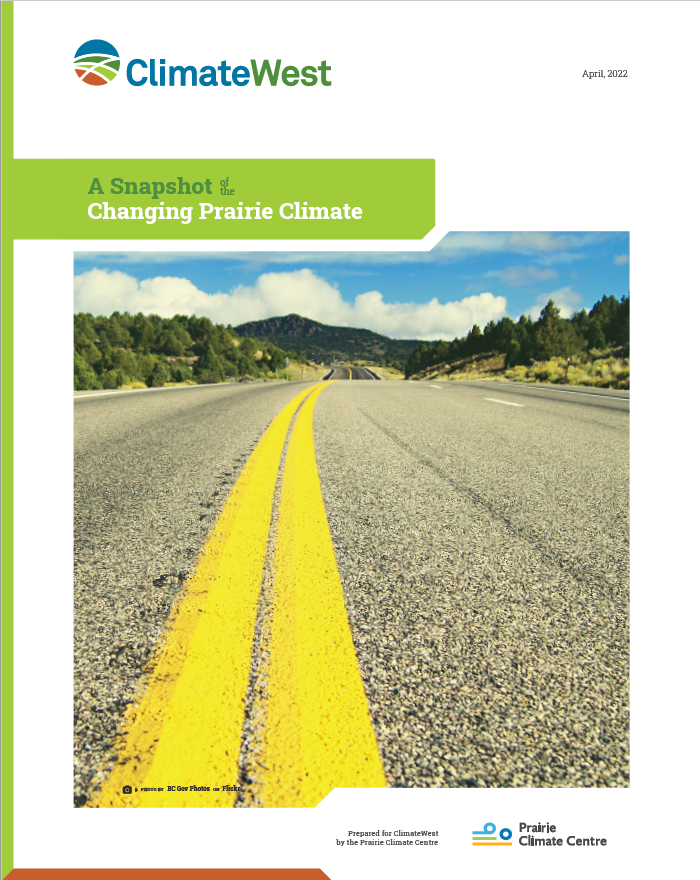
  • A Snapshot of the Changing Prairie ClimatePrepared by the Prairie Climate Centre, A Snapshot of the Changing Prairie Climate provides an accessible summary of past, present, and future climate trends, highlighting three key hazards and their projected impacts on seven sectors in Alberta, Saskatchewan, and Manitoba under a high-emissions scenario. 
  • Farming the Future: Agriculture and climate change on the Canadian Prairies: This report examines both the climate risks facing agriculture in the Canadian Prairies and the sector’s impacts on the climate. It looks at solutions that can increase producers’ resilience, improve economic viability, and contribute to Canada’s climate change mitigation and adaptation goals. 

These examples demonstrate how climate data is increasingly integrated into the advice provided agronomists provide – not as a separate activity, but as a core part of understanding agronomic systems under changing environmental conditions. They also show how effective and strong regional partnerships can be in incorporating climate change into the agricultural sector. These two initiatives have ultimately increased agricultural resilience in both regions through awareness raising, collaboration with farmers and scientists, and implementation of best adaptation farming practices.  

How ClimateData.ca supports agronomists 

ClimateData.ca is a platform developed to provide open access to high-resolution climate information for users across Canada. For agronomists, the site offers tools that support climate-informed agricultural decision-making, including: 

1. Access to key climate variables 

ClimateData.ca offers a range of variables relevant to agronomic practice, including: 

These data are available for both historical trends and future projections. 

2. Location-based data visualization 

Interactive tools allow users to explore changes in climate variables over time and across locations. Agronomists can: 

  • Compare past and projected values at the municipal, regional, or grid cell scale (6 km by 10 km rectangles) scales. 
  • Download location-specific data to support field assessments and consultations. 
  • Use interactive graphs and maps to communicate risks to producers and clients. 
3. Sector-specific support

ClimateData.ca features agriculture-focused resources for agricultural professionals. It includes:

This content was developed with input from sector experts and is aligned with other national and regional climate services. 

Looking ahead 

As climate pressures grow, agronomists are playing an increasingly important role in helping producers adapt and build resilience. Integrating climate data into this work isn’t always straightforward, as many still lack region-specific resources, face uncertainty about how to interpret projections in decision-making, or have limited time and tools to apply the information. Even so, the sector is steadily moving toward more climate-informed practice. 

Initiatives like those led by Agriclimat and ClimateWest show how strong partnerships and locally relevant information can turn climate data into meaningful action on the ground. ClimateData.ca supports this shift by providing practical, high-resolution data along with guidance, learning material, and example analyses that help translate climate science into concrete decisions. 

Ultimately, building climate-ready agronomy is about equipping agronomists to turn complex climate information into useful, actionable guidance for the producers they support. Explore ClimateData.ca and discover more resources designed to help agronomists and others in Canada’s agriculture sector plan for a more resilient future.