Browse pages that connect climate hazards to climate indicators and find climate data resources.
Climate Hazards
Article
10 minutes
These pages facilitate the discovery of future climate information by connecting climate hazards to relevant climate data. They provide a practical starting point to identify hazard-specific indicators and link to relevant datasets and guidance.
Each hazard page includes the following sections:
NOTE: The information in these pages is neither prescriptive nor exhaustive. Content is updated periodically as more information becomes readily accessible. Readers are encouraged to consider complementary information.
Each climate hazard page starts with relevant Key Messages from Canada’s Changing Climate Report 2026. These messages include confidence statements in square brackets. To learn how to interpret them, refer to Section 1.4.3 (How to interpret confidence and likelihood terms) of the report, as well as Figure 1.8, which is reproduced below for convenience.
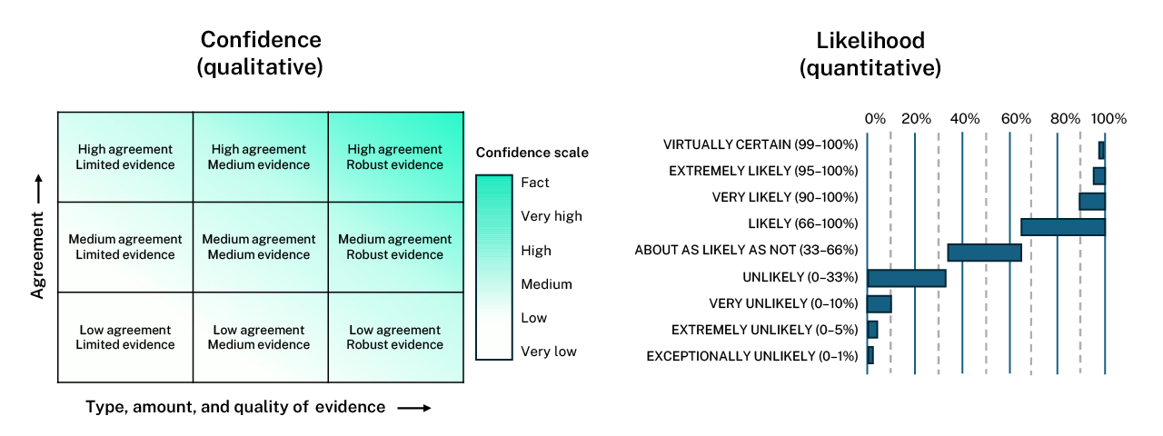
Figure 1.8: The calibrated language for assessing the confidence in and likelihood of the findings in the second edition of Canada’s Changing Climate Report. These terms are the same as those used in the Intergovernmental Panel on Climate Change’s Fifth and Sixth Assessment Reports. Generally, evidence is most robust when there are multiple, consistent independent lines of high-quality evidence. A level of confidence is expressed using five qualifiers: very high, high, medium, low, and very low. When statements in chapter findings appear without confidence terms, this means they are statements of fact. The figure depicts summary statements about evidence and agreement, and their relationship to the confidence scale. The colour gradient implies this relationship is flexible and dependent on expert judgement. The categories of likelihood are also considered to have fuzzy boundaries. For example, a statement that a result is likely means that the probability of its occurrence ranges from over 66% to 100%. This corresponds to a chance of the event occurring of two-thirds or more. (Source: Mastrandrea et al., 2010.) Reproduced from Canada’s Changing Climate Report 2026.
The climate variables and indicators featured on the ClimateData.ca hazard pages were selected through consultation with subject matter experts and drawn from Chapter 10 of Canada’s Changing Climate Report 2026. As these types of resources are often tailored to specific applications, the indicators listed may vary from those in other similar resources. They may not include all climate indicators that can inform a particular climate-related hazard. These resources are intended as a starting point for a deeper exploration of climate data.
To see how other organizations frame and categorize climate hazards, variables, and indicators, consider these external references:
To be featured on the hazard pages, climate data sources must:
Except for the “analytical tools” listed below, the climate data sources must also include:
Beyond the climate data sources featured across the ClimateData.ca hazard pages and indexed below, other resources exist such as those from provincial, territorial, municipal, and local governments, Indigenous groups, conservation authorities, and academia. Importantly, project context, local knowledge, Traditional Knowledge, and site-specific assessments provide valuable context to guide indicator selection and interpretation alongside these resources.
Generally, these sources have been excluded from the pages where finer resolution national or regional data are available. However, in some cases, coarse global information may be the most accessible option.
For many climate indicators in the hazard pages, multiple national climate data resources are provided. These resources may use different base datasets and may vary in how data are calculated, presented and made available for download. It is important to be aware of these differences when interpreting the data. See their respective “About the data”, “Technical Documentation” or “Data source” pages for further details.
These data analysis tools provide more complex data download options, programming environments and specialized software to support bulk downloads, custom data processing, and analysis of large Canada-wide datasets. They generally require more technical expertise to navigate. In many cases these resources are not linked directly on individual hazard pages, as other resources offer similar data through simpler access methods.
To complement the data sources, each hazard page includes contextual guidance, report findings, and educational materials. The criteria for including these resources are outlined below.
The hazard pages incorporate relevant content from the fourth (2019–2024) and fifth (2026–2029) Canada in a Changing Climate assessment report cycles. Where appropriate, older reports from the third cycle (2007–2016) are also cited.
Relevant Learning Zone modules, news articles, and case studies are embedded across the hazard pages to provide background context. Time-bound items (such as single-season forecasts) are excluded to ensure long-term relevance.
This project was undertaken with the support of: