Using Climate Change Risk Assessments to Better Manage Assets
Here are a few ways in which a municipality can incorporate climate change data and the resulting change in risk in asset management work:
- Asset Register: Integrating climate data into an asset register to update asset attributes to better inform condition assessments and guide maintenance needs.
- Risk Management: Anticipating and assessing risks, including climate-related risks, and how to mitigate them
- Lifecycle Costing: Incorporating climate data into lifecycle costing to account for potential impact of future climate change scenarios on maintenance, repairs and replacement needs.
- Sustainable Service Delivery: Taking climate change into account now and into the future to ensure that assets can deliver services in an environmentally sustainable and economically efficient way over the long term.
As the examples above show, there is a tremendous opportunity to improve municipal resilience to climate change through the processes of asset management. At its core, asset management involves balancing costs, opportunities, and risks against desired levels of service. Effective asset management depends on using reliable data to guide decisions. The data needed to support better-informed decisions typically includes asset and lifecycle cost data, service level information, and risk assessments. Climate data complements these datasets, and by integrating them, municipalities can gain a more complete picture of how location-specific climate hazards and risks may impact their infrastructure – and, in turn, their ability to maintain expected levels of service.
A climate risk assessment process also presents an important opportunity for asset managers to incorporate demographic and geographic data, helping to improve awareness and decision-making for equity-deserving groups, who often face disproportionate impacts from climate risks[8].
FCM’s free, complete-at-your-own-pace, online course titled “Building climate resilience with asset management” explains these interconnected relationships. By taking the course, participants will learn how to:
- Describe the concepts of sustainability and resilience in relation to asset management.
- Explain the impact that climate change and extreme weather events have on the various regions and groups of people in Canada.
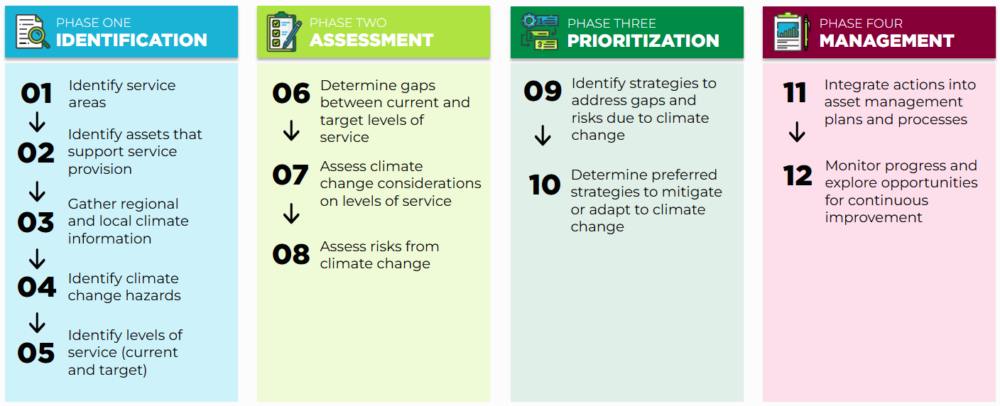
- Apply the “Climate change framework for levels of service and risk” (the Framework) in your local government.
Learners are engaged through lessons, tools, examples, scenarios, and a practical workbook.