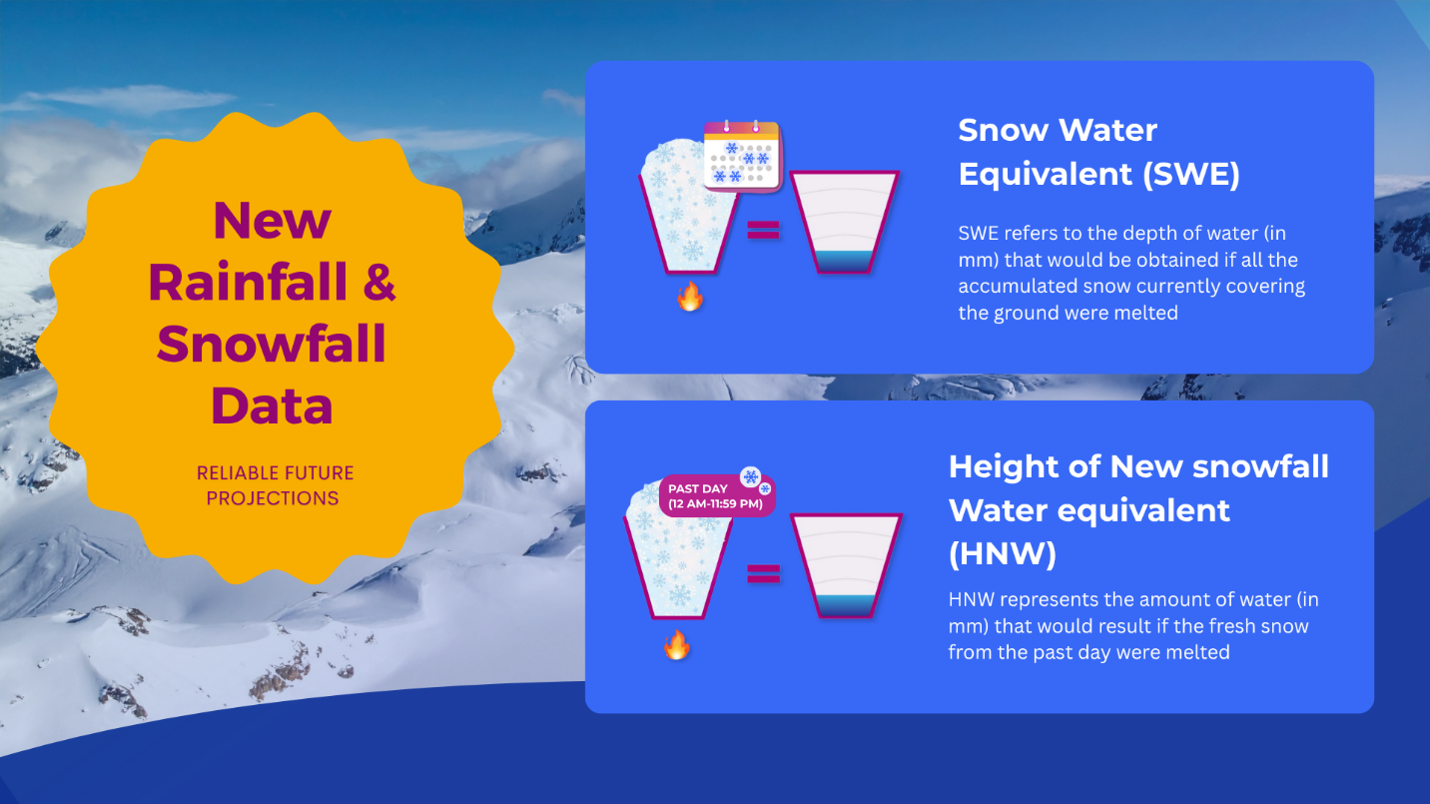
New: Snowfall and Rainfall Projections on ClimateData.ca

Date May 27, 2026
Author ClimateData.ca
Topics New and Noteworthy
Share this post

Introduction

ClimateData.ca has introduced new indices of snowfall and rainfall, providing information on how precipitation patterns may shift in a changing climate. These indices can be used to inform planning in areas such as infrastructure, winter recreation and tourism, and emergency management.

What’s New?

  • Snowfall indices: Derived from CMIP6 global climate models, this data provides high-resolution (~10 km) projections for snowfall across Canada in Height of New snowfall Water equivalent (mm) (see the Snowfall Data Learning Zone article to learn more about this unit of measurement). The data is available under four emissions scenarios (SSPs) and includes ensemble percentiles (10th, 50th, 90th) for the indices listed below.


  • Annual only (with 30-year averages and deltas):


  • Rainfall indices: Rainfall data, calculated as total precipitation minus snowfall, is provided for the same SSPs, time frequencies, 30-year averages and percentiles as outlined for snowfall, for the following indices:


Why are these new indices important?

Reliable future projections of rainfall and snowfall are important for climate change adaptation because they help communities and sectors better understand changing precipitation patterns. By providing these two indices, ClimateData.ca supports informed decision-making in areas that are impacted by precipitation including:

  • The winter recreation and tourism sector, where ski hills, trails, and outdoor events depend on consistent snow cover.
  • Emergency management, where large amounts of snowfall or rainfall in short time periods can cause emergency situations, like road closures, power outages, or flooding.
  • Infrastructure planning, where design standards must account for changing snow loads and season lengths.

Rollout and Availability


For more information on how to use these datasets and incorporate them into adaptation planning, contact the Climate Services Support Desk for assistance.