ClimateData.ca has undergone a major redesign to make it easier than ever to find, understand, and use high-quality climate data. Meet the Updated ClimateData.ca.

Overview of available Western science-based climate data for northern Canada

Learn the basics about Western science-based climate data available for adaptation planning in northern Canada.

Module

Northern Climate Data Resources

Format

Article

Time to completion

30 minutes

This article can be explored in 3 formats:

Full article

(continue reading below)

Infographic

(click to download)

Print friendly infographic

(click to download)

A rapidly changing northern climate

Northern Canada is warming three times as fast as the global average1, and the global Arctic is warming nearly four times as quickly2. Because of this, climate adaptation is urgently needed. Adaptation can help us plan for and address impacts such as more frequent storms, wildfires, and thawing permafrost3. Historical climate data alone is insufficient for informing most adaptation decisions. Instead, Indigenous Science, historical climate data and future climate data should be used together. Western science-based climate data, particularly future climate projections, is a valuable and reliable resource to inform northern decision-making. Future climate projections allow communities to explore different possible climate futures linked to different possible trajectories of global greenhouse gas emissions. This article provides information about why climate data is reliable in northern regions and provides details on the different types of climate data that are available. See Future Climate Data for Northern Decision-Making: Getting Started with Western science-based climate data in northern Canada for some beginner guidance and best practices for the use of climate data in decision-making.

Is climate data reliable for northern Canada?

Sometimes people wonder whether climate datasets (such as future climate projections) are reliable for use in the northern regions of Canada. One common assumption is that future climate projections cannot be used due to the lower number of weather stations in the North, but this is not the case. Future climate projections from climate models are produced using numerical representations of the physical processes that govern our climate and are based on well-established physical laws, like the laws of motion and thermodynamics. This means that climate models, and the future projections they produce, do not depend directly on weather station observations. Even though there are fewer weather stations in northern Canada than in southern Canada, climate model data is reliable and provides insights into what our future northern climate might look like.This article provides more information on the different kinds of climate data available for northern Canada:

  1. How much confidence do we have in different climate variables?
  2. Different types of historical climate data
  3. Different types of future climate projections (including more information on the reliability of future climate data in northern regions)
  4. Summary, key takeaways and dataset summary table

How much confidence do we have in different climate variables?

In any climate analysis, regardless of where you are in Canada, some uncertainty exists. This means that it’s important to be aware of the level of confidence we have in the variables being used. For example, temperature is controlled by well-understood physical processes (laws of physics), is spatially consistent, and varies by latitude and elevation in a predictable way. These factors give us high confidence in projections of temperature.

Precipitation, on the other hand, is controlled by more complex processes. It’s greatly influenced by local conditions and topography, such as nearby water bodies or mountains.  In climate models, precipitation processes are often simplified. This is because the spatial scales at which precipitation forms are too small to be represented directly in global climate models. For these reasons, we have medium confidence in projections of precipitation. These levels of confidence hold true wherever you are in Canada and reflect the current state of the science and computing capacity, both of which are always evolving and improving.

It is important to keep in mind that information with medium or even low confidence can still be useful; the utility of these data depends on the planning and risk decisions that you are making. Understanding confidence levels for projections of specific climate variables, allows you to take uncertainty into account when using the data.

Different types of historical climate data

Let’s begin by exploring historical data for northern Canada. Western science-based historical climate data can come from weather stations directly or can be calculated from weather station data and additional information. Historical data can also be based on modelled simulations of the Earth’s climate system that cover the historical period.

Weather Station data

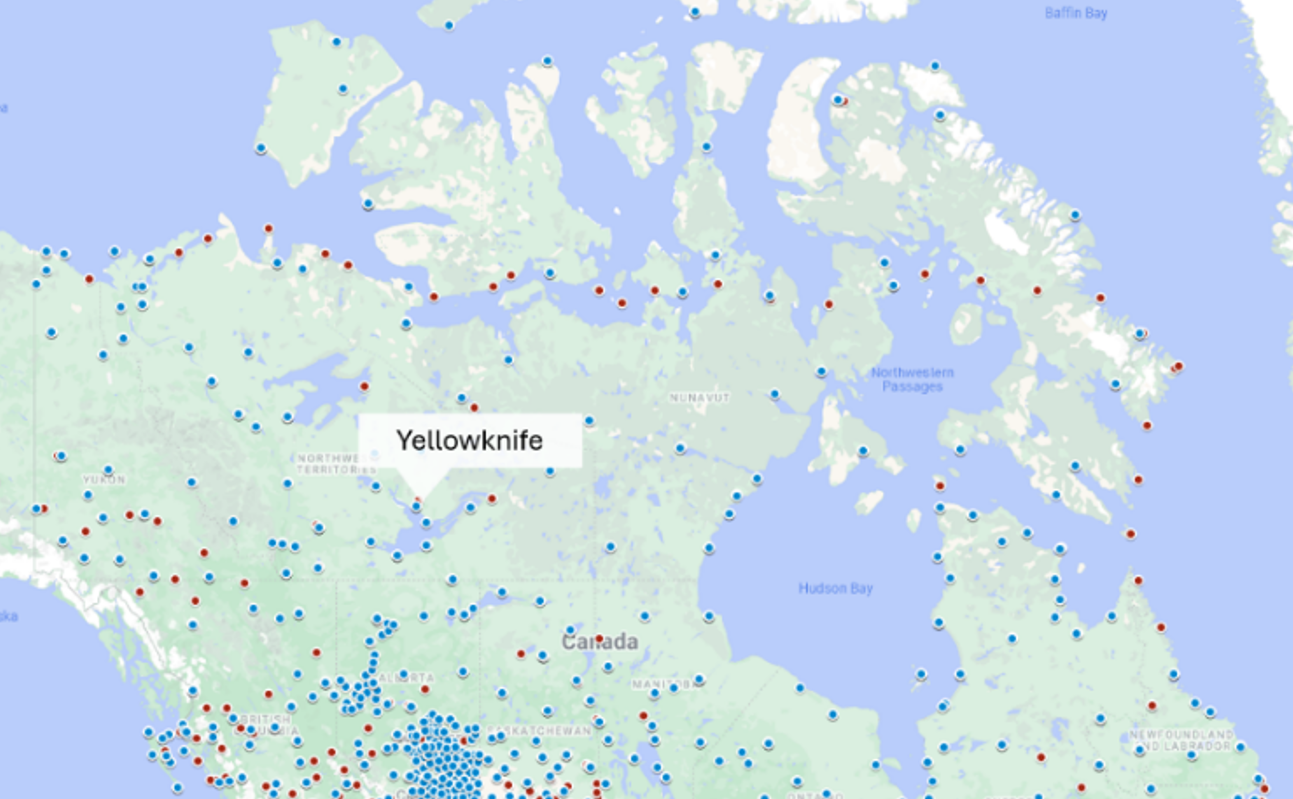
Climate data that comes directly from weather stations is called observational data and is often recorded at airports. For example, the “YELLOWKNIFE A” weather station records data at the Yellowknife Airport. Weather station data is a record of conditions at a specific location (sometimes called ‘point data’ or ‘station data’). While the raw data undergoes some basic quality control, it can be incomplete. Gaps in measurements can occur if a station is down for a few days due to a power outage, storm damage, or is moved. Observational data is a useful piece in the larger decision-making puzzle. Weather station data is available for download from a number of locations including the ClimateData.ca download page, the Government of Canada’s Historical Climate Data page and the Climate Data Extraction Tool.

Figure 1. Map of AHCCD (red) and Surface Weather Observations (blue) stations in Canada.

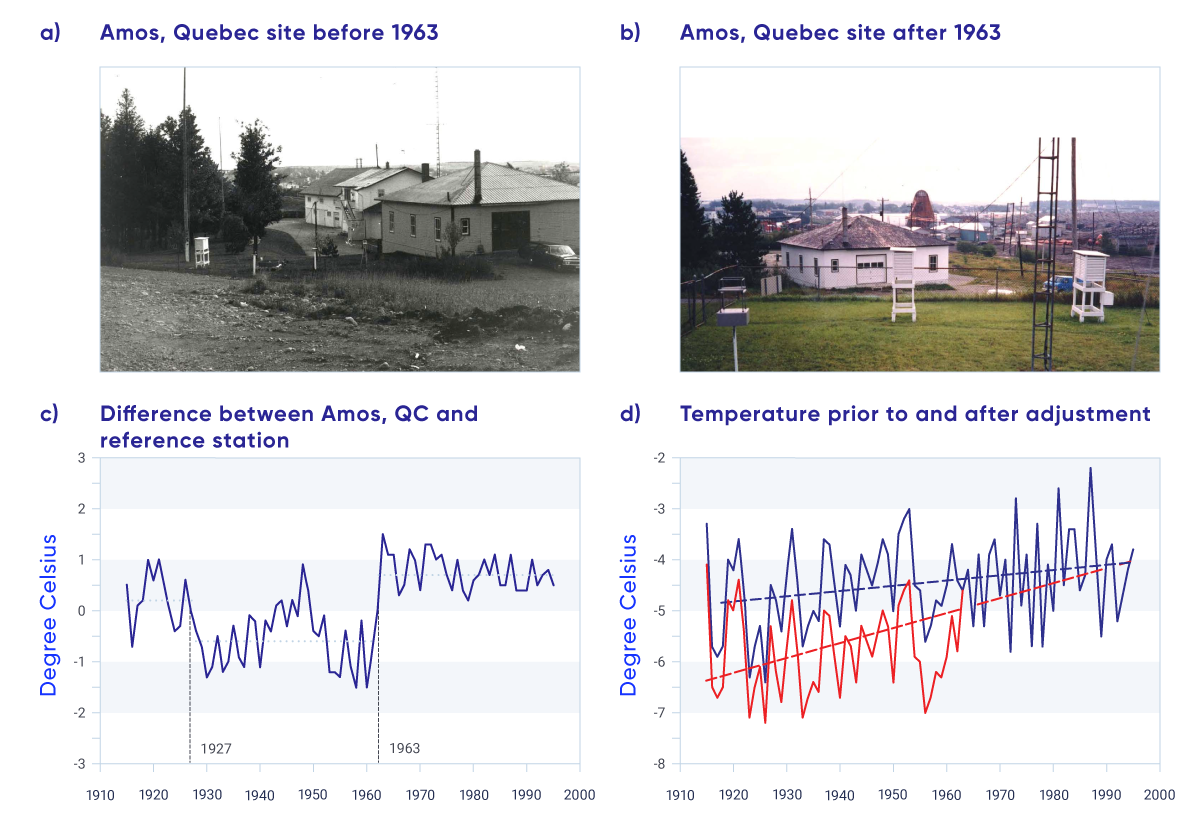
Figure 2. CCCR 2019 Figure-4.2 1: How artifacts in instrument data can affect temperature change estimates

Processed Weather Station Data

Data has been collected at weather stations across Canada, such as those at Whitehorse Airport and Iqaluit Airport, for different periods of time and in different ways. Over a station’s lifetime, many factors can impact the data recorded at a weather station that are not due to changing weather conditions. For example:

  • The tools or instruments used at stations can change;
  • Measurement techniques can result in errors in the observations themselves (for example, a precipitation measurement may be recorded as lower than it actually is if wind blows snowflakes out of the instrument);
  • Broken equipment can cause data gaps; and
  • The environment around a station can change over the years, such as buildings being built close to the station, changing how the wind moves through the area.

Because of these factors, Environment and Climate Change Canada (ECCC) reviews and refines the weather station data to produce a more consistent and representative set of historical observations for some stations. These processed station data make up the Adjusted and Homogenized Canadian Climate Data (AHCCD). This high-quality dataset is especially useful when longer periods of consistent historical climate data are needed, for example, when examining climate trends over time. AHCCD data, including northern stations, are available on the ClimateData.ca download page and the Climate Data Extraction Tool.

What about places that don’t have, or are far from, weather stations?

Many areas of northern Canada don’t have weather stations nearby, but this doesn’t mean that there is no data available. There are various types of gridded historical data available that can be helpful for decision-making.

Gridded Historical data

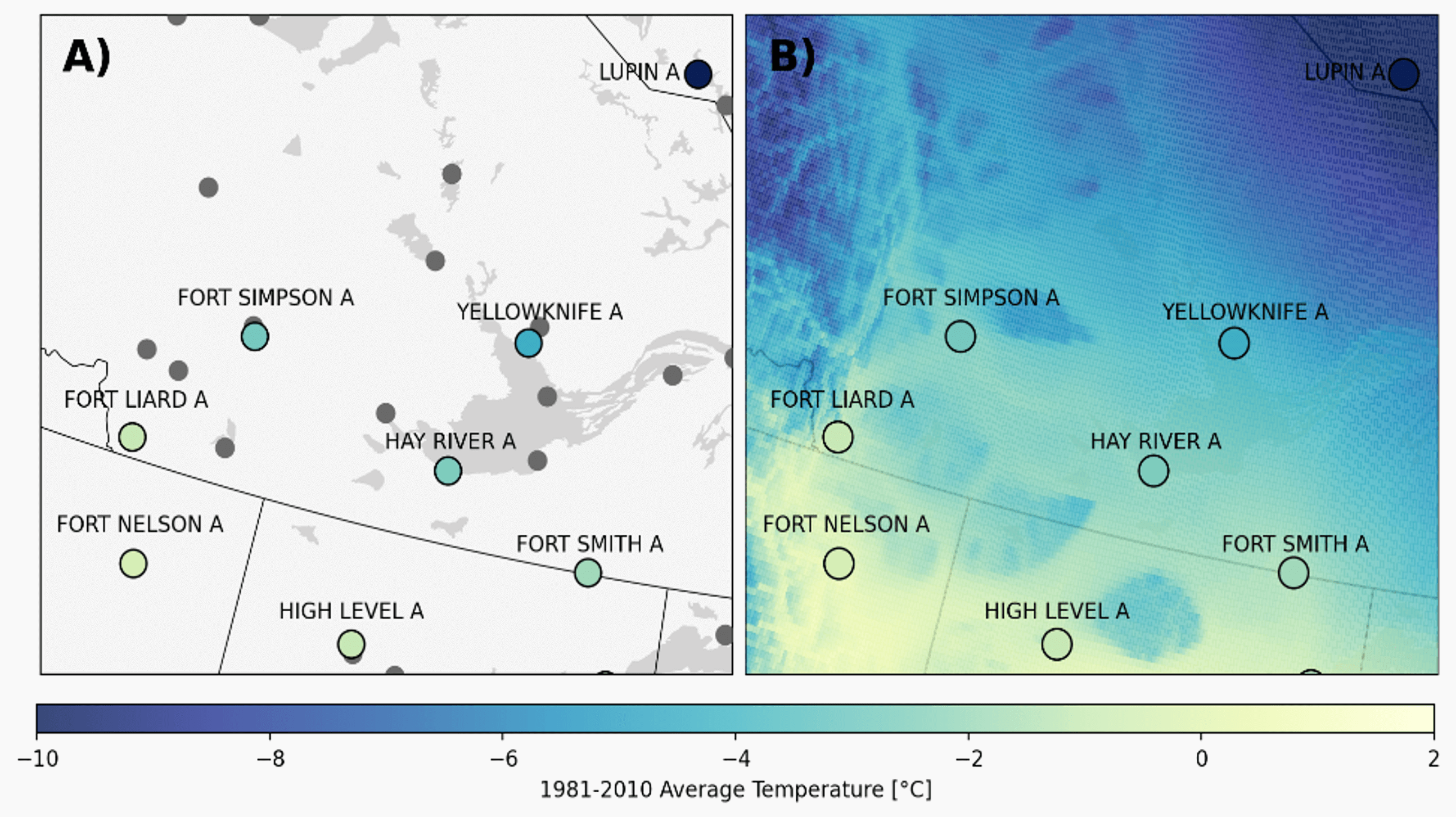
Historical data, based on weather station observations, can be calculated for areas that are far from these stations. Observed weather station data can be “interpolated” (i.e., the data from the closest stations is used to help fill in data gaps for the area between those stations). The interpolation process transforms point data (weather stations noted in Figure 3A) to gridded data that covers all of Canada (shown in Figure 3B).

Interpolation between weather station observations generally works better for some variables than others. As discussed at the start of the article, some variables, like temperature, change in predictable ways. Consequently, interpolation can be done with more confidence. Interpolating precipitation, on the other hand, can mask smaller-scale precipitation patterns that occur between weather stations. Because of this, gridded historical precipitation should be used with caution.

Figure 3. Illustrative example, around Yellowknife, of how weather station data can be interpolated, to transform station data into gridded data. A) AHCCD stations noted in grey circles, with the average temperature from 1981-2010 shown in coloured circles where available. B) The historical gridded data (NRCANmet) based on station data.

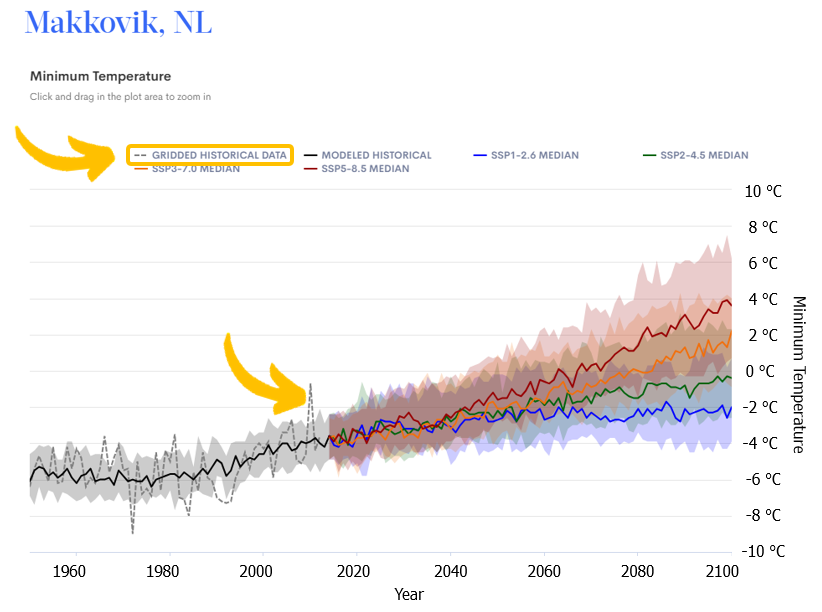
Figure 4. Timeseries chart of minimum temperature in Makkovik, Nunatsiavut (NL) from ClimateData.ca. The light grey dashed line labelled “Gridded historical data” shows the NRCANmet dataset.

One of the most commonly used gridded historical datasets (See Figure 4) is called NRCANmet (formerly known as ANUSPLIN). This dataset was calculated using a relatively complex interpolation technique that considers station elevation and location (latitude and longitude). NRCANmet is available on an approximately 6×10 km grid for all of Canada, including much of the North. NRCANmet data is available on ClimateData.ca by clicking on any grid cell, going to the top of any figure and activating the “Gridded historical data” option.   

Reanalysis data

Other gridded historical datasets have been developed using a variety of methods to best estimate climate conditions where observations are sparse. For example, reanalysis datasets combine observed data (from weather stations, radar, satellites, etc.) with numerical weather models. Unlike the gridded historical data (NRCANmet), reanalysis datasets are not a result of interpolation. Reanalysis data incorporates observations into weather models to estimate weather conditions without any gaps in space or time. This means that they are guided by observations where available, but data gaps have been filled in using physical equations that describe atmospheric processes. This makes reanalysis datasets particularly useful in areas where observational data is more sparse. Reanalysis datasets are available at relatively fine spatial resolutions (usually in the range of 10 by 10 km, or 25 by 25 km).

Because reanalysis datasets have been developed using a combination of observations and weather models, they contain more climate variables, like wind and solar radiation, that are not typically available for interpolated datasets. Reanalyses are particularly helpful when more than one climate variable is needed, or when climate variables that are not widely available in observed datasets, such as snow, wind, or humidity, are required. Two reanalysis datasets, developed specifically for Canada, are the Regional Deterministic Reforecast System (RDRS) and the Canadian Surface Reanalysis (CaSR), which are available at 10 km by 10 km spatial resolution over all of Canada. Another popular reanalysis is called ERA5-Land. This dataset was used in the development of the Humidex projections available on ClimateData.ca. Copernicus’ Interactive Climate Atlas5 is also a great tool for visualizing the ERA5-Land data.

Gridded climate data represents the average climate over the area of the grid cell, meaning that it may not capture the specific conditions observed at a weather station. This means that it may not be appropriate to compare gridded data and point observations directly. If the comparison is necessary, be aware that they are not expected to be the same, since gridded data represents average conditions over the area of the grid cell and point observations represent the conditions at a particular point within that grid cell.

For more information on how to pick a historical climate dataset, check out Which Historical Data Set Should I Use? on ClimateData.ca.

Climate Model Data

Climate models are mathematical representations of the real climate system and use well established physical principles to simulate the Earth’s climate.

Modelled historical data

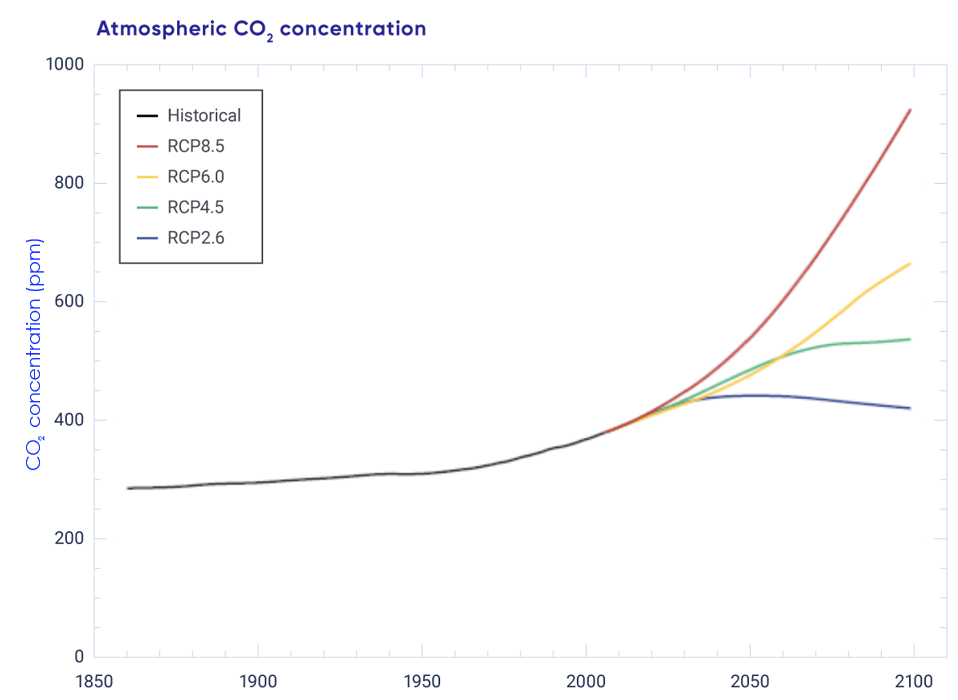
Climate models don’t just project future climate, they can also simulate the past climate. Most global climate models have simulations that start in the preindustrial period, typically around 1850, continue until “present”, and then extend into the future. The historical simulations use information about past atmospheric composition, like greenhouse gas concentrations (see Figure 5 to see how carbon dioxide is considered), to simulate past temperature and precipitation. Past observations can provide useful context for assessing how climate models are projecting change in response to changing greenhouse gas emissions, but direct comparisons of historical observations to future projections is not possible without taking steps to account for differences in spatial scale and the fact that the day-to-day weather in a climate model is not identical to actual observed weather.

Figure 5. CCCR 2019 Figure-3.7 1: Carbon dioxide concentrations under the four Representative Concentration Pathways for CMIP5 models.

Different types of future climate projections

Is future climate data reliable for northern Canada?


As mentioned at the start of this article, people sometimes wonder whether future climate datasets (or projections) are reliable in the North. In some instances, it is incorrectly assumed that climate data is not sufficiently robust to be used reliably in northern Canada. While historical climate observations for northern regions have limitations that differ from those of other regions due to the lack of observations, climate projection data can and should be used when planning for the future. An important distinction to make is that climate projections from climate models are produced by representing physical processes of our climate with numerical equations, so they don’t depend directly on weather station observations. This means that, despite there being fewer stations in northern Canada than in southern Canada, we should still use climate model data in the North to understand how our climate may change in the future. Future climate projections are an important tool to support climate-smart decision-making in northern Canada. Some best practices and tips for working with northern climate data are explored in the other articles in this series.

What kinds of future climate data exist?


Future climate data for all of Canada, including northern regions, is available from climate models. Climate modelling is used to project potential future climate conditions and relies on information about changing atmospheric composition, which is obtained from greenhouse gas emissions scenarios, or pathways. Generally, climate projections describe a range of possible climates for low, moderate, and high greenhouse gas emissions scenarios.  

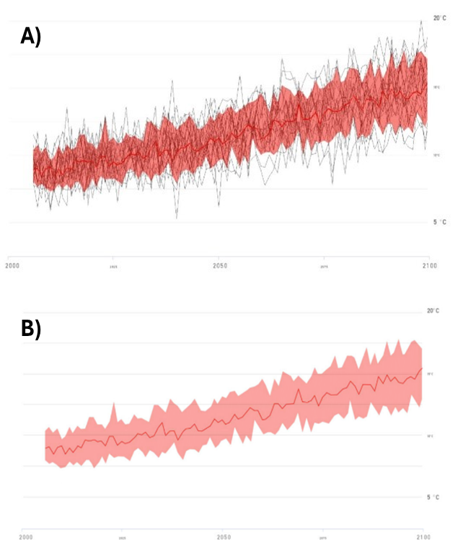
Dozens of different modelling centres around the world have developed their own climate models that each have somewhat different ways of representing the Earth’s climate. While all climate models use well-established physical principles to simulate the climate, the use of different approaches produces slightly different results. Each result is valid, so it is recommended to use not just a single model but rather a number of different models together. When multiple models are brought together, they’re called multi-model ensembles (Figure 6). 

Each time a model is “run” it provides one version of the future climate. Each version of the climate that a model simulates also includes natural variability. Natural variability refers to the natural reasons that the climate in a region may vary, such as volcanic eruptions and natural cycles like El Niño. Using multi-model ensembles helps to understand the range of possible future climate conditions that could occur under a particular greenhouse gas emissions pathway.  Furthermore, considering an ensemble of model results helps us define the uncertainty associated with the model projections. The output of multi-model ensembles is often provided in a summarized way (Figure 6B). The mid-point or median (50th percentile) of these multi-model ensembles is typically provided and is often accompanied by the 10th and 90th percentiles, for further explanation of percentiles see the article on multi-model ensembles. The 10th and 90th percentiles  provide a reasonable estimate of the range of possible future climates under any one emissions scenario.  

Figure 6. Temperature projections for a high emissions scenario (RCP8.5). The black lines in (A) show each individual model, with the red shaded area indicating the 10th – 90th percentile values and the red line showing the median (50th percentile) in (A) and (B).

There are also some uncertainties related to how well particular climate variables can be simulated. As discussed above, we have high confidence in temperature projections, and medium confidence in the projections of precipitation and related variables. High confidence means that we are confident in both the direction and magnitude of the expected change, and that the processes that affect a variable are well represented in the models. While we may have high confidence in future projections of a variable, interannual variation and extreme events may still create unprecedented new conditions. Medium confidence means that we are confident in the direction of the projected change (e.g., more or less rain or snow), but we are less certain about the exact amount of change (e.g., 12% to 35% increase in the future compared to the past).      

There are two main kinds of climate models: global climate models and regional climate models. Both are based on physical equations describing climate processes, but they operate at different spatial scales. These models simulate a large number of different climate variables (e.g., humidity, incoming solar radiation, wind speed, evaporation) and are not limited to temperature and precipitation variables. 

Global Climate Models

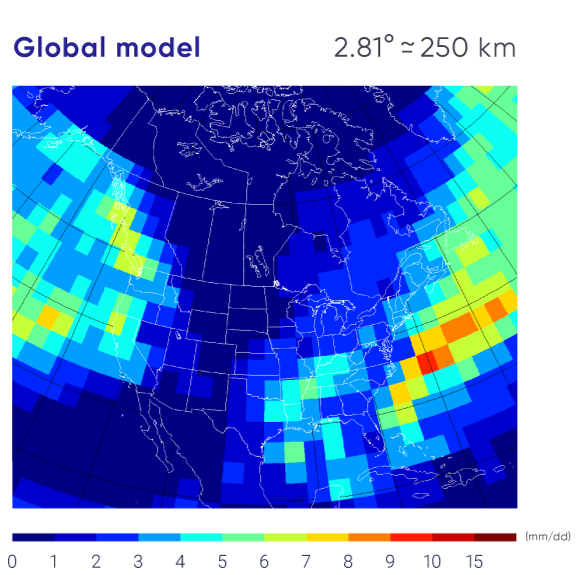
Global climate models (GCMs) generate climate information over the entire globe at a ~100 by 100 km to 250 by 250 km grid resolution. GCMs are used in large model comparisons (e.g., Coupled Model Intercomparison Projects, CMIP5 and CMIP6), where hundreds of model simulations are performed using many different models to create an ensemble. The large number of simulations included in the ensemble increases our confidence in potential changes and gives us a better understanding of the uncertainty.

GCMs are especially useful for global or regional analyses, and for investigating future trends in climate. The Intergovernmental Panel on Climate Change’s Working Group I Interactive Atlas4,5 and Copernicus’ Interactive Climate Atlas6 are powerful portals for interacting with and visualizing CMIP5 and CMIP6 global climate data. 

Figure 7. CCCR 2019 Figure-3.101: Monthly precipitation simulated by a global model based on simulations described by Scinocca et al. (2016).

Regional Climate Models

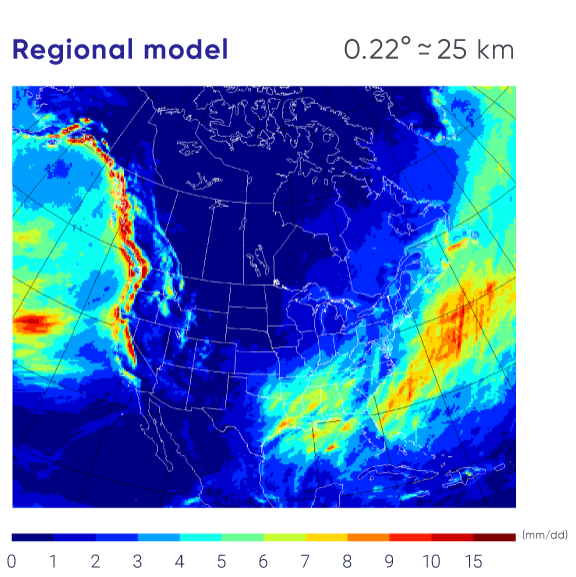
Regional climate models (RCMs), such as CanRCM and the Weather Research and Forecasting Model (WRF), generate climate information over smaller regions, typically at resolutions of 50 by 50 km or smaller. Since they operate at a finer spatial scale than GCMs, RCMs generally represent the landscape (underlying topography) of a region more accurately. Improved spatial resolution also means that some RCMs can model certain climate processes, and therefore climate variables, more effectively. For example, RCMs generally have improved local precipitation projections compared to GCMs. Copernicus’ Interactive Climate Atlas6 is a great portal for interacting with and visualizing regional climate data.

Figure 8. CCCR 2019 Figure-3.101: Monthly precipitation simulated by a regional model based on simulations described by Scinocca et al. (2016).

More information about future climate data

For more information on climate models and modelling uncertainties, see this article on Uncertainty in Climate Projections. For more information on scenarios, see this article on Understanding Shared Socio-economic Pathways (SSPs)

Downscaled Climate Model Data 

In some cases, particularly with RCMs, running multiple climate models with multiple emissions scenarios requires a lot of computational power and time. High resolution simulations include detailed atmospheric processes and are therefore very computationally expensive, making it difficult to do multiple simulations that are long enough for climate analyses.  

Although the climate model projections from both GCMs and RCMs can be used at their original spatial scales, they can be made more locally relevant by transforming them to a finer spatial grid. This transformation process is called “downscaling”. Downscaling can be done using gridded historical datasets, such as NRCANmet, ERA5-Land, and PCIC-blend. These datasets, called “target datasets”, can be used to increase the spatial resolution of the GCM or RCM data to finer local scales and can reduce the difference (or bias) between the model and observations. For more detailed information on how downscaling works, check out Chapter 3.5 Regional Downscaling from Canada’s Changing Climate Report1

The future climate projections on ClimateData.ca have been downscaled from GCMs using gridded historical datasets and are therefore available at the same spatial resolution as these datasets, at about 6 x 10 km. Downscaling can introduce some uncertainties, but it allows climate data to be made available at a scale that is much more useful for local decision-making.   

Summary, key takeaways and dataset summary table

Summary and key takeaways

  • A variety of Western science-based climate data types are available to support climate-smart decision-making in northern Canada, including observation-based datasets as well as historical and future climate model data.
  • Each data type has unique strengths and limitations, which need to align with the intended use of the data.  Even data with some uncertainty can be helpful in adaptation planning and for better understanding of changes in the northern climate.
  • Future climate simulations for northern regions are available from global or regional climate models. As is the case anywhere on the globe, it is best to use multiple model simulations (a multi-model ensemble) and a range of future emissions scenarios to increase confidence in future projections.

The table below summarizes the suitability of the datasets discussed in this article for particular use cases. For a comprehensive overview of the climate data available for northern Canada, check out the Northern Climate Data Report and Inventory (NCDRI)7. For more information on strategies for using climate data, see Future Climate Data for Northern Decision-Making: Getting Started with Western science-based climate data in northern Canada. For detailed information on northern climate datasets, constraints, and specific uses, see the Northern Climate Data Report and Inventory (NCDRI) or Future Climate Data for Northern Decision-Making: Best practices for choosing and using Western science-based climate data in northern areas.

Dataset summary table (developed in July 2025) 

Data typeWhen to useKey uncertainties/limitationsUseful datasets and data portals
Weather station data
  • Understanding past conditions recorded by meteorological instruments
  • Understanding past vulnerabilities
  • Data only available where there are weather stations
  • Incomplete records (missing data)
Processed station dataUnderstanding trends in past conditions at specific locations
  • Only available for some weather stations (e.g., with a sufficient length of record)
  • Limited time periods
Gridded historical dataUnderstanding past conditions away from station data or over a wider area (e.g., watershed, region or territory)
  • Regionally dependent on the quality and quantity of station data available for interpolation
  • More uncertainty for more complex variables (like precipitation)
  • PCIC-blend
    • View and download from ClimateData.ca by selecting CMIP6 and enabling “Gridded historical data” on the figures
    • PCIC
  • NRCANMet (formerly ANUSPLIN)
    • View and download from ClimateData.ca by selecting CMIP5 and enabling “Gridded historical data” on the figures
    • PCIC
ReanalysisUnderstanding past conditions of more complex variables (e.g., snowfall, wind, solar radiation)
  • Model biases
  • Generally coarser spatial resolution than gridded historical data
Historical model simulationsComparing future projections with past conditions
  • Model biases
  • Does not have same weather events as observations (should have the same overall climate though)
Future model simulationsUnderstanding potential future conditions
  • Model biases
  • Use multiple models (multi-model ensemble) to improve confidence in projections

If you’re starting a project, have questions about using climate data or want to confirm if you’re using the right data, you can get expert help (for free) from the Climate Services Support Desk, which can be contacted via ClimateData.ca or the Canadian Centre for Climate Services

This article has been prepared by the ECCC’s Canadian Centre for Climate Services in collaboration with regional climate service providers (Ouranos, the Pacific Climate Impacts Consortium and CLIMAtlantic), northern organisations (the Governments of the Northwest Territories, Nunavut and the Yukon as well as Yukon University and Queen’s University) and ECCC’s Climate Research Division. 


References 

  1. Zhang, X., Flato, G., Kirchmeier-Young, M., Vincent, L., Wan, H., Wang, X., Rong, R., Fyfe, J., Li, G., Kharin, V.V. (2019): Changes in Temperature and Precipitation Across Canada; Chapter 4 in Bush, E. and Lemmen, D.S. (Eds.) Canada’s Changing Climate Report. Government of Canada, Ottawa, Ontario, pp 112-193
  2. Rantanen, M., Karpechko, A.Y., Lipponen, A. et al., 2022, The Arctic has warmed nearly four times faster than the globe since 1979. Commun Earth Environ 3, 168. https://doi.org/10.1038/s43247-022-00498-3
  3. Walsh, J. E., Ballinger, T. J., Euskirchen, E. S., Hanna, E., Mård, J., Overland, J. E., Tangen, H., and Vihma, T., 2020. Extreme weather and climate events in northern areas: A review. Earth-Science Reviews, 209, 103324. DOI: 10.1016/j.earscirev.2020.103324
  4. Iturbide, M., Fernández, J., Gutiérrez, J.M., Bedia, J., Cimadevilla, E., Díez-Sierra, J., Manzanas, R., Casanueva, A., Baño-Medina, J., Milovac, J., Herrera, S., Cofiño, A.S., San Martín, D., García-Díez, M., Hauser, M., Huard, D., Yelekci, Ö., 2021, Repository supporting the implementation of FAIR principles in the IPCC-WG1 Atlas. Zenodo, DOI: 10.5281/zenodo.3691645. Available from: https://github.com/IPCC-WG1/Atlas
  5. Gutiérrez, J.M., R.G. Jones, G.T. Narisma, L.M. Alves, M. Amjad, I.V. Gorodetskaya, M. Grose, N.A.B. Klutse, S. Krakovska, J. Li, D. Martínez-Castro, L.O. Mearns, S.H. Mernild, T. Ngo-Duc, B. van den Hurk, and J.-H. Yoon, 2021: Atlas. In Climate Change 2021: The Physical Science Basis. Contribution of Working Group I to the Sixth Assessment Report of the Intergovernmental Panel on Climate Change [Masson-Delmotte, V., P. Zhai, A. Pirani, S.L. Connors, C. Péan, S. Berger, N. Caud, Y. Chen, L.Goldfarb, M.I. Gomis, M. Huang, K. Leitzell, E. Lonnoy, J.B.R. Matthews, T.K.Maycock, T. Waterfield, O. Yelekçi, R. Yu, and B. Zhou (eds.)]. Cambridge University Press. In Press. Interactive Atlas available from Available from http://interactive-atlas.ipcc.ch/
  6. Copernicus, 2024, Copernicus Interactive Climate Atlas: User Guide, Accessed on April 22, 2024: https://confluence.ecmwf.int/x/aZZ-Fw
  7. Diaconescu, E.P., P. Kushner, J. Lukovich, A. Crawford, E. Barrow, L. Mudryk, M. Braun, R. Shrestha, S. Gruber, S. Déry, S. Howell, and L. Matthews, 2023: An inventory of historical climate data and climate projections for the Canadian North; Government of Canada, Gatineau, QC, 698p