Designing Future-Ready Buildings

Welcome to the Buildings sector information page. Learn how climate change impacts this sector, explore how climate information can be used in decision-making through case study examples, quickly access relevant climate data, and discover other resources to support adaptation planning.

Buildings protect occupants from outdoor environments and weather, ensuring their safety and comfort. However, as climate change accelerates, buildings face growing challenges from rising temperatures, shifting precipitation patterns, and increasingly frequent extreme weather events. Because most buildings constructed today will remain in use for 50 years or more, they will inevitably encounter these climate-related challenges. Despite this, many current design practices still rely solely on historical climate records that describe the past rather than the future. This results in a growing disconnect between the conditions anticipated in design and the realities that buildings will ultimately be exposed to. A building may fully meet today’s standards, but as climate conditions shift, it could become less resilient and more vulnerable to climate risks.


Climate Change and Buildings


Already, the climate we experience today is unlike that of just a few decades ago, and the future climate will be even more unfamiliar. Extreme heat, flooding, and wildfires are no longer distant threats; they are actively reshaping the built environment in Canada. For example, rising temperatures have placed unprecedented demands on Heating, Ventilation, and Air Conditioning (HVAC) systems, resulting in costly retrofits and repairs. Insufficient cooling capacity in older buildings, which were not originally designed for cooling, has left occupants vulnerable to overheating. Meanwhile, wildfires and extreme weather events have compromised both indoor air quality and the structural safety of buildings. As warming continues, so too does the risk of reduced performance, costly retrofits, and climate-related damages.

To ensure buildings remain safe, functional and resilient throughout their lifespans, building designers must consider a range of future scenarios. Incorporating future climate data early in the design process allows buildings to better withstand gradual shifts in average conditions as well as the increasing frequency of extreme events. The National Building Code of Canada (NBC) acknowledges this necessity, stating that “many buildings will need to be designed, maintained, and operated to adequately withstand ever-changing climatic loads.” Reflecting this need, the 2025 NBC incorporates future climatic design values for the first time. These values account for projected changes in heat, cold, wind, snow, and rainfall, rather than relying solely on historical observations. Their inclusion marks a significant step toward supporting the resilient building design.

Relevant Climate Datasets

High quality climate projection datasets are now accessible to all Canadians on ClimateData.ca, offering practitioners the means to design for resilience beyond current code minimums. For buildings, several key resources are available: 

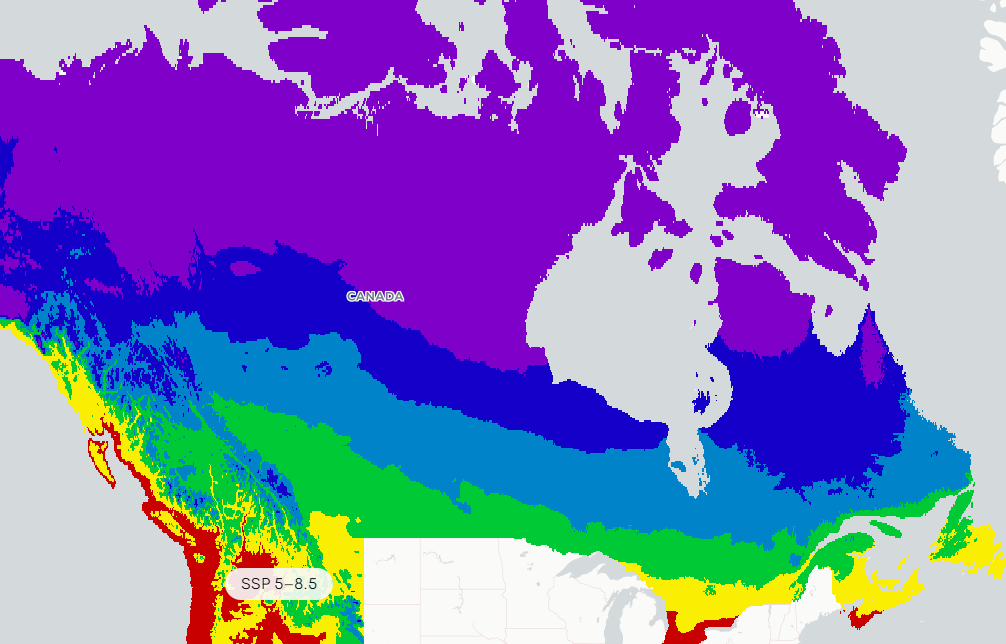
  • Future Building Climate Zones – Maps of projected National Energy Code for Buildings (NECB) climate zones, showing how each climate zone classification is expected to shift over time and as a result potentially affecting cooling and heating design conditions. 
  • Future Building Design Value Summaries – Location-specific one-page reference documents available for over 660 locations across Canada. The format mirrors that of Table C-2 of the National Building Code (NBC), making it immediately recognizable and easy to use. 

While the above resources are focused on buildings, ClimateData.ca also hosts other sector-relevant tools and datasets that may be of interest to building professionals, such as projected Short-duration IDF Data for future rainfall extremes and the Fire Weather Projection app that provides future information of hot and dry “fire weather” conditions.

A ClimateData.ca survey found that over 80% of building professionals believe climate change should inform their designs and are prepared to act before code updates are formalized. By taking action now, building professionals can stay ahead of the curve by utilizing future climate datasets and tools based on the best available climate science to not only design climate-resilient buildings, but also improve energy efficiency, reduce long-term costs, and, above all, safeguard occupant safety and comfort.


Case Studies: Integrating Future Climate Data into Building Design


By striking a balance between mitigating climate change – through improved energy efficiency – and adapting to climate hazards, building professionals can ensure both the durability of structures and the long-term well-being of their occupants. It is therefore important that building designers put in place strategies to adapt to climate change. To facilitate this process, ClimateData.ca also presents several case studies which show practices on how climate data can be used to contribute to adaptation efforts.

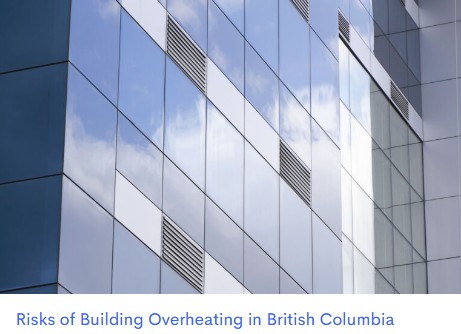
In Risks of Building Overheating in British Columbia, BC Housing, the largest provider of non-profit housing in the province, identified overheating as a main climate risk. To comply with the province’s Step Code and to prepare buildings for warmer conditions, BC Housing used future-shifted weather files for building energy modeling. Simulating building performance under warmer conditions ensures that both existing and new housing stock can maintain comfort and safety under projected climate conditions.

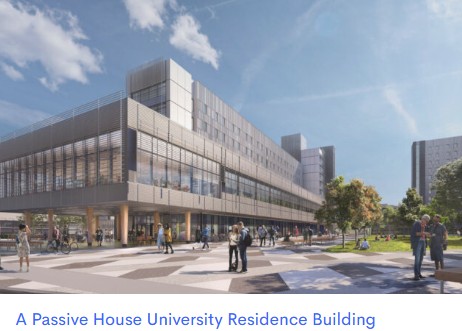
Another example from BC details how future climate conditions were considered during the design of two new student residences at the University of Victoria (UVic). Engineering consultants initially used historical climate data for Abbotsford, BC, as an analogue for Victoria’s future climate, as Abbotsford experiences warmer summers. However, future-shifted weather files revealed that Victoria’s 2050s summer temperatures would be significantly warmer than current conditions in Abbotsford. This early realization allowed designers to resize HVAC systems to meet future demands.

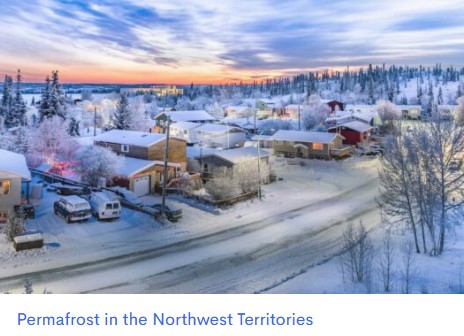
Rising temperatures in northern Canada are also accelerating permafrost thaw, posing risks to infrastructure. A case study in the Northwest Territories assessed these risks, highlighting that while increasing temperature is the primary driver of permafrost thaw, increasing precipitation and precipitation extremes could also accelerate degradation. This assessment underscores the importance of considering multiple climate variables in northern design.

Box 1. Federal Regulatory Landscape And Design Standards

The design of buildings that take climate change into account is a national priority:

  • The National Building Code of Canada (NBC) has been traditionally based on historical climate data, but for the first time ever, the 2025 NBC incorporated future climate data in response to growing climate risks. The climatic design data presented in Appendix C, Table C-2 of NBC provides recommended design data for 680 locations across Canada that account for climate change.
  • In support of the Framework and its goals, the National Research Council launched a major program in 2016, titled the Climate-Resilient Buildings and Core Public Infrastructure (CRBCPI) Initiative, which worked to integrate climate change into design guidelines, codes, and standards. The assessment of the impact of climate change on climatic design data in Canada report is Canada’s most detailed foray yet into providing building-specific climate change metrics. The climatic design data produced as part of this report has been adopted for use in the 2025 National Building Code.
  • Canada’s National Adaptation Strategy has set infrastructure specific objectives and targets, including that “Public and private infrastructure decision-making is informed by system-wide assessments of, and planning for, current and emerging climate change risks.”
  • The 2016 Pan-Canadian Framework on Clean Growth and Climate Change highlights that “climate-related infrastructure failures can threaten health and safety, interrupt essential services, disrupt economic activity, and incur high costs for recovery and replacement,” and that “integrat[ing] climate resilience into building design guides and codes” is vital for ensuring the standardized consideration of future climate hazards in building design and retrofit.
  • The Federal Sustainable Development Strategies (FSDS) guides actions on sustainable development, including the integration of climate change considerations into design, construction, and maintenance of buildings and public infrastructure.

The Pan-Canadian Framework and CRBCPI Initiative mentioned above have yielded a range of new building design guidelines, including:

For a complete listing of the above-mentioned standards, guides, and reports, please see Annex A of the Standards in Action: Building a Climate-Resilient Future report by the Standards Council of Canada.

Professional Practice Bodies

Professional organizations are also working hard to establish capacity in the building sector, and to integrate appropriate guidance and policies into building design best practices and standards of care. Some examples of recent steps forward include:

Climate change is also being incorporated into the duty of care definitions that define professional conduct, building project risk, and issues surrounding liability.

Blog Posts

New 2025 National Building Code uses future climate data for first time

February 20, 2026

Pouriya Jafarpur and Ryan Smith, Canadian Centre for Climate Services

Harnessing Climate Data for Resilient Asset Management

June 11, 2025

Geneviève Thouin, Federation of Canadian Municipalities and Rachel Malena-Chan, Casey Clunas, and Ryan Smith, CCCS

Climate Data in Action: Future Weather Files

January 23, 2023

Pouriya Jafarpur and Ryan Smith, Canadian Centre for Climate Services

Climate Data in Action: Costing Climate Change Impacts

December 15, 2022

Ryan Smith, Canadian Centre for Climate Services

Sector Resources

Learning Zone

Explore the wide range of information available to better understand and use climate data.

Download

Download available climate data, choose download options to refine your data choice, or use your own settings to obtain location-specific climate indices.

Future Building Design Value Summaries

The Future Building Design Value Summaries are location-based summaries of the building design values developed by Environment and Climate Change Canada as part of the Climate-Resilient Buildings and Core Public Infrastructure (CRBCPI) project.

IDF Curves and Climate Change

Learn how to use, read and interpret IDF curves, as well as how to account for extreme precipitation in a changing climate.

Seasonal to Decadal (S2D) Forecasts

Looking for climate information for the more immediate future? Seasonal forecasts are now available on ClimateData.ca and can help inform short-term decision-making.

Related Variables

Explore variables which are relevant to this sector.

Building Climate Zones

Building climate zones are based on HDDs and used to indicate energy requirements for space heating to maintain comfortable conditions.

View the variable

Future Building Design Value Summaries

The Future Building Design Value Summaries are location-based summaries of the building design values developed by  Environment and Climate Change Canada as part of the Climate-Resilient Buildings and Core Public Infrastructure (CRBCPI) project.

View the variable

Cooling Degree Days

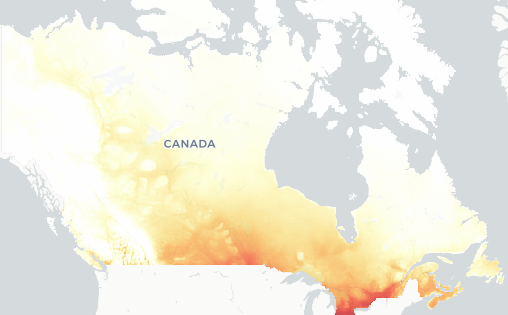
Cooling degree days are used to estimate the amount of energy required for air conditioning during the warm season and are used in utility planning and construction decisions.

View the variable

Heating Degree Days

HDDs are used to indicate energy requirements for space heating to maintain comfortable conditions inside buildings.

View the variable

Hottest Day

High temperatures exacerbate the urban heat island effect in cities leading to even higher temperatures in urban locations. Without cooling, conditions indoors may become unsuitable for building inhabitants, and outdoor construction may need to be limited.

View the variable

Related Content

Design Value Explorer (DVE)
The Design Value Explorer tool provides historical and future-projected design values for 19 climatic design variables used within the National Building Code of Canada (NBC) and the Canadian Highway Bridge Design Code (CHBDC).
Climate-Resilient Buildings and Core Public Infrastructure (CRBCPI)
Environment and Climate Change Canada’s Climate Resilient Buildings and Core Public Infrastructure (CRBCPI) report provides an assessment of how climatic design data relevant to users of the National Building Code of Canada (NBC) and the Canadian Highway Bridge Design Code (CHBDC) might change as the climate continues to warm. Explore this report to discover sector-relevant climate projections, including an assessment of climate model limitations and an evaluation of uncertainty.
Future Weather Files for Building Performance Simulation

Future Weather files for locations across Canada are available for building performance simulation. Two types of ‘future weather files’ are now available through the Pacific Climate Impacts Consortium (PCIC) and the National Research Council of Canada (NRC). PCIC and NRC’s future weather files differ in terms of technical approaches, and this is outlined in the ClimateData.ca Learning Zone article. Files from the two methods offer somewhat different data availability and may be suited for different building performance simulation purposes.