Explore new decadal forecasts on the map, and learn more about how to interpret and use them in our latest Learning Zone and News articles.

Decadal forecasts: Now available on ClimateData.ca

Date November 5, 2026
Author Canadian Centre for Climate Services
Topics New and Noteworthy
Share this post

Decadal forecasts: Now available on ClimateData.ca

What could Canada’s climate look like in the next five to ten years? New decadal forecasts on ClimateData.ca offer insight into climate conditions over this time frame, helping bridge the gap between seasonal forecasts and longer-term climate projections.

What do decadal forecasts tell us?


Decadal forecasts on ClimateData.ca are probabilistic forecasts that show whether the mean temperature and total precipitation over the next five to ten years are expected to be above, near, or below normal, or “unusually high” or “unusually low” compared to normal. Here, “normal” refers to typical climate conditions over the 30-year reference period, 1991–2020. Since these forecasts are probabilistic, they provide the likelihood of occurrence of different outcomes. These forecasts are divided into two five-year time periods. Each period has its own forecast describing average climate conditions over those five years. For example, the forecasts released in 2026 describe average conditions for 2026–2030 and separately for 2031–2035.

New forecasts are issued annually, moving both time periods forward by one year. As such, the 2027 forecasts will cover 2027–2031 and 2032–2036, and so on.

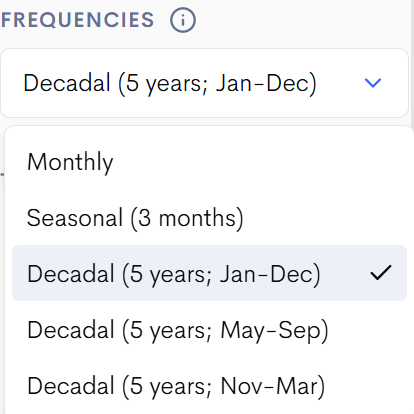
Decadal forecasts are available for three frequencies:

  • Warmer months: May to September
  • Cooler months: November to March
  • All months: January to December

Importantly, decadal forecasts do not predict day-to-day weather or tell us what conditions will be like during a particular month or season. Instead, they provide information about average conditions over these five-year periods.

A forecast of warmer-than-normal conditions for 2026–2030, for example, refers to the average across that period; it does not necessarily mean that every year or month in that period will be warmer than normal.

Like all forecasts, decadal forecasts involve uncertainty: they show the likelihood of different outcomes, rather than a guarantee of what will happen. Find out more about uncertainty by reading the Learning Zone Article here: What Causes Uncertainty in Seasonal Forecasts?
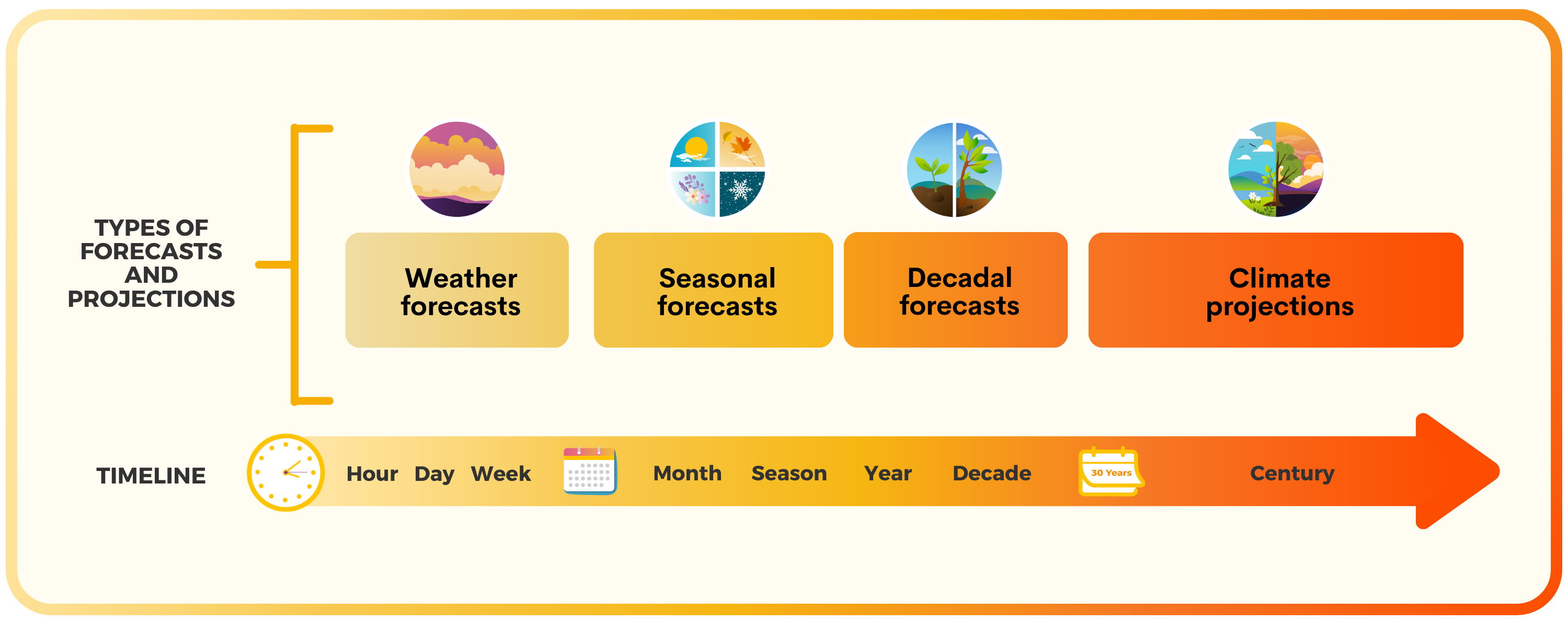
How can decadal forecasts support planning over the next five to ten years? Many planning decisions require climate information for the next five to ten years. For example, a ski resort owner could use decadal forecasts of mean temperature for the cooler months (November to March) to help assess whether or not to invest in snowmaking equipment. The ski resort owner could decide whether to invest within the next 10 years (using decadal forecasts), or further in the future (using climate projections).Ski resort owners can also check out ClimateData.ca’s new snowfall projections to support business decisions. Learn more here:  Climate Data in Action: How do we expect climate change to impact the ski industry in Ontario?

How decadal forecasts can be used with longer term climate projections

Decadal forecasts begin with observations of the current climate, including ocean conditions that can influence climate for several years. This starting point helps models predict natural climate variability, the fluctuations that occur alongside the longer-term trends caused by human activities. As forecasts look further ahead, the influence of these initial conditions weakens, making natural variability harder to predict. Decadal forecast models have very little skill when forecasting periods beyond 10 years, so decadal forecasts are only available for periods in the upcoming decade.

Do the decadal forecasts include climate change?

Yes. Decadal forecasts include the effects of human-caused climate change alongside natural climate variability. Unlike climate projections, decadal forecasts are not provided for multiple emissions scenarios because differences between scenarios are small over the next 10 years. The decadal forecasts on ClimateData.ca use the SSP2-4.5 emissions scenario.

Climate projections, on the other hand, focus on longer-term changes in climate under different emissions scenarios, rather than predicting the timing of natural fluctuations (e.g., the timing of El Niño).

For projects expected to last several decades, decadal forecasts and climate projections can be used together to provide complementary information. Decadal forecasts help assess conditions over the next five to ten years, while climate projections describe how conditions may change over the entire life of the project (e.g., over the next 50 to 70 years). Therefore, someone planning a building with a 50-year lifespan could consider decadal forecasts when assessing near-term operating needs and climate projections for elements that need to endure the building’s lifespan.

Learn more by reading the Learning Zone article “What are decadal forecasts?”.

Explore decadal forecasts on ClimateData.ca

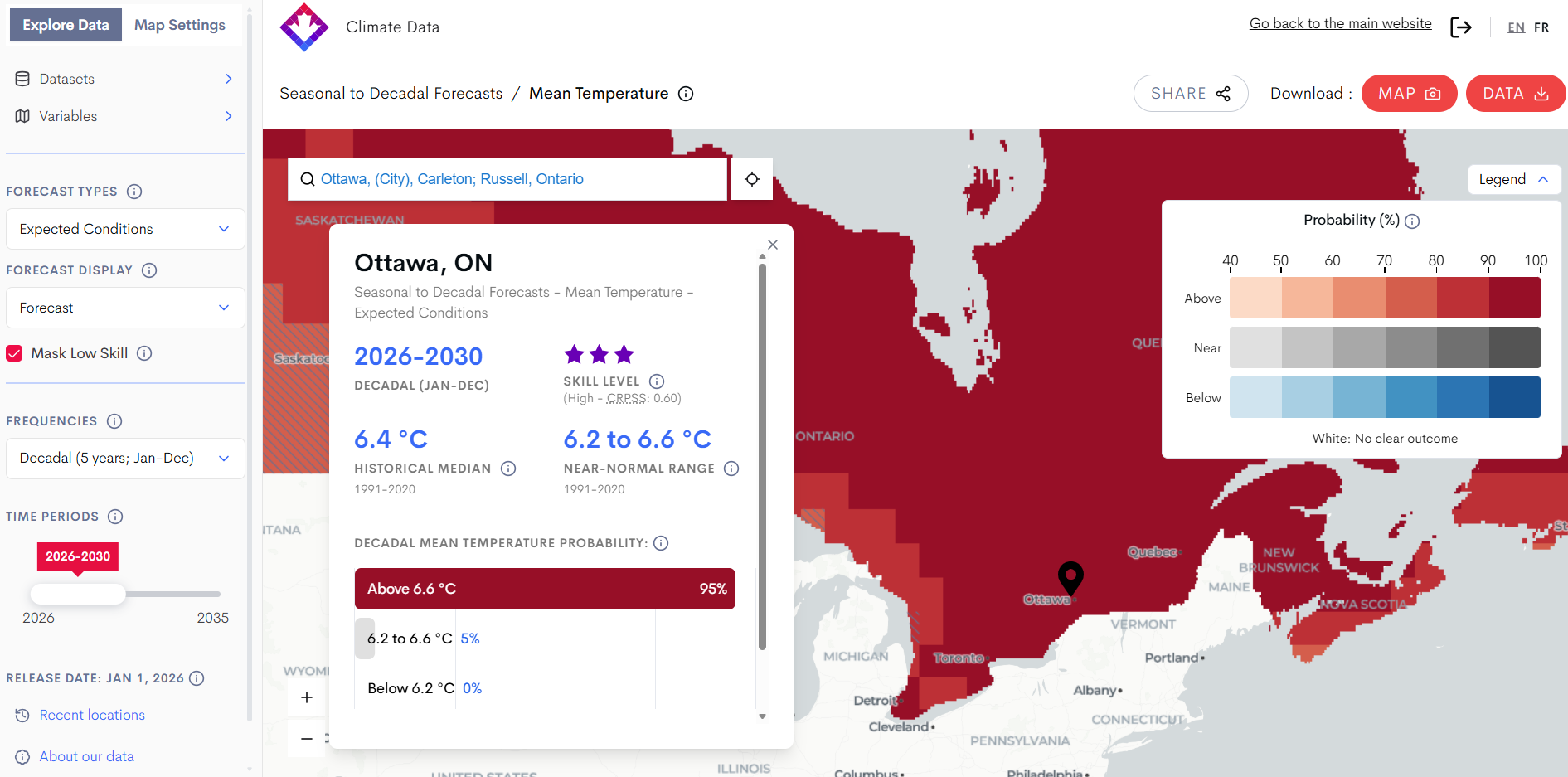
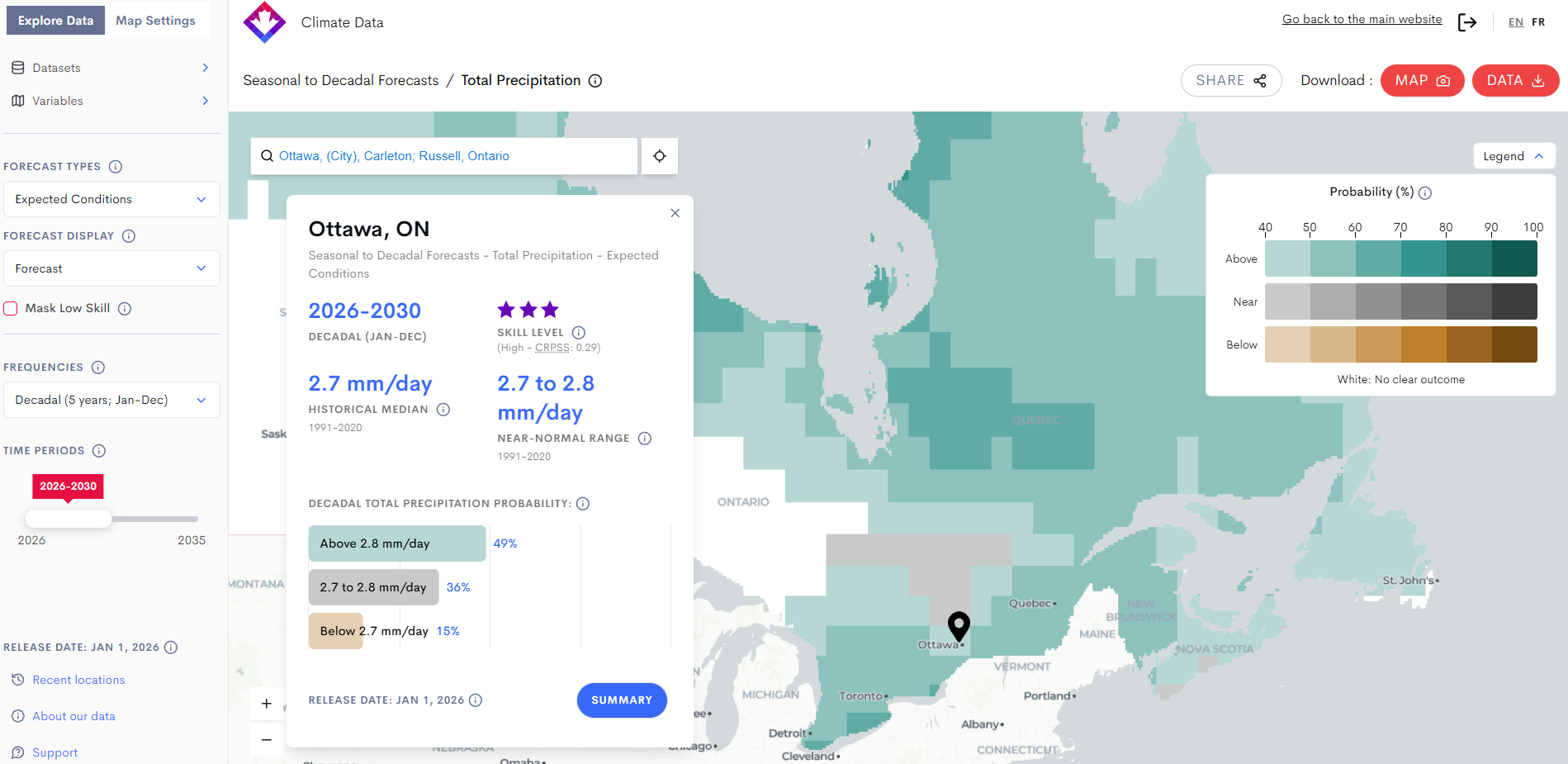
Decadal forecasts are now accessible alongside seasonal and monthly forecasts on ClimateData.ca’s interactive map. Decadal forecasts can be accessed from the Frequencies menu (Decadal (5 years; Jan-Dec; May-Sept; or Nov-March).  Zooming in and clicking on the map or searching for a location using the search tool will bring up a popup that displays the forecast details, including the probabilities of different outcomes, information about the historical climatology, and a forecast model skill rating.

The screenshots below show decadal forecast maps on ClimateData.ca for Ottawa for the whole year (January – December) for (a) mean temperature over 2026–2030 and (b) total precipitation over 2031–2035.

a)

b)

Ready to look ahead? Explore the new decadal forecasts on ClimateData.ca today: