Climate Data in Action: Projecting the Future of Heavy Snowfall Events in Northern Canada

Date October 28, 2026
Author Carly Madge, Canadian Centre for Climate Services
Topics Climate Data in Action
Share this post

Note

The information regarding extreme weather events and the community of Kangiqtugaapik (Clyde River), Nunavut comes from a team of scientists and community partners from the Arctic Rain on Snow Study at the National Snow and Ice Data Centre. Further information on their work and their investigation into the extreme events in 2021 and 2022 in Kangiqtugaapik can be found in the study Extreme Arctic Weather and Community Impacts in Nunavut: A Case Study of One Winter’s Storms and Lessons for Local Climate Change Preparedness. This article was written by the Canadian Centre for Climate Services (CCCS), a partner of ClimateData.ca, and is shared with the permission of the National Snow and Ice Data Center. The CCCS sincerely thanks them for their collaboration.

Introduction

Snow is an important part of Canadian culture and identity. While it brings many benefits to communities, from recreational to traditional activities, it also presents challenges, from blizzards and icy roads to dealing with damage to infrastructure. Conversely, a lack of snow poses its own problems, such as reduced water supplies and heightened wildfire risks.[1]

As climate change alters snowfall patterns, understanding these changes has become important for long-term planning and adaptation. ClimateData.ca offers snowfall projections for the country under a range of future scenarios. This article highlights the Maximum 1-day Snowfall variable from these projections through a case study from Kangiqtugaapik, Nunavut, illustrating how climate data can shed light on potential future extreme winter events.

Extreme Weather Events and Northern Communities

Heavy snowfall events are a hazard in many parts of Canada, affecting the economy, shutting down transportation networks, and leading to power grid failures. They also pose substantial risks to public safety, as heavy snow loads can lead to structural failures, increase the likelihood of accidents on roads, and create mobility challenges.

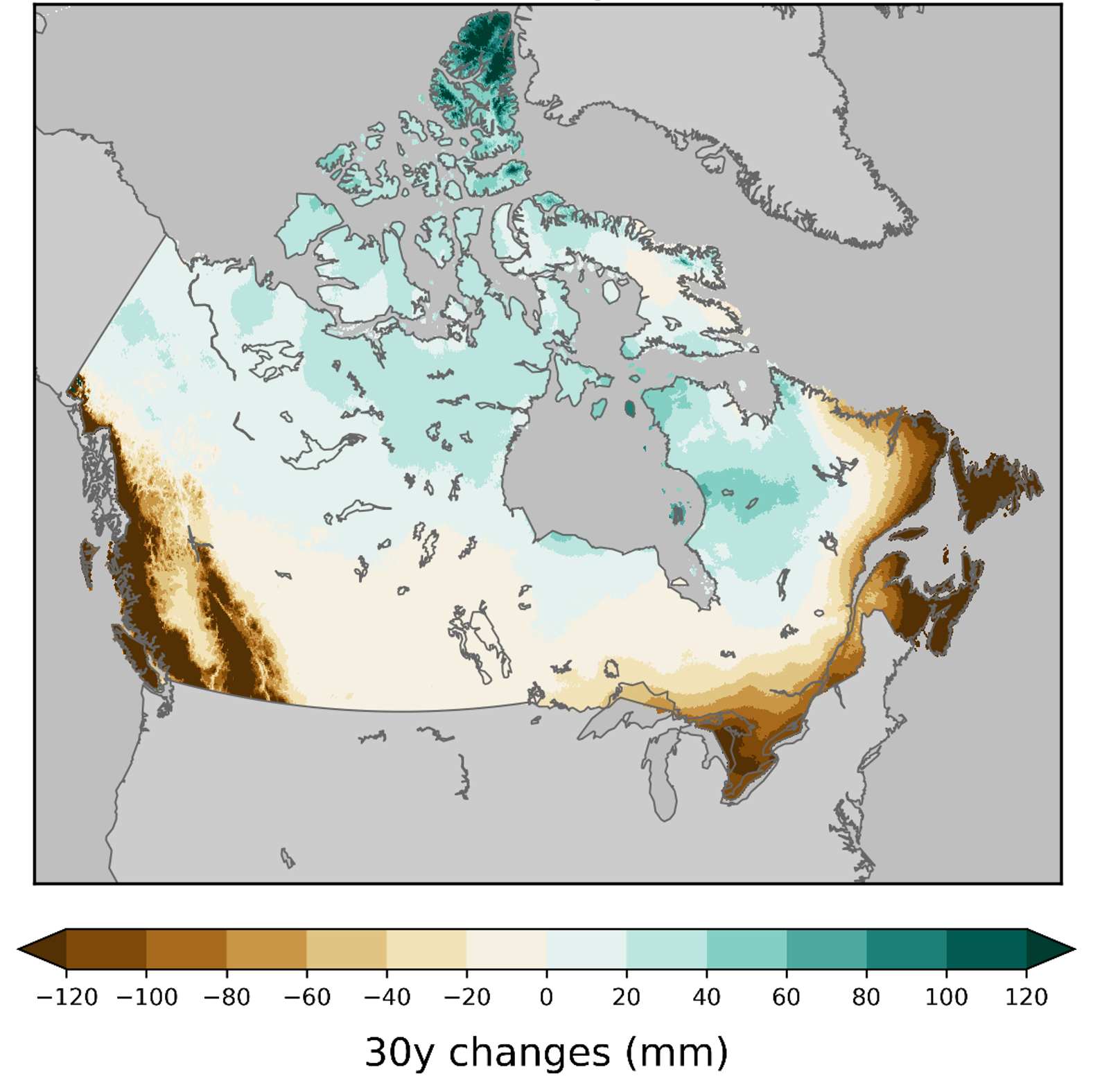
Global warming is altering snowfall patterns across Canada. As temperatures rise, more precipitation is likely to fall as rain instead of snow in significant parts of the country. However, climate models project an increase in snowfall for northern Canada (see Figure 1). This is because warmer air can hold more moisture.[2] Although the region is warming at roughly three times the global average[3], winter temperatures will generally remain low enough for precipitation to fall as snow.  With warmer but still cold winters and moister air, northern Canada could face more snowfall and a higher risk of heavy snow events.

Figure 1: Change in annual snowfall from 1971-2000 to 2071-2100 under the SSP5-8.5 emissions scenario with higher future temperatures, showing projected increases in the north

Increasing Blizzard Conditions

In the community of Kangiqtugaapik, Nunavut, extreme winter weather is a common occurrence. The community is situated on the eastern coast of Baffin Island and often experiences high winds and heavy precipitation. However, due to the remoteness of this community, storms can put the community’s health and safety at risk. From November 2021 to April 2022, the community experienced thirty-three days of blizzard conditions, more than any winter since at least 1978-1979.[4]  These extreme conditions, as well as the lack of functioning snow removal equipment, resulted in the community being cut off from vital services including water and food delivery, leading to the declaration of a state of emergency.

How Future Climate Data Can Help

Using climate data to show trends in future extremes and extreme events can be challenging. One indicator of heavy snowfall events is maximum 1-day snowfall, which depicts the largest amount of snow that falls within a single 24-hour day for a selected temporal frequency and is available with the snowfall projections on ClimateData.ca.

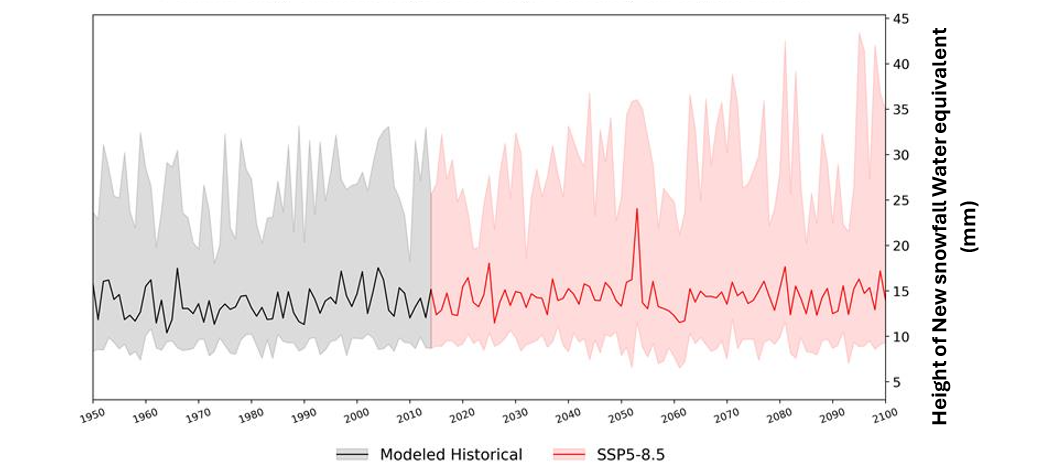
Figure 2 shows projected changes in maximum 1-day snowfall for Kangiqtugaapik under a high-emissions scenario through 2100. The red line shows the median projection, or the middle value across all models. The shaded area represents the spread of results: the lower edge (10th percentile) marks the level at which 90% of model results will exceed this value, while the upper edge (90th percentile) marks the level at which only 10% of model results will be higher.

The median maximum 1-day snowfall in Kangiqtugaapik is not expected to increase significantly (Figure 2), even under the highest emissions scenario. However, the upper limit (90th percentile) shows that by the end of the century, there is a possibility of an increase in single-day snowfall events. This scenario is less likely than the median outcome, but it highlights the potential for continuing heavy snowfall events in the future.
Maximum 1-day Snowfall Kangiqtugaapik (HNW in mm)

Figure 2: Maximum 1-day snowfall in Height of New snowfall Water equivalents (mm) for Kangiqtugaapik under a high emissions scenario (SSP5-8.5)

During the winter of 2021-2022, the community came together to navigate and overcome the harsh blizzard conditions, helping one another dig out of the snow. However, concerns remained about why that winter brought such extreme blizzards and how the community could be better prepared for future storms, which are likely to persist and possibly intensify. These concerns initiated a collaborative investigation involving physical and social scientists and community members.

Community members noted that high winds exacerbated the impact of the extreme snowfall of 2021-2022. Blizzards are characterized by reduced visibility and high winds, rather than just snowfall. Therefore, blizzard conditions can be triggered by actively falling snow or wind-blown snow[2]. The influence of climate change on extreme winds in Canada is difficult to determine, due to the complexity of atmospheric processes governing wind speed, many of which are not included in climate models. Most historical analyses of extreme wind speeds in Canada show weak or inconsistent trends, and there remains considerable uncertainty about how wind patterns may change in a warming climate[5] (for more information, see the article Climate Change and Strong Winds). Despite this uncertainty, it is prudent for communities to be prepared to minimize potential impacts. In this context, understanding how heavy snowfall events may change in the future is important for helping communities adapt and reduce risk.

How Communities are Adapting to Changing Snowfall Regimes

Climate projections provide valuable information about how extreme weather events may change, but they don’t tell the whole story. To gain a more complete understanding, it’s essential to hear from those who have experienced these events firsthand. In the study Lessons from an Arctic community’s winter of extreme events, researchers analyzed news reports, social media posts, and joined community discussions to better understand why the winter blizzards were so severe and identify key areas for improving preparedness and adaptation. Community insights highlighted the importance of enhancing snow removal capabilities, providing training for equipment operators, and collaborating with local experts and residents to develop more effective weather services and information.[2]

Extreme weather events, especially heavy snowfall events and blizzards, are increasingly of concern in northern communities like Kangiqtugaapik, Nunavut. With climate change altering snowfall patterns, these areas will likely face more intense events in the future. While climate data projections can inform preparedness, working with communities is important for understanding their experiences and developing effective adaptation strategies. The study conducted in Kangiqtugaapik underscores the importance of integrating physical science, Indigenous Knowledge Systems and local knowledge in climate change adaptation efforts.

References

[1] Jain, P., Barber, Q.E., Taylor, S.W. et al. Drivers and Impacts of the Record-Breaking 2023 Wildfire Season in Canada. Nat Commun 15, 6764 (2024). https://doi.org/10.1038/s41467-024-51154-7

[2]Primer on Climate Change and Extreme Precipitation

[3] Environment and Climate Change Canada (2024) Canadian
Environmental Sustainability Indicators: Temperature change in Canada. Consulted on Month day, year.
Available at: https://www.canada.ca/en/environment-climate-change/services/environmental-indicators/temperature-change.html

[4] Lessons from an Arctic community’s winter of extreme events

[5] Climate Change and Strong Winds — ClimateData.ca